Posted on 02/09/2024 2:29:29 PM PST by MtnClimber
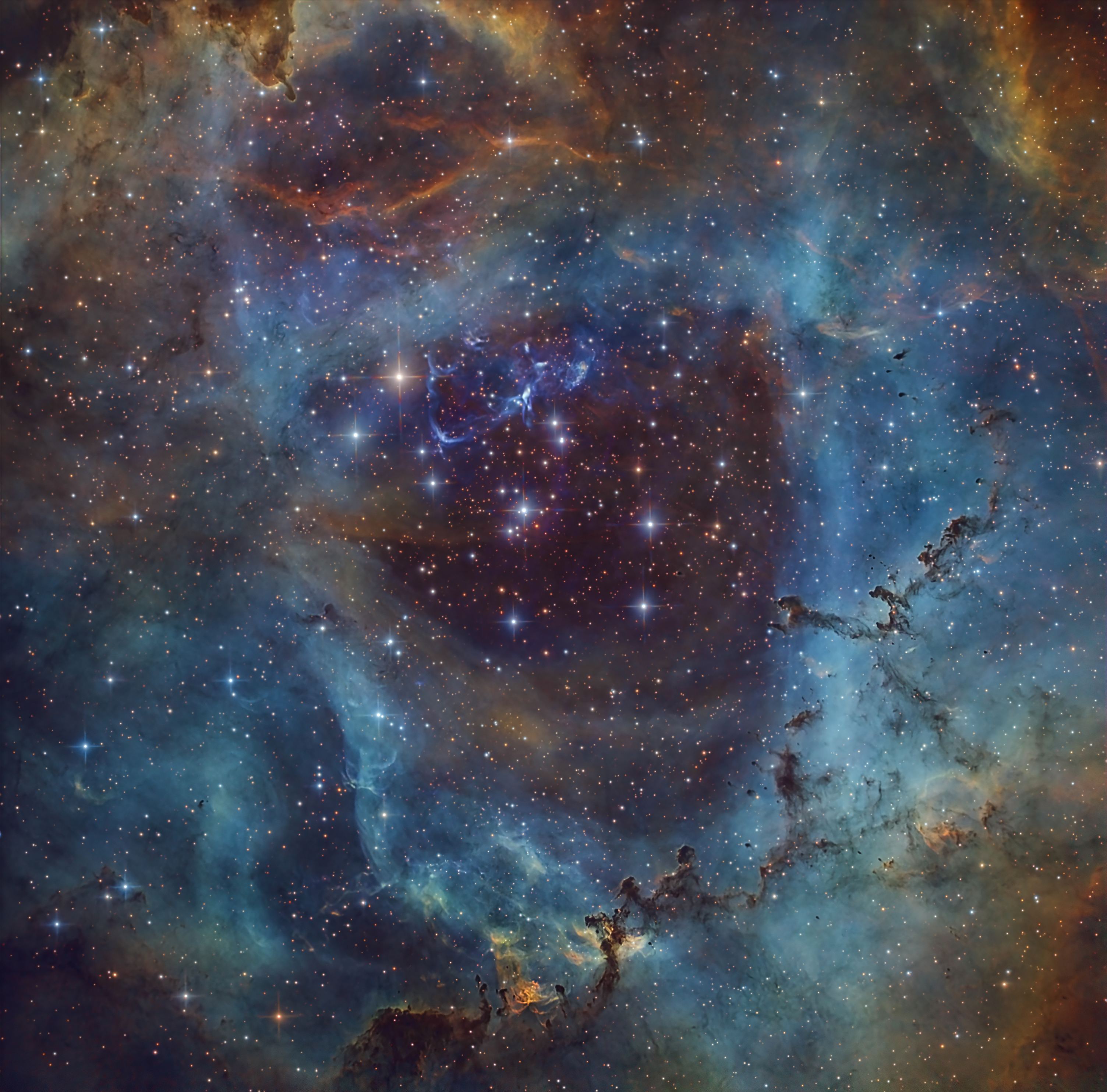
Explanation: Not all roses are red of course, but they can still be very pretty. Likewise, the beautiful Rosette Nebula and other star forming regions are often shown in astronomical images with a predominately red hue, in part because the dominant emission in the nebula is from hydrogen atoms. Hydrogen's strongest optical emission line, known as H-alpha, is in the red region of the spectrum. But the beauty of an emission nebula need not be appreciated in red light alone. Other atoms in the nebula are also excited by energetic starlight and produce narrow emission lines as well. In this close-up view of the Rosette Nebula, narrowband images are mapped into broadband colors to show emission from Sulfur atoms in red, Hydrogen in green, and Oxygen in blue. In fact, the scheme of mapping these narrow atomic emission lines (SHO) into the broader colors (RGB) is adopted in many Hubble images of emission nebulae. This image spans about 50 light-years across the center of the Rosette Nebula. The nebula lies some 3,000 light-years away in the constellation Monoceros.
For more detail go to the link and click on the image for a high definition image. You can then move the magnifying glass cursor then click to zoom in and click again to zoom out. When zoomed in you can scan by moving the side bars on the bottom and right side of the image.
Wow.
good pic...
btt!
Very pretty. I’ve seen it in my telescope, but it was really dim. The stars were bright enough that I could confirm what I was seeing.
Back in the day when the skies were darker…
I wonder if the nebula our solar system came from is still around after 4.6 billion + years. How many stars came from it?
Before any good telescopes (invented 1608) and this guy is thinking this.
Search: French astronomer and mathematician Pierre-Simon Laplace first suggested in 1796 that the Sun and the planets formed in a rotating nebula which cooled and collapsed.
Big telescopes of the time but not very good mirrors or lenses.
https://en.wikipedia.org/wiki/List_of_largest_optical_telescopes_in_the_18th_century
William Herschel and the Giant 40-foot Telescope
https://owlcation.com/stem/William-Herschel-and-the-Giant-40-foot-Telescope
Disclaimer: Opinions posted on Free Republic are those of the individual posters and do not necessarily represent the opinion of Free Republic or its management. All materials posted herein are protected by copyright law and the exemption for fair use of copyrighted works.