Posted on 01/19/2024 12:36:45 PM PST by MtnClimber
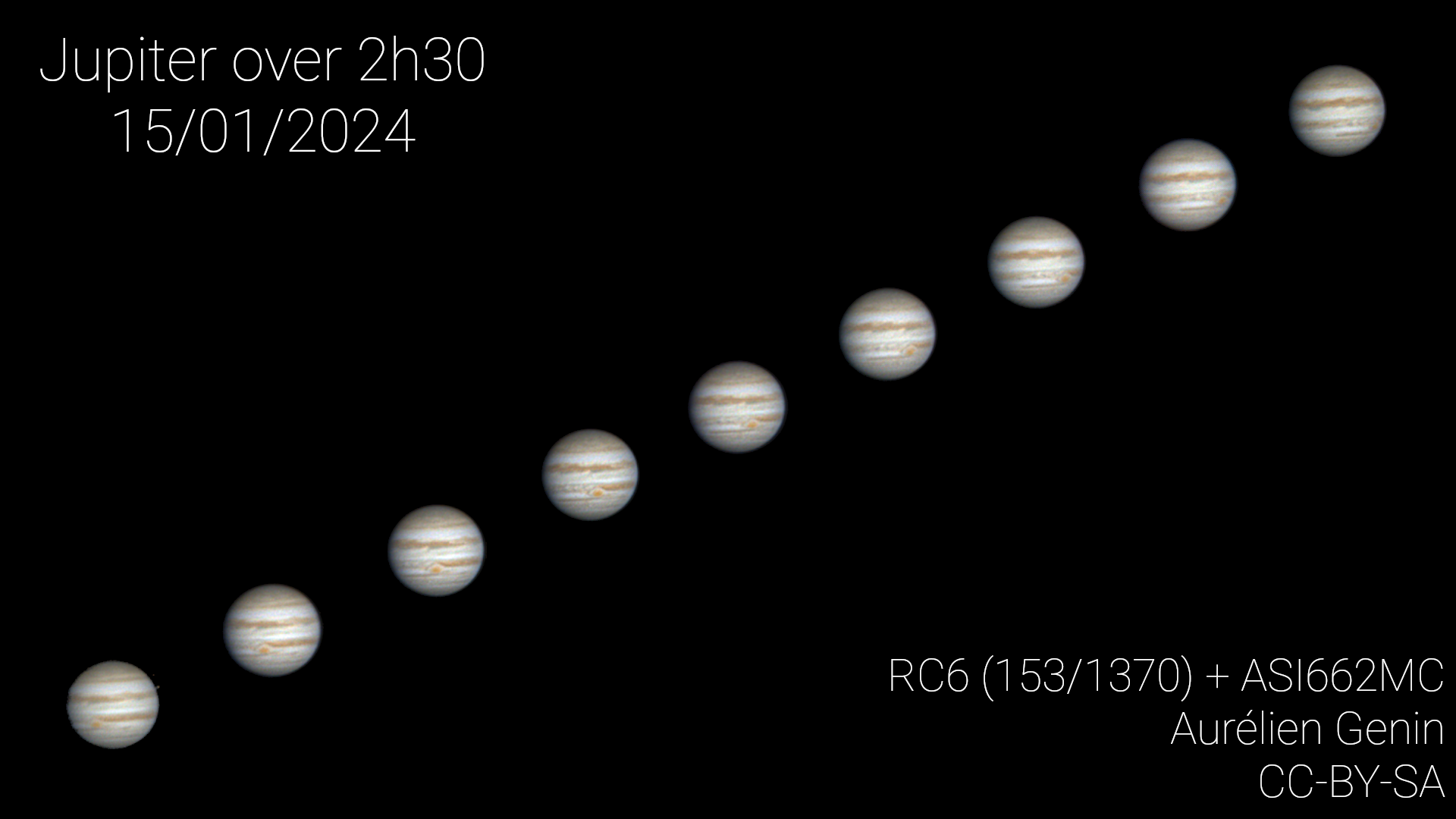
Explanation: Jupiter, our Solar System's ruling gas giant, is also the fastest spinning planet, rotating once in less than 10 hours. The gas giant doesn't rotate like a solid body though. A day on Jupiter is about 9 hours and 56 minutes long at the poles, decreasing to 9 hours and 50 minutes near the equator. The giant planet's fast rotation creates strong jet streams, separating its clouds into planet girdling bands of dark belts and bright zones. You can easily follow Jupiter's rapid rotation in this sharp sequence of images from the night of January 15, all taken with a camera and small telescope outside of Paris, France. Located just south of the equator, the giant planet's giant storm system, also known as the Great Red Spot, can be seen moving left to right with the planet's rotation. From lower left to upper right, the sequence spans about 2 hours and 30 minutes.
For more detail go to the link and click on the image for a high definition image. You can then move the magnifying glass cursor then click to zoom in and click again to zoom out. When zoomed in you can scan by moving the side bars on the bottom and right side of the image.
Before I saw the picture I was thinking it was going to be a video.
Pretty neat, good job and 👍to the photographer!
Disclaimer: Opinions posted on Free Republic are those of the individual posters and do not necessarily represent the opinion of Free Republic or its management. All materials posted herein are protected by copyright law and the exemption for fair use of copyrighted works.