
Posted on 12/10/2023 11:28:50 AM PST by MtnClimber
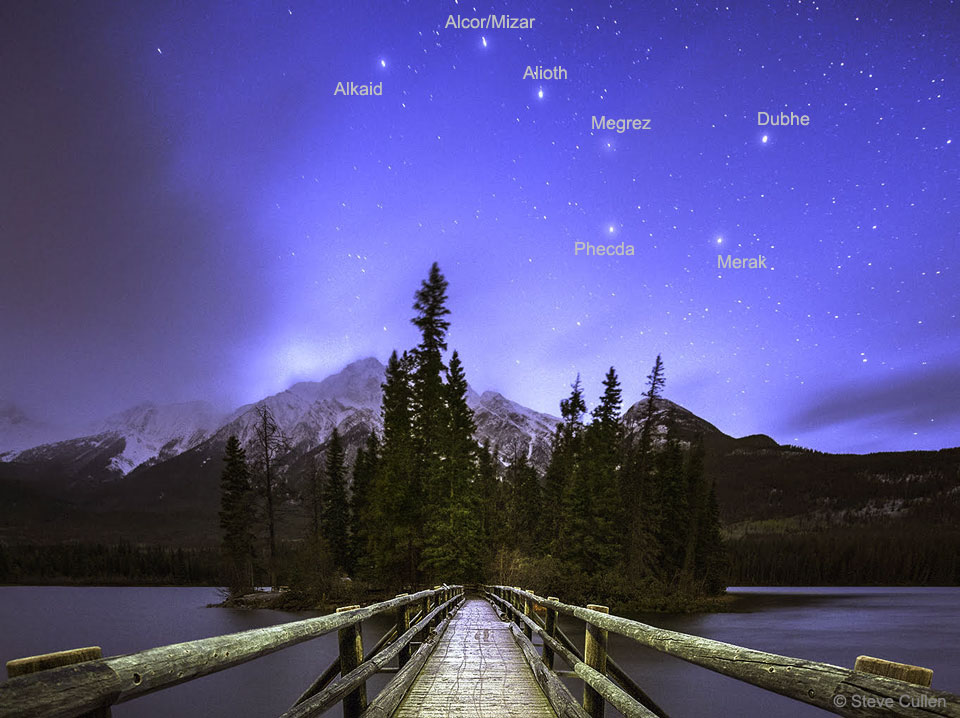
Explanation: When did you first learn to identify this group of stars? Although they are familiar to many people around the world, different cultures have associated this asterism with different icons and folklore. Known in the USA as the Big Dipper, the stars are part of a constellation designated by the International Astronomical Union in 1922 as the Great Bear (Ursa Major). The recognized star names of these stars are (left to right) Alkaid, Mizar/Alcor, Alioth, Megrez, Phecda, Merak, and Dubhe. Of course, stars in any given constellation are unlikely to be physically related. But surprisingly, most of the Big Dipper stars do seem to be headed in the same direction as they plough through space, a property they share with other stars spread out over an even larger area across the sky. Their measured common motion suggests that they all belong to a loose, nearby star cluster, thought to be on average only about 75 light-years away and up to 30 light-years across. The cluster is more properly known as the Ursa Major Moving Group. The featured image captured the iconic stars in 2017 above Pyramid Mountain in Alberta, Canada.
For more detail go to the link and click on the image for a high definition image. You can then move the magnifying glass cursor then click to zoom in and click again to zoom out. When zoomed in you can scan by moving the side bars on the bottom and right side of the image.
Awesome...!!!
Gorgeous.
It’s a good thing no game show host ever asked me “For ten million dollars, name the seven stars in the Big Dipper.”
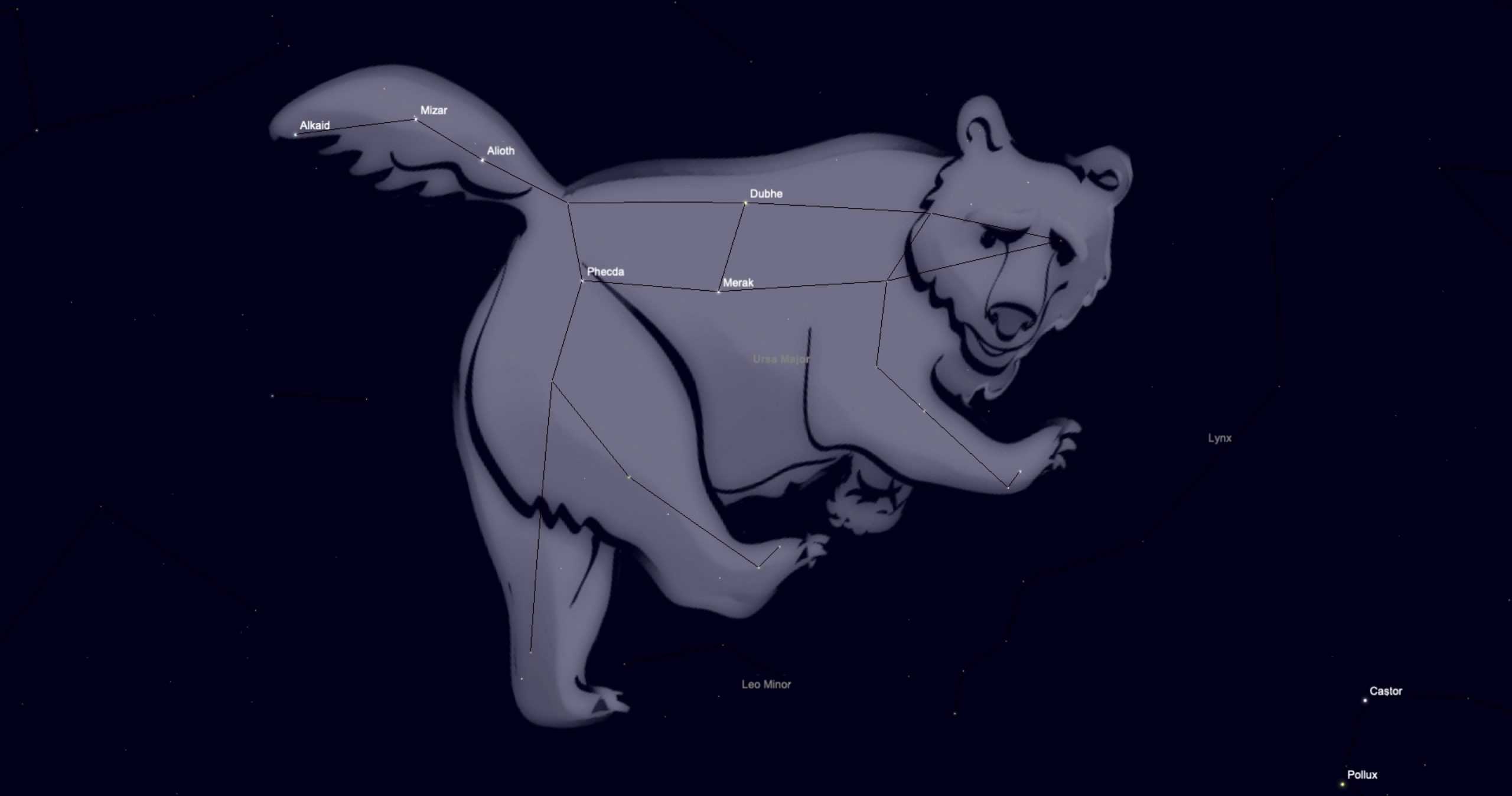
You have to be real drunk or high on acid to think that looks like a bear. Someone apparently was.
Through a telescope Alcor and Mizar are each double star systems, with
Mizar A and B readily visible. Alcore A nd B are a spectroscopic binary.
Ancient armies used to use them as a test of a prospective soldier’s eyesight.
It’s the Bear’s hindquarters and tail…
We went up to Maligne Lake to the east and went canoeing on the lake. What a magnificent place. It was our first time in the Canadian Rockies and definitely a place to return to.

Bears have very short tails. In any case, constellations are very useful for mapping an otherwise randomly construed sky. They need to have names, therefore. But in this case, people tend to just call it the Big Dipper instead of the Great Bear because it doesn’t look anything like a bear.
Thanks for the photo. Beautiful.
Looks like the bridge is facing NNW at about 340 degrees. Beautiful picture.

I was at Banff in the mid-1970s. Beautiful place.
When I was in second grade, our reader had a story explaining how the bear lost his tail. Supposedly a bear was ice-fishing with his tail stuck through a hole in the ice, but it froze and he was left with just the stub of a tail. Even in second grade I realized that the story was nonsense. And that was without ever having heard of Lamarck.
Kind of like Orion: We identify it by “The Belt.”
Must have been before TV.
Just about everyone notices those three stars if they’ve looked at the sky enough times. But many or most don’t know it as Orion’s Belt.
**You have to be real drunk or high on acid to think that looks like a bear.**
Lol. Or a liberal dem. They believe a man can be a woman, and visa versa. I have wondered since my youth how those star groups got such names. The big dipper gets a pass with me because it does fit the description.
Disclaimer: Opinions posted on Free Republic are those of the individual posters and do not necessarily represent the opinion of Free Republic or its management. All materials posted herein are protected by copyright law and the exemption for fair use of copyrighted works.