Posted on 08/27/2023 12:28:35 PM PDT by MtnClimber
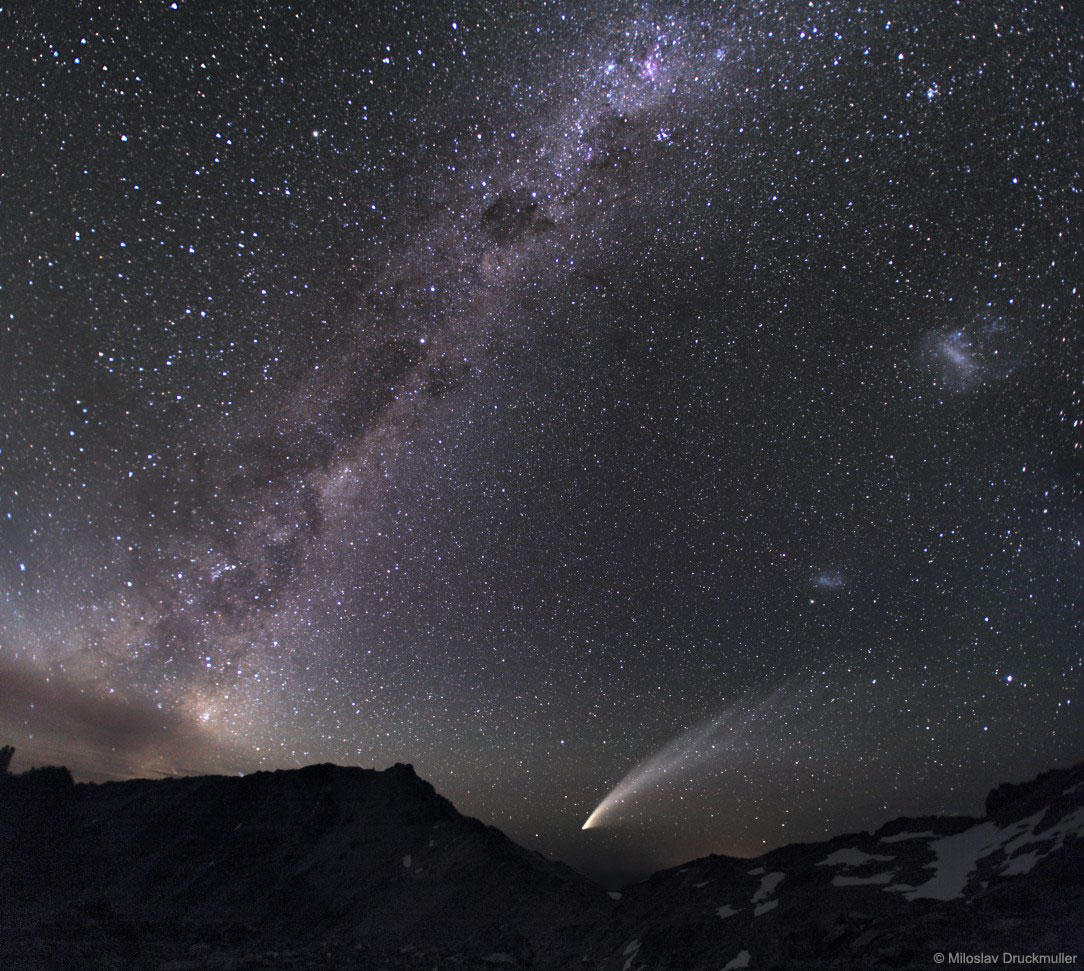
Explanation: Diffuse starlight and dark nebulae along the southern Milky Way arc over the horizon and sprawl diagonally through this gorgeous nightscape. The breath-taking mosaic spans a wide 100 degrees, with the rugged terrain of the Patagonia, Argentina region in the foreground. Along with the insider's view of our own galaxy, the image features our outside perspective on two irregular satellite galaxies - the Large and Small Magellanic Clouds. The scene also captures the broad tail and bright coma of Comet McNaught, the Great Comet of 2007.
For more detail go to the link and click on the image for a high definition image. You can then move the magnifying glass cursor then click to zoom in and click again to zoom out. When zoomed in you can scan by moving the side bars on the bottom and right side of the image.
Majestic!
I try to mentally view scenes like this in 3D, since you can’t tell by just looking. The individual stars are much farther away than the comet, eventually forming the band of the Milky Way as they go into the distance. The two galaxies are the farthest things you see, the mountains the closest. But mostly the difference in distance scales is not just by a few times, but more like millions of times. The Magellanic Clouds are only a few times farther than the Milky Way, however.
Yes, and landing on the moon or on Mars seems like such an accomplishment, but it is small in the scheme of things. Really small, but worthwhile.
Still one giant leap for mankind, who are really, really small individually.
I love these photos. They make for good wallpaper or cover images.
Thanks!
I look at the sky with a sense of 3D too. It makes it that much more awesome.
Disclaimer: Opinions posted on Free Republic are those of the individual posters and do not necessarily represent the opinion of Free Republic or its management. All materials posted herein are protected by copyright law and the exemption for fair use of copyrighted works.