Posted on 07/09/2023 12:16:40 PM PDT by MtnClimber
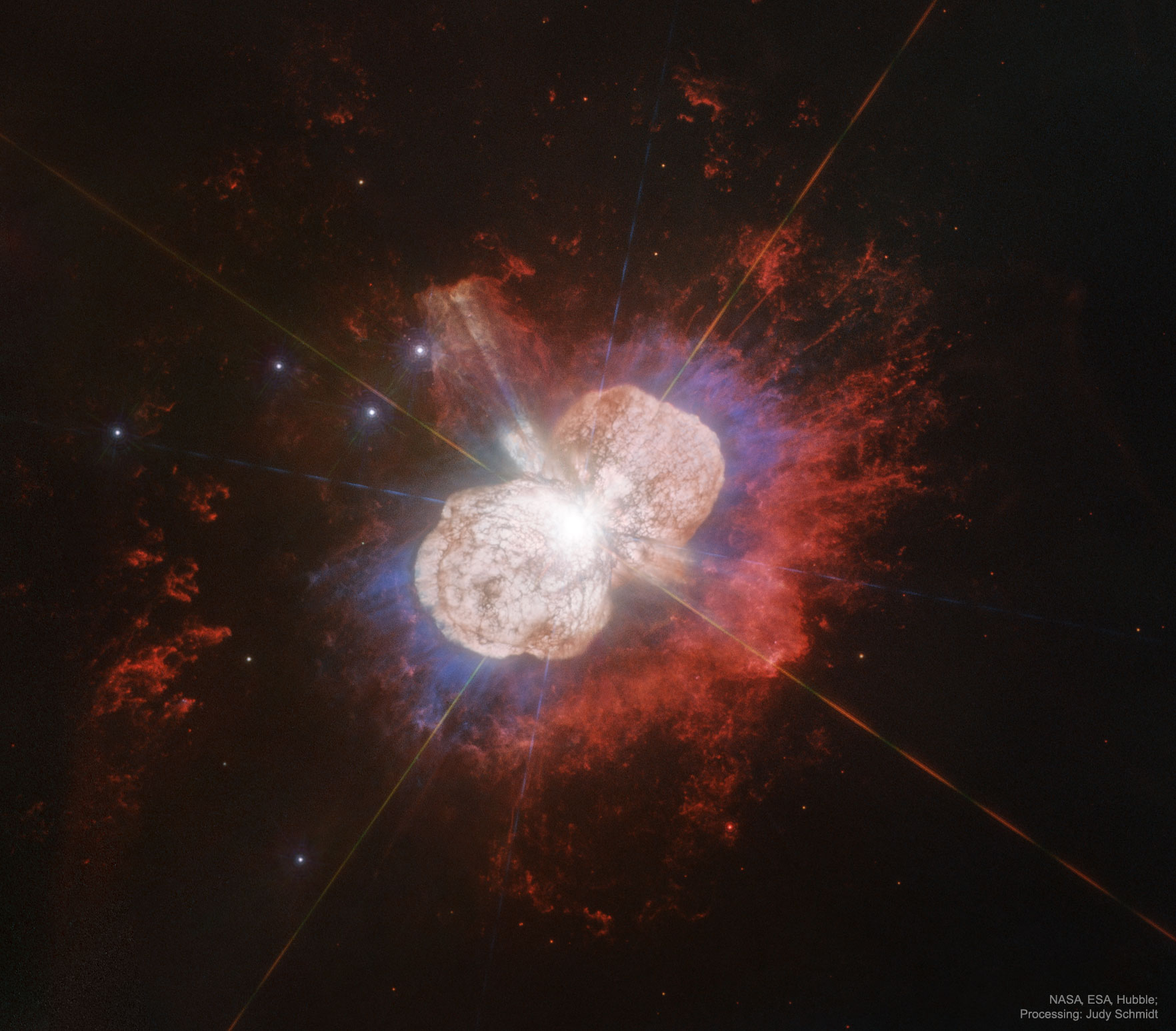
Explanation: Eta Carinae may be about to explode. But no one knows when - it may be next year, it may be one million years from now. Eta Carinae's mass - about 100 times greater than our Sun - makes it an excellent candidate for a full blown supernova. Historical records do show that about 170 years ago Eta Carinae underwent an unusual outburst that made it one of the brightest stars in the southern sky. Eta Carinae, in the Keyhole Nebula, is the only star currently thought to emit natural LASER light. This featured image brings out details in the unusual nebula that surrounds this rogue star. Diffraction spikes, caused by the telescope, are visible as bright multi-colored streaks emanating from Eta Carinae's center. Two distinct lobes of the Homunculus Nebula encompass the hot central region, while some strange radial streaks are visible in red extending toward the image right. The lobes are filled with lanes of gas and dust which absorb the blue and ultraviolet light emitted near the center. The streaks, however, remain unexplained.
For more detail go to the link and click on the image for a high definition image. You can then move the magnifying glass cursor then click to zoom in and click again to zoom out. When zoomed in you can scan by moving the side bars on the bottom and right side of the image.
Those spikes look like shrapnel from the Holy Hand Grenade.
7,500 light years away...it could have already gone supernova, and the visible event is still on its’ way.
“7,500 light years away”
The article says the star changed 170 years ago, more like 7,670 years ago.
Two sets of diffraction spikes at different angles, so it’s probably a composite image. If anything looks like it’s ready to blow up, this does.
Someone counteth to four...
Good catch. The orange spikes are all 90 degrees to each other and the blue diffraction spikes are also 90 degrees to each other.
The Greek letters are supposed to denote the 24 brightest stars in each constellation, starting with the brightest (although some mistakes were made—Beta Orionis is brighter than Alpha Orionis—and the stars of the Big Dipper are named in order). Carina is one of several constellations which were part of a huge constellation, Argo (”carina” means “keel”). When the designations were made, Eta Carinae was the seventh-brightest star in Argo, or at any rate seemed to be. I’m not sure how many stars in Carina were actually brighter than Eta Carinae, which has fluctuated in magnitude over the years.
Cool.
Beautiful.
Good info. Thanks.
Disclaimer: Opinions posted on Free Republic are those of the individual posters and do not necessarily represent the opinion of Free Republic or its management. All materials posted herein are protected by copyright law and the exemption for fair use of copyrighted works.