The view port is completely missing: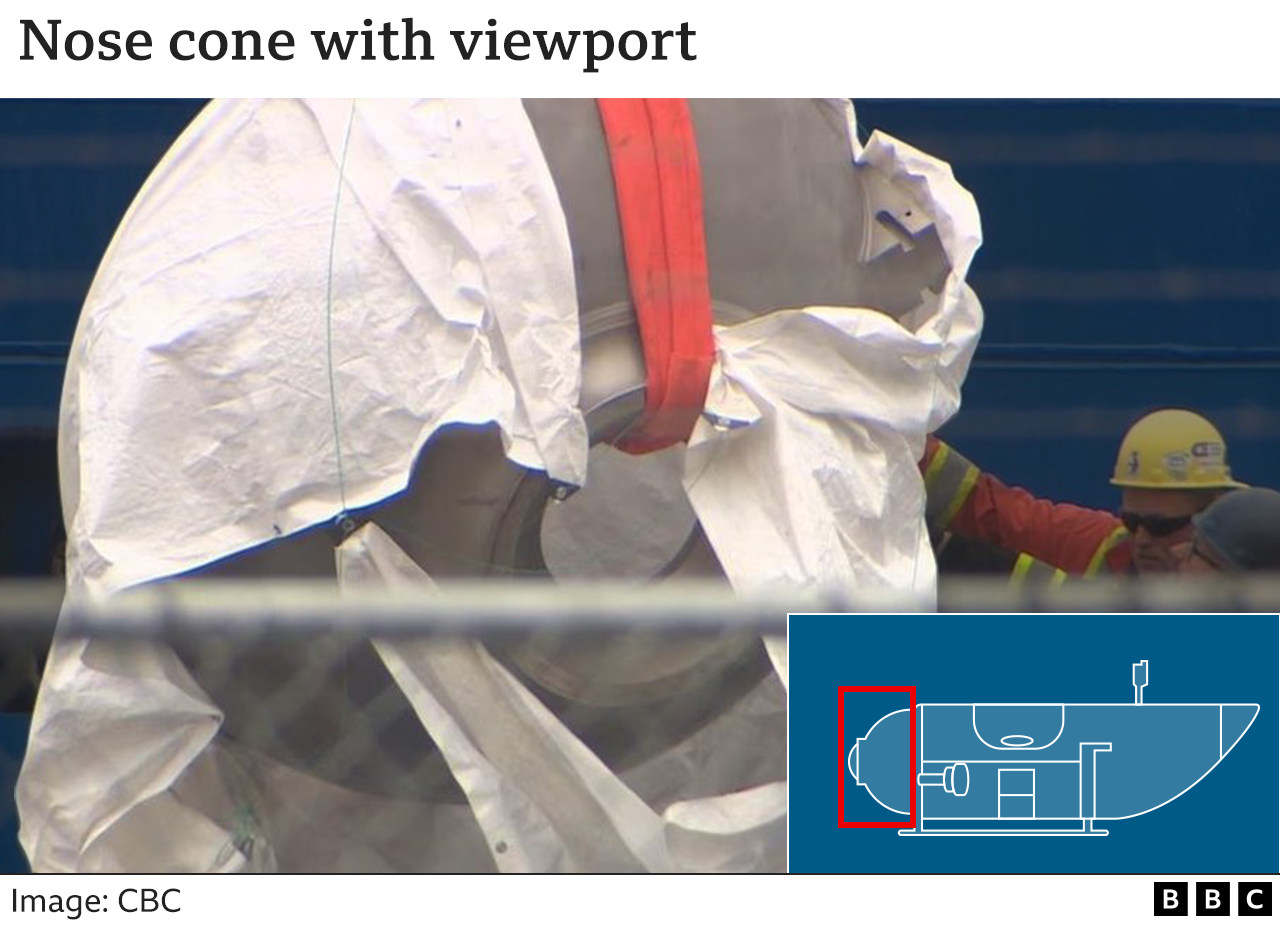
If the view port blew inward first, the implosion would have been lessened.
There wouldn't have been much left of the person immediately behind the view port.
Posted on 07/06/2023 10:58:57 AM PDT by Red Badger
The OceanGate Titan submersible, the first deep-sea vehicle with a hull made primarily from carbon fibers, recently imploded in the Atlantic Ocean, resulting in the loss of five crew members. Experts, including Arun Bansil, a distinguished professor of physics at Northeastern, are investigating the possibility that the vessel’s experimental carbon-fiber hull, constructed in a mere six weeks, might have been a key factor in the disaster.
The OceanGate Titan submersible imploded in the Atlantic Ocean, causing the death of five crew members. Investigations focus on the experimental carbon-fiber hull, a first in deep-sea vehicles, as a possible cause. While carbon-fiber composites offer advantages like light weight and high strength, their ability to withstand deep-sea pressures is not well understood, highlighting the need for further research and testing in such applications.
With the debris of the OceanGate Titan submersible now in the possession of authorities, investigators are hard at work piecing together (literally) what caused the vessel to implode in the Atlantic Ocean more than two weeks ago.
Northeastern Global News already spoke to Arun Bansil, university distinguished professor of physics at Northeastern, to try to gain a better understanding of what exactly might have happened all those fathoms beneath the surface, where the five Titan crew members died.
One potential explanation has been widely discussed: the vessel’s experimental carbon-fiber hull, which the company turned around in just six weeks, according to one report.
Northeastern Global News tapped Bansil again to provide a brief overview (and history) of the use of carbon-fiber materials in deep-sea watercraft. The conversation has been edited for brevity and clarity.
There’s been a lot of chatter about the Titan submersible’s carbon-fiber composition. Can you explain why carbon-fiber material might not hold up as well as titanium, aluminum, and steel under deep-ocean pressure?
For components requiring light weight and high strength, carbon fiber-based composites have been successfully developed for use in aerospace, automotive, sports, medical, and consumer industries.
When it comes to deep-sea applications, however, this is not the case, and steel, titanium, and aluminum are used widely for making pressure hulls.
Titan was the first deep-sea vehicle with a hull made mainly from carbon fibers. The ability of carbon fibers to withstand repeated cycles of stress, especially compressive stress, under deep-sea pressures is not well understood, making it difficult to design safe hulls based on carbon fibers.
The degrading effects of water absorption on the epoxy binding the carbon fibers in the composite should also be kept in mind in assessing the failure of Titan.
When did carbon fiber begin to be seen as a candidate material for these types of watercraft?
It seems that adventurist Steve Fossett started exploring the use of carbon fibers around 2000 for the hull of a one-person submersible to dive to the bottom of Challenger Deep, which is the deepest point in the Mariana Trench, at about 36,000 feet.
The submersible DeepFlight Challenger that Fossett commissioned has not been tested or deployed. Titan was the first deep-sea submersible with a carbon-fiber hull.
Why are companies experimenting with these new materials, and are there other alternatives that have shown promise?
New materials are the backbone on which transformative science and engineering advances are made. Carbon fibers offer many advantages over metals, such as high strength, lightweight and corrosion resistance.
Titan had made several dives to the Titanic shipwreck, and we should withhold judgment on the primary trigger for its implosion until the ongoing investigations are completed.
My guess is that researchers will eventually develop carbon-fiber-based materials for deep-sea applications, along with testing protocols for safe operation of the submersibles.
Carbon fiber has a high strength to weight ratio in tension. In compression, well, we found out.
I am waiting for the political spin on how Trump or carbon emissions caused the submersible to implode.
It sounds like it’s possible the viewing port in front which was not rated for the Titanic depth could have failed and then the rest crushed apart too.
Did I not read that the ?acrylic viewport was seen by passengers/crew to be visibly deforming and buckling inward and outward under the pressure strain on previous dives but the craft continued to be used anyway?
In a study at University of Texas carbon fiber materials were tested for deep ocean oilfield applications. One example of the study is that:
Failure of the materials occurred TEN times faster at water pressure of 2,000 psi as compared to ambient conditions.
There is your delamination consideration under water pressure.
The number of research papers about CFRP failure and fatigue characteristics from the last 30 to 40 years might fill a good sized room. I found five relevant papers in just about 30 minutes of searching. I read only the summaries and looked as some of the test results. I was quickly convinced that CFRP is certainly not a slam dunk application for submersibles under compressive loads and likely not at all. I think we have seen that supposition supported in action.
This will go down in history as the underwater Hindenburg.................
The view port is completely missing:
If the view port blew inward first, the implosion would have been lessened.
There wouldn't have been much left of the person immediately behind the view port.
That would be everyone.
Search “Titan transcript” on YouTube.
There are a number of videos on the “leaked” transcript of messages passing between the mothership topside and the submersible. The one I watched yesterday had a disclaimer at the front, saying that the poster was not certain about the authenticity of the transcript.
That said, he then went on to analyze it, and the salient “facts“ emerging from the transcript was that the craft descended too fast on its way to the Titanic. It essentially took only 2/3 of the time normally allotted (2.5 hours) to reach a depth just a couple hundred meters short of the bottom. So add possibly unmanaged descent to any inherent structural flaws in the carbon fiber vessel.
At that point, the crew is doing everything it could to bring the craft back to the surface. They apparently had dropped ballast and may have even jettisoned a portion of the support frame to improve buoyancy. They were reporting ominous noises coming from the aft end of the compartment prior to the loss of the signal. The craft was very slowly rising, and it looks like there may have been a partial power failure to the thrusters involved as well .
So, even though the final event may have been essentially instantaneous, it appears the passengers and crew spent the last 20 minutes of their lives knowing that disaster was upon them.
Not a good place to be...
I used to design pressure vessels for instruments and optics (cameras and lasers). One of the biggest problems is matching properties of different components (dome, body, endcap). It is impossible that the dome wasn’t designed for depth. It is possible that the joint between the acrylic port and the next (spherical) component wasn’t well done. On one camera housing I built the acrylic dome would compress more than the aluminum seat. An oring between the two and lubricant sealed out seawater and let the two compress at different rates. That is,the dome slid on the aluminum. I’ve never experienced fatigue of acrylic and that housing had thousands of dives.
Gas stoves.
They should have used monocoque technology. But they just laid it up on a drum. Dumb dumb…
Which was stronger — the carbon fiber or the glue that held it together?
Compression or tension ?
The expression ‘pushing a rope’ comes to mind.
Don’t know what was used to encapsulate the fiber.
Ah, monocoque technology.
I once owned an MG B.
How about “Mini-Titanic”
Biden, in all his wisdom, begged and warned Rush to shelve the entire project and to make test runs using LEGO equipment.
Your drawing indicates failure at the view port and/or flanged connection. We still have no data on type of flange gasket used.
Transformative science. Wtf is transformative science? Is it the new 2+2=5 science?
Disclaimer: Opinions posted on Free Republic are those of the individual posters and do not necessarily represent the opinion of Free Republic or its management. All materials posted herein are protected by copyright law and the exemption for fair use of copyrighted works.