Posted on 04/05/2023 2:12:59 PM PDT by MtnClimber
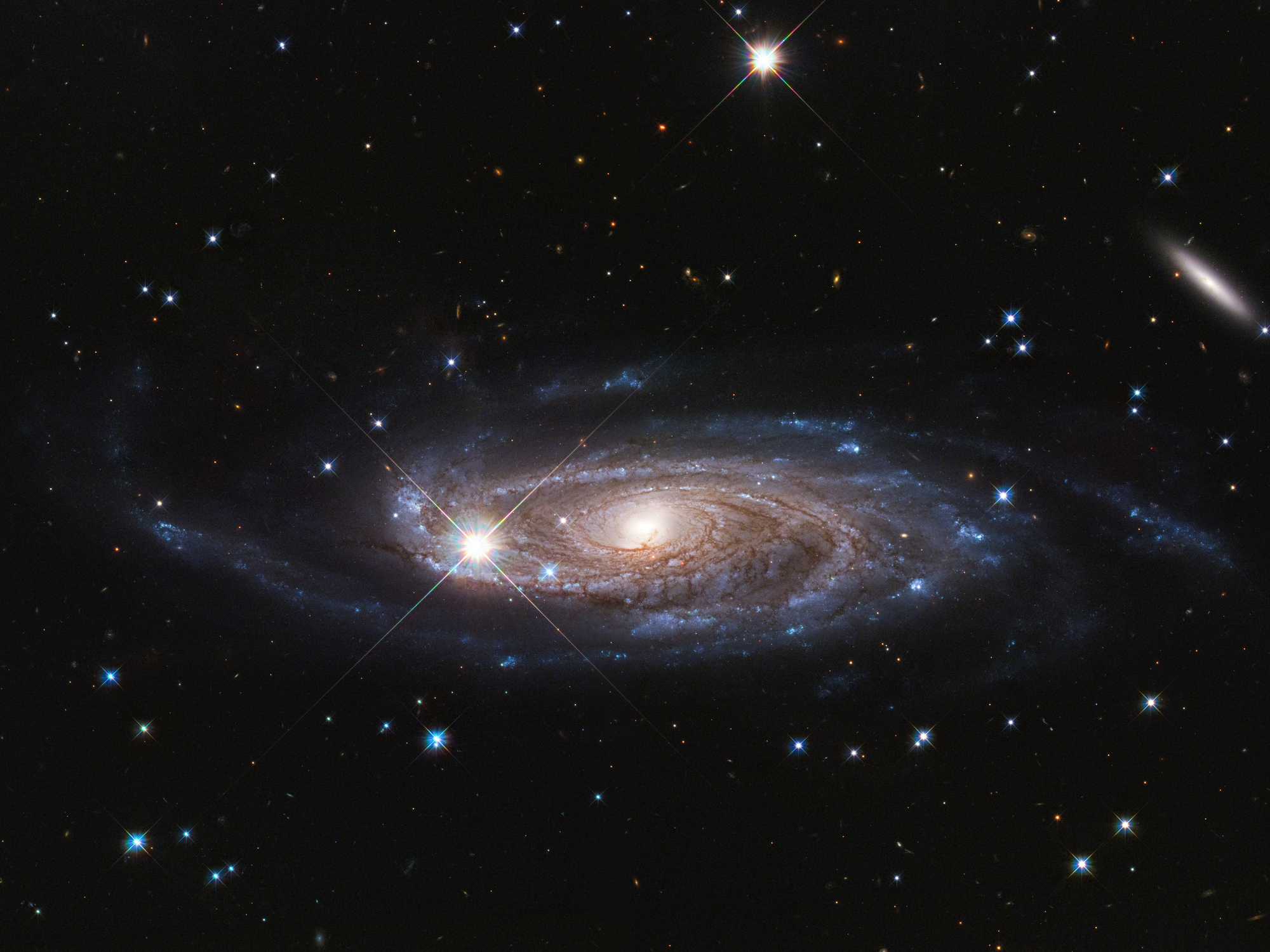
Explanation: In this Hubble Space Telescope image the bright, spiky stars lie in the foreground toward the heroic northern constellation Perseus and well within our own Milky Way galaxy. In sharp focus beyond is UGC 2885, a giant spiral galaxy about 232 million light-years distant. Some 800,000 light-years across compared to the Milky Way's diameter of 100,000 light-years or so, it has around 1 trillion stars. That's about 10 times as many stars as the Milky Way. Part of an investigation to understand how galaxies can grow to such enormous sizes, UGC 2885 was also part of An Interesting Voyage and astronomer Vera Rubin's pioneering study of the rotation of spiral galaxies. Her work was the first to convincingly demonstrate the dominating presence of dark matter in our universe.
For more detail go to the link and click on the image for a high definition image. You can then move the magnifying glass cursor then click to zoom in and click again to zoom out. When zoomed in you can scan by moving the side bars on the bottom and right side of the image.
I guess this is a good time to comment — NASA images are almost entirely made by AI. There I’ve said it again.
DannyTN: A person commented on an astronomy thread and said "NASA images are almost entirely made by AI.". What do you think about that?
ChatGPT: "While NASA uses artificial intelligence (AI) for various tasks, such as data analysis and processing, it is not accurate to say that NASA images are "almost entirely" made by AI. NASA images are typically produced from data captured by various instruments on spacecraft, telescopes, and other observation platforms. These images are then processed and analyzed by both automated algorithms and human experts to produce the final images that we see.
"While AI can certainly aid in the image processing and analysis, it is still heavily reliant on human input and expertise. The final images produced by NASA are typically the result of a combination of automated algorithms and human interpretation and refinement.
"In summary, while AI is an important tool used by NASA in various aspects of its work, it is not accurate to say that NASA images are "almost entirely" made by AI.
The “Rubin” is Vera Rubin. She was one of the most important scientist of the 20th Century. She was the one that discovered the effect that we call “Dark Matter” while measuring the movement of stars in the Andromeda Galaxy.
When she first wanted to be an Astronomer, she was told over and over that she should just go home and be a housewife, except her father. He encouraged her to keep trying, she got her degree and changed the path of cosmology. She was also a Mother and devout Jew.
Does Dark Mater really exist? We still need to study it. But she showed that there was something going on that worked just like Zwicky predicted in the early 20th Century.
This particular galaxy can be seen even with binoculars under good viewing conditions. NASA can’t control everyone.
What I am eluding to is the coloration in the images presented to us by NASA. I don’t believe that even with the best of telescopes you and I can actually see those colors in the viewport.
Typically the coloring is done with filters, which enhances the colors. Amateur astronomers use the same techniques. But it’s true, you can’t get photos like this without a $1.5 billion space telescope.
You can see color in stars without any optical device.
Just remember that you’re standing on a planet that’s evolving
And revolving at nine hundred miles an hour,
That’s orbiting at nineteen miles a second, so it’s reckoned,
A sun that is the source of all our power.
The sun and you and me and all the stars that we can see
Are moving at a million miles a day
In an outer spiral arm, at forty thousand miles an hour,
Of the galaxy we call the ‘Milky Way’.
Our galaxy itself contains a hundred billion stars.
It’s a hundred thousand light years side to side.
It bulges in the middle, sixteen thousand light years thick,
But out by us, it’s just three thousand light years wide.
We’re thirty thousand light years from galactic central point.
We go ‘round every two hundred million years,
And our galaxy is only one of millions of billions
In this amazing and expanding universe.
The universe itself keeps on expanding and expanding
In all of the directions it can whizz
As fast as it can go, at the speed of light, you know,
Twelve million miles a minute, and that’s the fastest speed there is.
So remember, when you’re feeling very small and insecure,
How amazingly unlikely is your birth,
And pray that there’s intelligent life somewhere up in space,
‘Cause there’s bugger all down here on Earth.
The Universe Song, Monty Python
How come my cell phone pics just a few yards away of objects here on earth are not as sharp as this galaxy 232 million light-years away?
I wonder what cell phone camera the astronomers use....? : )
Disclaimer: Opinions posted on Free Republic are those of the individual posters and do not necessarily represent the opinion of Free Republic or its management. All materials posted herein are protected by copyright law and the exemption for fair use of copyrighted works.