Skip to comments.
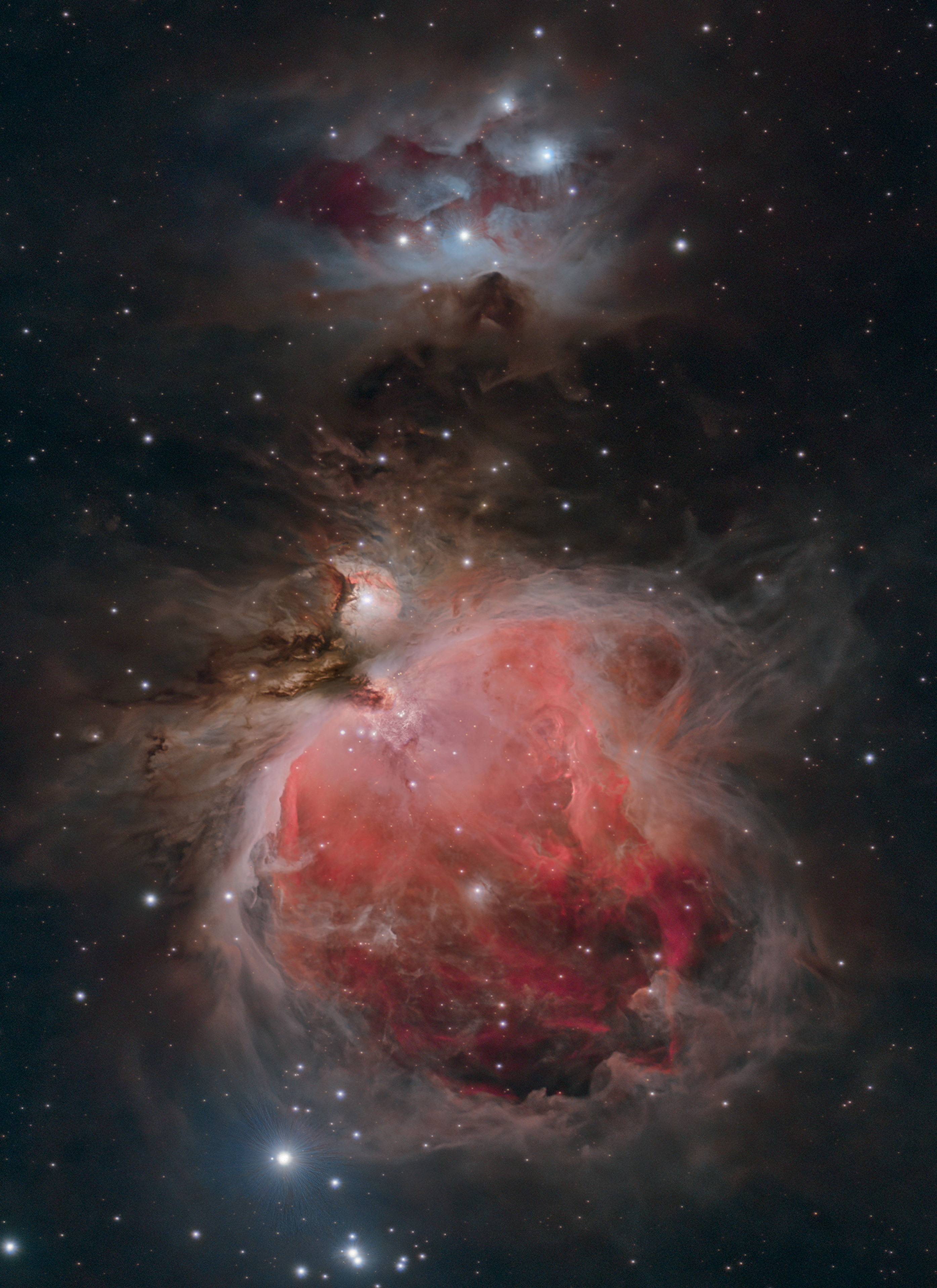
Astronomy Picture of the Day - Orion and the Running Man
https://apod.nasa.gov/apod ^
| 10 Mar, 2023
| Image Credit & Copyright: Abraham Jones
Posted on 03/10/2023 11:41:47 AM PST by MtnClimber
Explanation: Few cosmic vistas excite the imagination like The Great Nebula in Orion. Visible as a faint celestial smudge to the naked-eye, the nearest large star-forming region sprawls across this sharp telescopic image, recorded on a cold January night in dark skies from West Virginia, planet Earth. Also known as M42, the Orion Nebula's glowing gas surrounds hot, young stars. About 40 light-years across, it lies at the edge of an immense interstellar molecular cloud only 1,500 light-years away within the same spiral arm of our Milky Way galaxy as the Sun. Along with dusty bluish reflection nebula NGC 1977 and friends near the top of the frame, the eye-catching nebulae represent only a small fraction of our galactic neighborhood's wealth of star-forming material. Within the well-studied stellar nursery, astronomers have also identified what appear to be numerous infant solar systems.
TOPICS: Astronomy; Astronomy Picture of the Day; Science
KEYWORDS: nasa
To be added or removed from the Astronomy Picture of the Day ping list please send me a request via "Private Reply" (Mail). For more detail go to the link and click on the image for a high definition image. You can then move the magnifying glass cursor then click to zoom in and click again to zoom out. When zoomed in you can scan by moving the side bars on the bottom and right side of the image.
Pinging the APOD list.
🪐 🌟 🌌 🍔
To: 21stCenturion; 21twelve; 4everontheRight; abb; AFB-XYZ; AFPhys; America_Right; AZ .44 MAG; ...
Pinging the APOD list.
🪐 🌟 🌌 🍔
2
posted on
03/10/2023 11:42:55 AM PST
by
MtnClimber
(For photos of Colorado scenery and wildlife, click on my screen name for my FR home page.)
To: MtnClimber
I’ve looked in the night sky many a time and see Orion’s Belt. What is this image posted here ? I see nothing in there as I see in the sky.
To: George from New England
Look under the first star in the belt. You can see a smudge if you are not in the city. With even cheap binocs you can see the nebula pretty clearly. Of course, it wont look like these photos.
4
posted on
03/10/2023 11:57:51 AM PST
by
The Antiyuppie
(When small men cast long shadows, then it is very late in the day.)
To: George from New England
The nebulas in Orion need either a large telescope or a long time-exposure camera and a long lens. This is not visible to the unaided eye. Some of the nebulas need imaging that is not in the visible wavelength. This includes X-ray, infrared, ultraviolet and gamma ray imaging. These images are displayed in visible altered images, otherwise we could not see them.
5
posted on
03/10/2023 11:58:16 AM PST
by
MtnClimber
(For photos of Colorado scenery and wildlife, click on my screen name for my FR home page.)
To: The Antiyuppie
PS: wikipedia has a very clear photo of where to find it.
6
posted on
03/10/2023 11:59:30 AM PST
by
The Antiyuppie
(When small men cast long shadows, then it is very late in the day.)
To: MtnClimber
Waiting for Beetlejuice (Betelgeuse) to blow
7
posted on
03/10/2023 12:19:36 PM PST
by
Vaquero
(Don't pick a fight with an old guy. If he is too old to fight, he'll just kill you. )
To: Vaquero
Waiting for Beetlejuice (Betelgeuse) to blow Ol' Lori Lightfoot already did exactly that . . . LOL
8
posted on
03/10/2023 12:36:30 PM PST
by
AFB-XYZ
(Stand up, or bend over)
To: MtnClimber
That looks like a giant dislocated eyeball about to fly into a giant vagina.
9
posted on
03/10/2023 1:18:03 PM PST
by
DannyTN
To: DannyTN
I know where your mind is at...thinking about eyeballs.
10
posted on
03/10/2023 1:20:56 PM PST
by
MtnClimber
(For photos of Colorado scenery and wildlife, click on my screen name for my FR home page.)
To: AFB-XYZ
My guess is that Betelgeuse will start shrinking as it collapses into a brown dwarf. A supernova would be purdy but not likely.
11
posted on
03/10/2023 1:23:55 PM PST
by
Bloody Sam Roberts
(You can never have enough clamps. Thanks Ben.)
To: MtnClimber
I blame Dr. Suess.

12
posted on
03/10/2023 1:28:55 PM PST
by
DannyTN
To: MtnClimber
13
posted on
03/10/2023 3:40:45 PM PST
by
ro_dreaming
(Who knew "Idiocracy", "1984", "Enemy of the State", and "Person of Interest" would be non-fiction?)
To: MtnClimber
Even in our club’s 10” refractor, it doesn’t look like the photo. Still, it does show quite a bit of detail.
Nice!
14
posted on
03/11/2023 6:29:15 AM PST
by
telescope115
(My feet are on the ground, and my head is in the stars. A Man, and proud of it!)
To: George from New England
When you are looking in the right place, you’ll see it, no problem, unless your skies are totally washed out. Even a pair of binoculars is helpful, if you have one.
Keep trying, you will see it!👍
15
posted on
03/11/2023 6:32:47 AM PST
by
telescope115
(My feet are on the ground, and my head is in the stars. A Man, and proud of it!)
To: George from New England
Your eyes don’t colorize the gradient
16
posted on
03/11/2023 6:49:15 AM PST
by
Nifster
( I see puppy dogs in the clouds )
Disclaimer:
Opinions posted on Free Republic are those of the individual
posters and do not necessarily represent the opinion of Free Republic or its
management. All materials posted herein are protected by copyright law and the
exemption for fair use of copyrighted works.
FreeRepublic.com is powered by software copyright 2000-2008 John Robinson