Posted on 03/07/2023 2:57:14 PM PST by MtnClimber
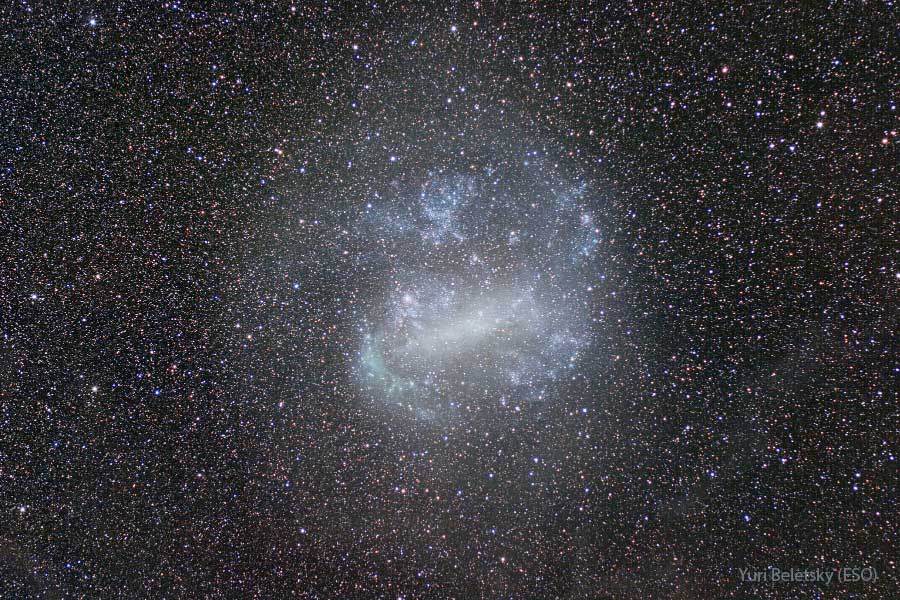
Explanation: Is this a spiral galaxy? No. Actually, it is the Large Magellanic Cloud (LMC), the largest satellite galaxy of our own Milky Way Galaxy. The LMC is classified as a dwarf irregular galaxy because of its normally chaotic appearance. In this deep and wide exposure, however, the full extent of the LMC becomes visible. Surprisingly, during longer exposures, the LMC begins to resemble a barred spiral galaxy. The Large Magellanic Cloud lies only about 180,000 light-years distant towards the constellation of the Dolphinfish (Dorado). Spanning about 15,000 light-years, the LMC was the site of SN1987A, the brightest and closest supernova in modern times. Together with the Small Magellanic Cloud (SMC), the LMC can be seen in Earth's southern hemisphere with the unaided eye.
For more detail go to the link and click on the image for a high definition image. You can then move the magnifying glass cursor then click to zoom in and click again to zoom out. When zoomed in you can scan by moving the side bars on the bottom and right side of the image.
Actually the LMC is a spiral galaxy that has been tidally disrupted into an irregular one by our own Milky Way, which is in the process of cannibalizing it. It is also turning into a starburst galaxy as the gas clouds that make up much of its mass is colliding and interacting. The Tarantula Nebula contained within it is in fact the largest star forming region in the local group of around 30-40 galaxies. If it were the same distance from us as the Orion Nebula, it would be as bright as the full moon.
I wonder if they’ll ever aim the Webb telescope at it. That might prove to be interesting.
I see a girl up there.
Thanks! I guess I missed that one!
Disclaimer: Opinions posted on Free Republic are those of the individual posters and do not necessarily represent the opinion of Free Republic or its management. All materials posted herein are protected by copyright law and the exemption for fair use of copyrighted works.