Posted on 03/01/2023 1:30:57 PM PST by MtnClimber
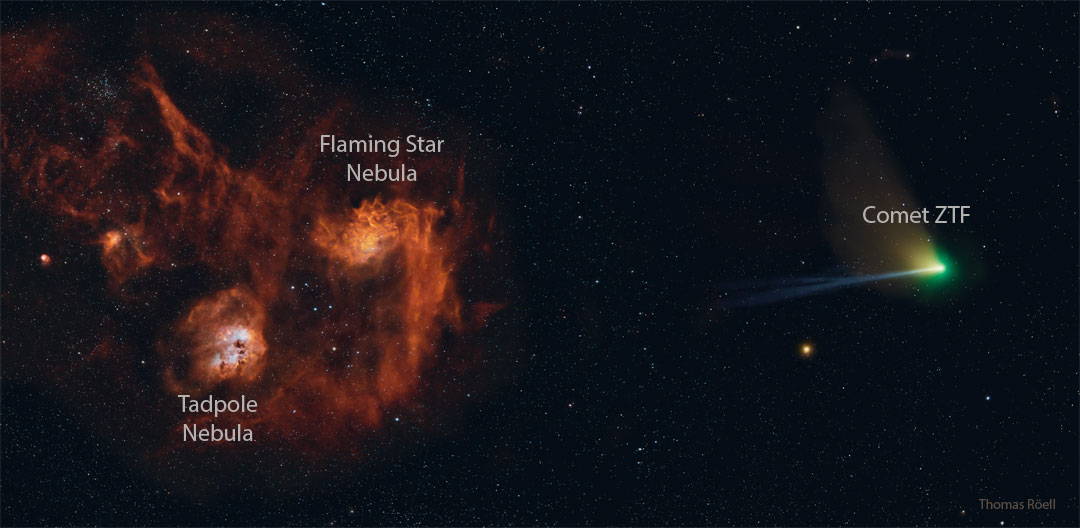
Explanation: Is star AE Aurigae on fire? No. Even though AE Aurigae is named the Flaming Star and the surrounding nebula IC 405 is named the Flaming Star Nebula, and even though the nebula appears to some like a swirling flame, there is no fire. Fire, typically defined as the rapid molecular acquisition of oxygen, happens only when sufficient oxygen is present and is not important in such high-energy, low-oxygen environments such as stars. The bright star AE Aurigae occurs near the center of the Flaming Star Nebula and is so hot it glows blue, emitting light so energetic it knocks electrons away from surrounding gas. When a proton recaptures an electron, light is emitted, as seen in the surrounding emission nebula. Captured here three weeks ago, the Flaming Star Nebula is visible near the composite image's center, between the red Tadpole Nebula on the left and blue-tailed Comet ZTF on the right. The Flaming Star Nebula lies about 1,500 light years distant, spans about 5 light years, and is visible with a small telescope toward the constellation of the Charioteer (Auriga).
For more detail go to the link and click on the image for a high definition image. You can then move the magnifying glass cursor then click to zoom in and click again to zoom out. When zoomed in you can scan by moving the side bars on the bottom and right side of the image.
Altogether, it looks like a lobster.
I’ll take one flaming cheese nebula, please.
There in 30 light years or it’s free.
Where is the Starship Enterprise?
Best Look Fast! The main star in the nebula is AE Aurigae is a run away star that started it’s path in the Orion Nebula area. The shape of the nebula is caused by it’s passing through the gases.
Disclaimer: Opinions posted on Free Republic are those of the individual posters and do not necessarily represent the opinion of Free Republic or its management. All materials posted herein are protected by copyright law and the exemption for fair use of copyrighted works.