
Posted on 01/09/2023 5:02:20 AM PST by MtnClimber
Supposedly, we are rapidly on our way toward a zero-carbon, all electric energy future. But has anybody done the arithmetic to see if this adds up?
I’m carving myself out a niche as the guy who does a few simple calculations to check if the grand schemes of our central planners make any sense. So far I’ve taken that approach to the question of energy storage to back up a wind/solar electricity grid, and on that one the schemes of the central planners most definitely do not add up. But the energy storage question, although involving no math beyond basic arithmetic, does have some complexities. How about something somewhat simpler, like: If we convert our entire automobile fleet to all-electric cars, where is the electricity going to come from?
With the big push currently on to get rid of internal combustion vehicles and replace them with electrics, surely someone has done the calculations to be sure that the electricity supply will be ample. Actually, that does not appear to be the case. Once again, the central planners have no idea what they are doing.
A few things in the recent news make this issue highly topical. First, in the days just before Christmas, much of the country experienced a severe cold snap. Severe, that is, but not record-breaking. Almost everywhere that had very cold temperatures during those days had had even colder temperatures in the past, not necessarily every year, but multiple times over the course of decades. Second, several utilities found themselves with insufficient electricity to meet demand, and had to impose rolling blackouts on their customers, even in the face of freezing cold temperatures. Examples of utilities imposing rolling blackouts during the severe cold wave included Duke Energy (covering most of North and South Carolina, and parts of Florida, Indiana, Ohio and Kentucky) and TVA (covering all of Tennessee and parts of Alabama, Mississippi and Kentucky). Both of those utilities, and many others, have spent the last decade and more shuttering reliable coal power plants, and building lots of wind turbines and solar panels, along with some (but obviously not enough) natural gas plants, as replacements.
As of today, electric vehicles are a tiny fraction of all vehicles (less than 1% in the U.S., says Reuters as of February 2022), particularly in these Midwestern and Southern states. Yet even with only the tiniest level of electricity demand coming from electric vehicles, already major utilities are short of electricity when a not-out-of-the-ordinary cold snap hits.
And now, where are things headed in the near future? The Wall Street Journal had a big piece with a January 1 date (it appeared in the print edition on January 3) about the coming rush of electric vehicles, headline “Shift to EVs Triggers Biggest Auto-Factory Building Boom in Decades.” The gist is that the industry is gearing up to build factories at a breakneck pace for the imminent supply of electric cars for all. Excerpt:
The U.S. auto industry is entering one of its biggest factory-building booms in years, a surge of spending largely driven by the shift to electric vehicles and new federal subsidies aimed at boosting U.S. battery manufacturing. Through November, about $33 billion in new auto-factory investment has been pledged in the U.S., including money for the construction of new assembly plants and battery-making facilities, according to the Center for Automotive Research, a nonprofit organization based in Michigan. . . . The capital outlays amount to a collective bet by the car industry that buyers will embrace battery-powered models in numbers large enough to support these investments. The global auto industry plans to spend a collective $526 billion on electric vehicles through 2026, according to consulting firm AlixPartners.
Whew! It’s the total transformation of the industry, from internal combustion engines to battery-electric. And if you look at the websites of the manufacturers themselves, they are almost all saying that they are committed to the rapid conversion to electric vehicles, with all internal-combustion manufacturing banished by some early date. Here is GM on its “path to an all-electric future” (by 2035); and here is Ford’s claim that it will “lead America’s shift to electric vehicles” (50% by 2030!). Numerous other manufacturers are making comparable claims.
OK, then, how much electricity is this going to take? I’ll start with this handy (if somewhat complicated) chart from the U.S. Energy Information Administration showing production (by source) and use (by sector) of all energy in the U.S. for the year 2021 (I do not find a chart for 2022 available as of yet.):
Here are a few key number from this chart:
- The total amount of energy consumed in the U.S. in 2021 is given as 73.5 quadrillion Btus.
- Of the 73.5 quadrillion Btus consumed, only 12.9 quadrillion Btus was in the form of electricity. That’s only 17.6% of total energy consumption.
- Almost all of the electricity was consumed in the household, commercial and industrial sectors, and almost none (less than 1%) in the transportation sector.
- The transportation sector consumed 26.9 quadrillion Btus of energy. That’s 37% of total energy consumption — and more than double the entire amount of electricity consumed in all sectors.
OK, but the transportation sector is a lot more than just automobiles. It also includes everything from airplanes to freight trains to ocean shipping. What part of that 26.9 quadrillion Btus of energy in the transportation sector consisted of automobiles and light trucks (like SUVs and pick-ups) which are the things that are supposedly about to get electrified? Looking around, I find something called the Transportation Energy Data Book, put out by the Oak Ridge National Laboratory — another part (like the EIA) of the U.S. Department of Energy. Here are two key facts from the introductory “Quick Facts” section: (1) “Petroleum comprised 90% of U.S. transportation energy use in 2020,” and (2) “Cars and light trucks accounted for 62% of U.S. transportation petroleum use in 2018.”
Assuming that those percentages held approximately true for 2021, then cars and light trucks consumed approximately some 26.9 x 0.9 x 0.62 = 15.0 quadrillion Btus in the form of gasoline or diesel in 2021 — well more than the entire amount of energy consumed in the country in that year in the form of electricity.
So have we now shown that converting all cars and light trucks to electric would require more than doubling the size of our electricity generation system? Unfortunately, it’s not quite that simple. There are a few other factors that need to be taken into account. Unfortunately, these additional factors are not subject to a great deal of precision, and can only be fairly rough approximations:
- Electric vehicles have about 85-90% efficiency in translating the stored energy in the battery into movement of the vehicle. That compares to only about 15-25% efficiency of ICE vehicles. That is a large difference.
- However, two other factors offset that advantage. One is that the batteries of electric vehicles experience an approximate 15% loss of charge in the turnaround between charge and discharge. The other is that the process of producing electricity in a power plant is in the range of 35-50% efficient, depending on the type of power plant. Some of the latest power plants even claim upwards of 50% efficiency, but note that the EIA chart above shows that the overall efficiency of electricity production in the U.S. is 35% (which also includes losses in transmission).
Put these factors together, and here is the calculation:
For an internal combustion vehicle, if you start with 10 Btus of energy in gasoline, you get about 2 Btus of motion from your car.
For an electric vehicle, if you start with the same 10 Btus of fuel, you get 10 x 0.35 = 3.5 Btus of usable electricity, 3.5 x 0.85 = 3.0 Btus of electricity in your battery after charging losses, and 3.0 x 0.87 = 2.6 Btus of motion from your car.
So overall, and remembering that this is approximate, an all-electric car and light truck fleet can run on about three-quarters (2 divided by 2.6) the number of Btus of energy input as can a comparable internal combustion-powered fleet. Instead of the 15 quadrillion Btus annually that we use for our current ICE vehicles, we could theoretically get it down to 11.25 quadrillion Btus, which would produce 11.25 x .35 = 3.93 quadrillion Btus of electricity to run the vehicles.
Recall that the current amount of electricity produced annually in the U.S., from the chart above, is 12.9 quadrillion Btus. So the additional 3.93 quadrillion Btus of electricity would represent approximately a 30.5% addition to the current capacity of our electricity generation system.
Are there any plans afoot for anything like that? Here’s another chart from EIA showing their projections of growth in U.S. electricity generation capacity out to 2050, from their 2022 Annual Energy Outlook:
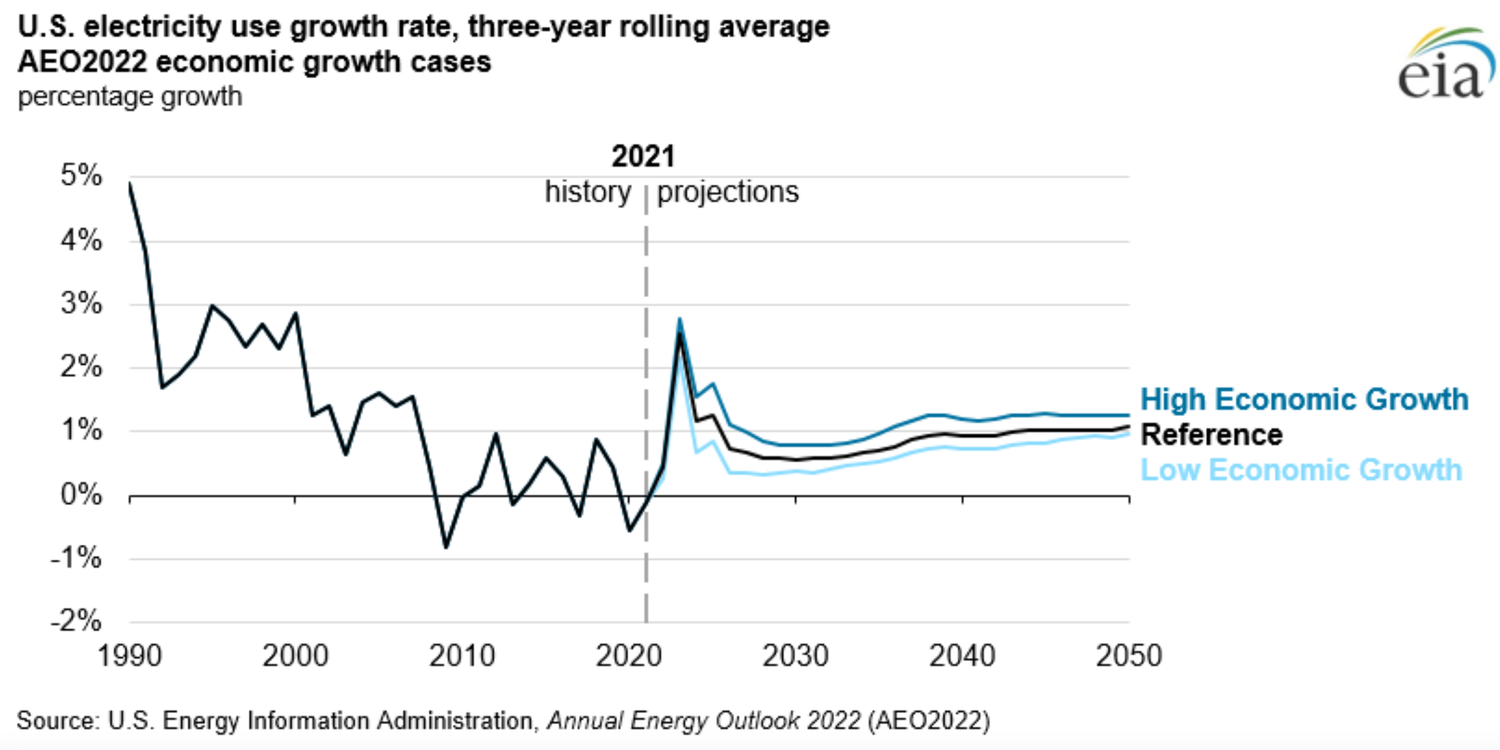
Basically, after the current rebound from the 2020-21 Covid-induced decline, they project 1% annual increase in consumption as far as the eye can see. The “high economic growth” and “low economic growth” scenarios do not differ meaningfully from the median “reference” case. This growth includes growing demand for everything, including from growing population and every sort of new electric gizmo that might be invented over the period. And note that this projection, at least for the earlier years, is largely based on the plans of utilities to add capacity — or not. And to the extent anyone is adding capacity, it is likely to be wind and solar, which will be completely useless for charging these vehicles on calm nights and lots of other times.
So where is the surge in generation capacity to support a 30% or so additional need for electricity to electrify all cars? It sure doesn’t look to me like it is there. Could it be that nobody really believes that this conversion to electric cars is actually going to occur? That would be my take.
“With the big push currently on to get rid of internal combustion vehicles and replace them with electrics, surely someone has done the calculations to be sure that the electricity supply will be ample. Actually, that does not appear to be the case.”
So, do they want the Plebes to drive electric vehicles or bicycles?
The premise is completely wrong. The objectives are clearly the following:
1. Forcibly retire all ICE vehicles by about 2030-2035
2. Only a modest fraction of people will be able to have an EV which has limited practical range
3. All the rest must move to an urban center, walk, bicycle, or uber for transportation
4. Living in urban centers will be in tiny rented apartments
4. Air travel will also be sharply restricted
5. Freedom of movement is eliminated
6. No new electrical power to be added, because overall power used per person is sharply reduced
Welcome to our future serfdom
Factor in the energy costs of creating and transportng a battery with a six year life span...
I used to work for an engineering consultancy that was paid to study the issue of “everyone having an electric car”.
A major conclusion involved the power grid and local transformers...if everyone were pulling the required current they’d melt down. It’s not only about generating the required Watts, the entire grid needs a new architecture.
I have no idea what the future holds for automobiles. Electric may or may not be the way to go, but it seems as if the technology isn’t there yet for widespread implementation. Infrastructure is nowhere near where it needs to be for charging hundreds of millions of cars. That can all come in time. We’ll see where it leads.
With that said, I drove my first electric car (Tesla) two weekends ago. The car drove great and had a ton of features. However, the BIG thing I loved was the power from a dead stop. When I punched it the immediate power buried me back into the seat, and, quite honestly, made me a tad dizzy the first time! I wasn’t expecting that kind of acceleration.
1. Zero Carbon is like zero carbs. Nope!
2. See 1 above
What adds up is; find out what stocks and shares your lawmakers are buying up, and what companies and organizations their family members are starting up.
Winner Winner, Chicken Dinner. Drop this info. Take away the subsidies. The only electric cars will be remote controlled ones with a kid whipping it up and down the block
Precisely correct. If they have thought about the long term effects at all they don’t care. Not even a little bit.
You can also use your Car battery to restart your furnace if you lose power.
Many houses have to have the wiring upgraded to handle the electrical requirement associated with charging the car. And most neighbourhoods can only handle 2-3 homes that have electric cars, before it over loads the local grid. It’s one of the biggest scams ever pushed.
Nailed it! And hydro IMHO is pretty good in the mountainous parts of the U.S. Red state Alabama is the #2 or #3 state (depending on who you ask LOL) in hydro power generation of all states east of the Rockies. The reason the TVA (which powers northern part of Alabama) recently had blackouts was not from hydro power, it's from the federal regulations saying thou can't build new coal plants or new natural gas plants even with a growing population. The only nat gas plants allowed are ones replacing coal plants you're forced to shut down.
So hydro is great and has probably been maxed out. We just can't count on it as the see all do all in a growing population.
Last summer I went for a ride in my customer’s Tesla Model S Plaid. My buddy punched it and when I looked over a few seconds later we were doing 135 MPH.
The only thing I could compare it to was the Rock and Roller coaster at MGM Disney World. It takes off in a straight level line and goes into a darkened building. It hits 75 mph in a couple seconds.
simple solution: just charge your EV using a gasoline powered genset. That was easy....
I promise you almost all EV owners would throw a ginormous hissy fit. LOL When my wife and I decide to take our EV on a trip, which means stopping at chargers along the way, we meet other EV owners. They almost always thank me for "doing my part" in "saving the planet" or whatever. LOL I tell them I'm not religious enough to believe that mess and that the only reason we have an EV and a large solar system at home is to protect our retirement financial planning from the Dims making good dependable energy too expensive and undependable. The few who respond that they have solar too either can't tell me the size of it (i.e. they're lying) or say it's a 5kW system (peanuts).
I tell them that I've never voted Dim and I have a 20kW system with 90kWH battery backup with an all-electric home and do most of the driving in the EV (but do some driving in an ICE pickup when we have pickup chores or when an EV won't cut it). Basically my wife and I have done more to personally implement the lifestyle the warmageddon cult Dims at EV chargers demand the rest of us do than they have, except that I'm the one who installed and customized the solar system so it'd meet almost all of mine and my wife's needs (not what some control-freak bureaucrat regulating power utilities think it should do). The fact that the cult believing EV owners don't do it themselves tells you everything you need to know that they don't really believe it. It's either just virtue signaling to them or they're lazy in their beliefs hoping their unrealistic goals can be met by demanding smart engineers at power companies come up with the impossible.
Shorting the EV industry makes investment sense. The problem is that markets tend to spiral upward on hot air until they meet reality, which this author definitely depicts, before the industry crashes and disappears. The question is how poor can you afford to get on your way to riches.
bookmark
Electric Vehicle scam
The EV thing is going top flop almost instantly. New car lots will fill up with unsold inventory of EVs while the few ICE vehicles they still sell will have a LONG waiting list.
We went to Beijing a few years back to visit my wife’s family. There was a huge lot full of junk EV’s that didn’t look very old. There must have been a couple hundred busses in there alone. There was charging stations, and electric cars by the hundreds as well.
New EV battery not made in Chinese Muslim Concentration Camp - $16,000
The problem with Chinese EV batteries is an hour later you have to recharge again.
Disclaimer: Opinions posted on Free Republic are those of the individual posters and do not necessarily represent the opinion of Free Republic or its management. All materials posted herein are protected by copyright law and the exemption for fair use of copyrighted works.