Posted on 12/18/2022 12:56:14 PM PST by MtnClimber
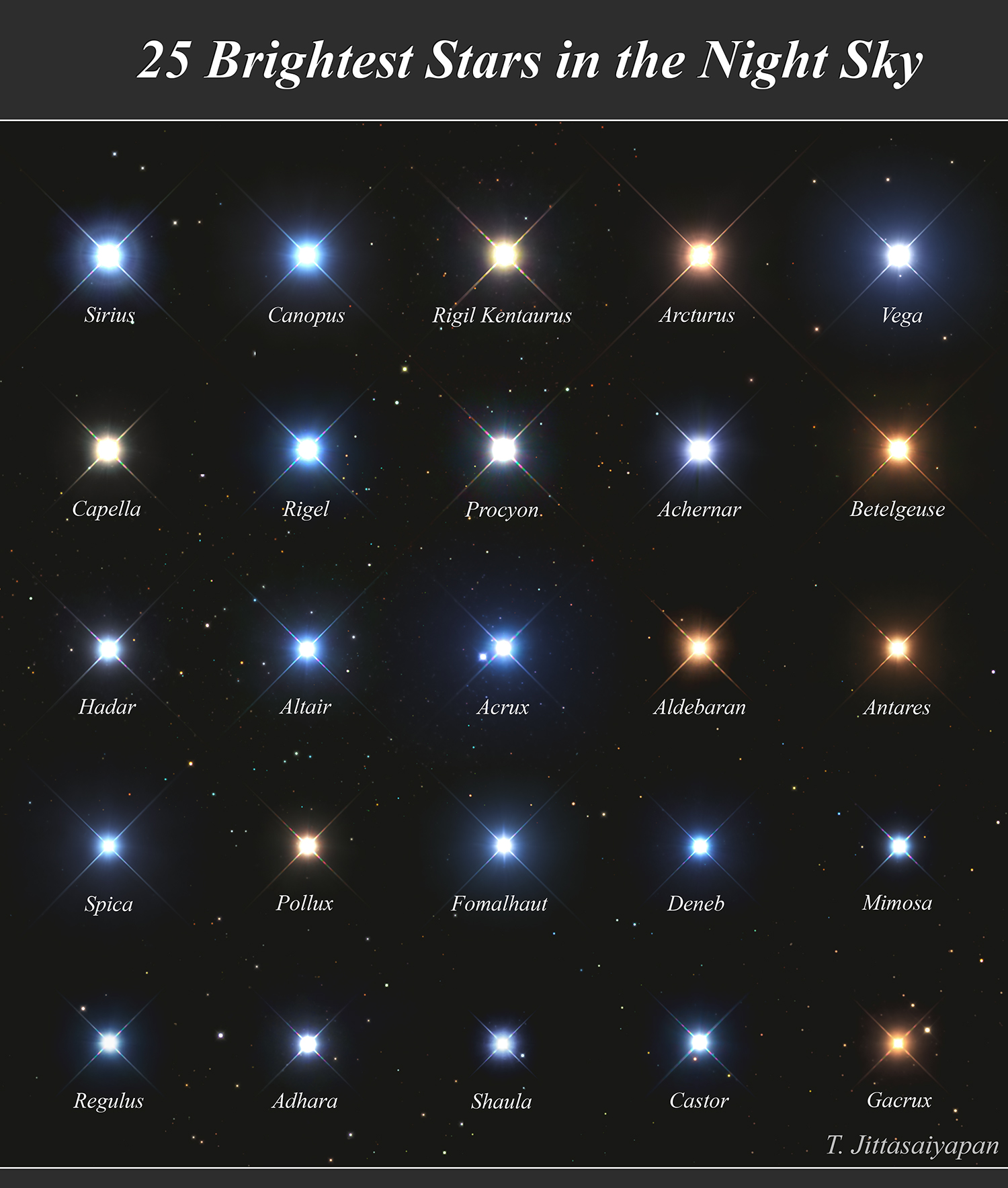
Explanation: Do you know the names of some of the brightest stars? It's likely that you do, even though some bright stars have names so old they date back to near the beginning of written language. Many world cultures have their own names for the brightest stars, and it is culturally and historically important to remember them. In the interest of clear global communication, however, the International Astronomical Union (IAU) has begun to designate standardized star names. Featured here in true color are the 25 brightest stars in the night sky, currently as seen by humans, coupled with their IAU-recognized names. Some star names have interesting meanings, including Sirius ("the scorcher" in Latin), Vega ("falling" in Arabic), and Antares ("rival to Mars" in Greek). You are likely even familiar with the name of at least one star too dim to make this list: Polaris.
For more detail go to the link and click on the image for a high definition image. You can then move the magnifying glass cursor then click to zoom in and click again to zoom out. When zoomed in you can scan by moving the side bars on the bottom and right side of the image.
How long before the IAU is called racist for standardizing on mostly Greek and Roman derived names?
Have to admit not having a clue about them.
Never took astronomy and still have a fit trying to find anything.
Actually, many of the star names are from Arabic.
Actually the Latin name Sirius is derived from the Greek name of the star, Seirios.
So as we were standing out by the street talking, I noticed
the blinking light of a 'airplane' in the night sky.
But after twenty minutes of so, I noticed that the plane's
blinking light had barely moved!
I mentioned this to my friend - who was an avid amateur
astronomer - and he laughed -"That's not a plane, that's
Arcturus! - It's a star!".
Actually it's a binary star - TWO stars in a rapid, tight
orbit around each other - hence the 'Twinkling' that makes
it look like a blinking airplane light.
It does a fast red-blue shift back and forth as it rotates.
So if you want to find Arcturus - look in the northern sky
for a bright twinkling star that looks very 'airplane-like'.
Video:
Actually the Latin name Sirius is derived from the Greek name of the star, Seirios.
>>>>>>>>>>>>>>>>>>>>>>>>>>>>>>>>>>>>>>>>>>>>>>>>
Isn’t Sirius referred to as the “Dog star”?
“Follow the arc to Arcturus.”

When astronomers discovered that Sirius has a white dwarf companion (Sirius B), it was nicknamed "the Pup."
The Dog Days of Summer got their name because it was thought that the position of Sirius in the sky in that part of the year was why the heat was so intense.
WWG1WGA
Garde la Foi, mes amis! Nous nous sommes les sauveurs de la République! Maintenant et Toujours!
(Keep the Faith, my friends! We are the saviors of the Republic! Now and Forever!)
LonePalm, le Républicain du verre cassé (The Broken Glass Republican)
Disclaimer: Opinions posted on Free Republic are those of the individual posters and do not necessarily represent the opinion of Free Republic or its management. All materials posted herein are protected by copyright law and the exemption for fair use of copyrighted works.