Posted on 10/18/2022 3:22:11 PM PDT by MtnClimber
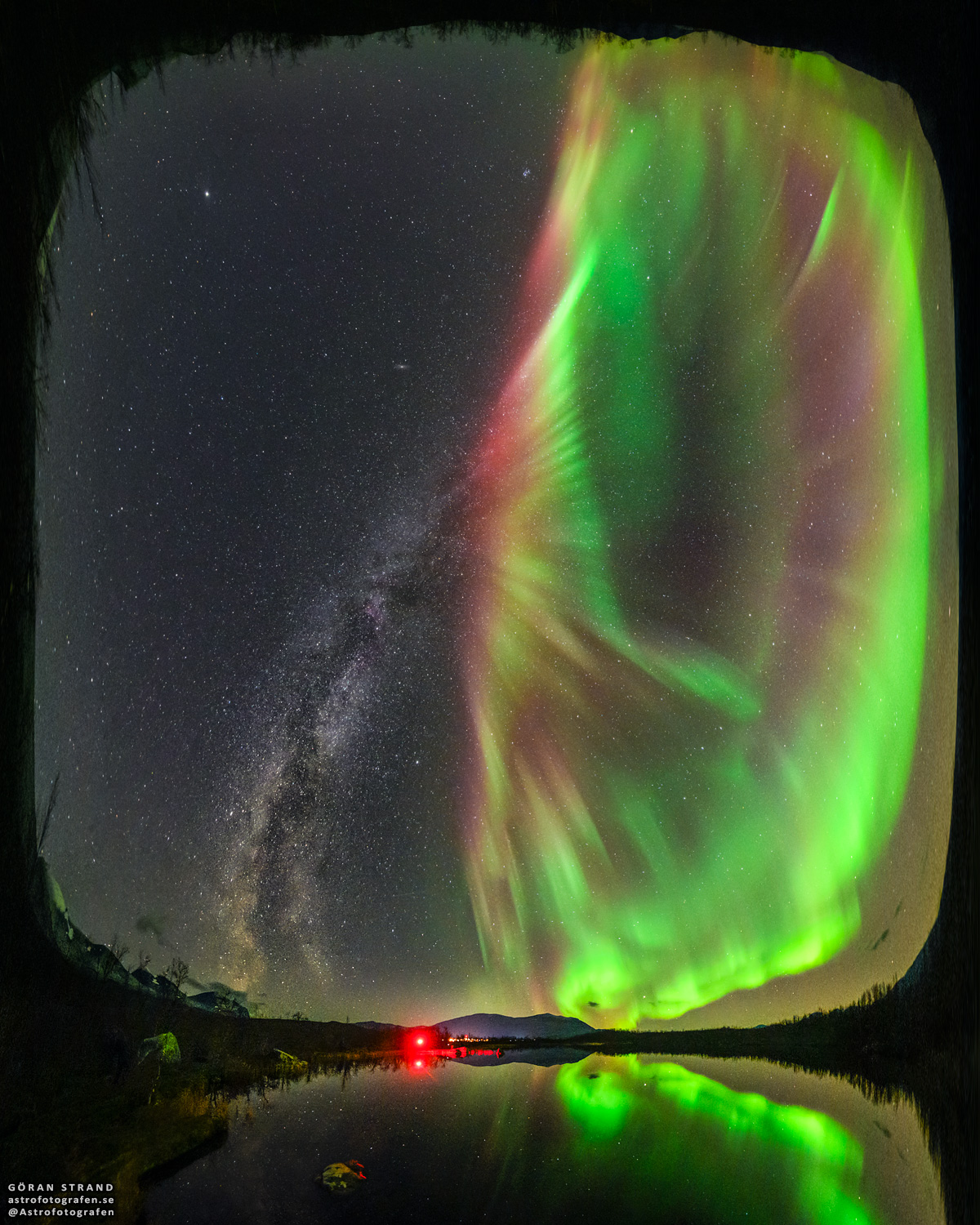
Explanation: Could the stem of our Milky Way bloom into an auroral flower? No, not really, even though it may appear that way in today’s featured all-sky image. On the left, the central plane of our home galaxy extends from the horizon past the middle of the sky. On the right, an auroral oval also extends from the sky's center -- but is dominated by bright green-glowing oxygen. The two are not physically connected, because the aurora is relatively nearby, with the higher red parts occurring in Earth's atmosphere only about 1000 kilometers high. In contrast, an average distance to the stars and nebulas we see in the Milky Way more like 1000 light-years away - 10 trillion times further. The featured image composite was taken in early October across a small lake in Abisko, northern Sweden. As our Sun's magnetic field evolves into the active part of its 11-year cycle, auroras near both of Earth's poles are sure to become more frequent.
For more detail go to the link and click on the image for a high definition image. You can then move the magnifying glass cursor then click to zoom in and click again to zoom out. When zoomed in you can scan by moving the side bars on the bottom and right side of the image.
From the little I know of auroras, they are caused by solar flares interacting with our atmosphere and they usually only last for a few minutes. They are a result of something happening now, in real time.
I am told with a James Webb Space Telescope, one could see back in time up to 0.3 Billion years, back when the first galaxies were forming! Amazing.
While it may be an optical illusion, what a beautiful one it is! Thanks for sharing with us.
Disclaimer: Opinions posted on Free Republic are those of the individual posters and do not necessarily represent the opinion of Free Republic or its management. All materials posted herein are protected by copyright law and the exemption for fair use of copyrighted works.