
Posted on 10/11/2022 4:41:38 PM PDT by nickcarraway
For the first time since 1952, wild cheetahs are living in India.
Eight of the big cats arrived Saturday from the southern African nation of Namibia.
They are part of a reintroduction program and will live in a large open space. Cheetahs once lived in India, but died out about 70 years ago. Scientists hope the cats will learn to hunt deer and other wild animals in the area. And they hope the cheetahs will reproduce.
The cheetahs coming to Africa are slightly different from the Asian ones which were widespread in India. Those died out due to hunting and human population growth. There are very few Asian cheetahs remaining, mostly in Iran.
Indian Prime Minister Narendra Modi released the cats into the wild on Saturday.
“When the cheetah will run again … grasslands will be restored, biodiversity will increase and eco-tourism will get a boost,” Modi said.
Nature experts hope that as more people learn about the cheetahs in India, they will be interested in working to save the grasslands on which they live.
India's Prime Minister Narendra Modi holds a camera after he released cheetahs following their translocation from Namibia, in Kuno National Park, Madhya Pradesh, India, September 17, 2022. (India's Press Information Bureau/Handout via REUTERS) India's Prime Minister Narendra Modi holds a camera after he released cheetahs following their translocation from Namibia, in Kuno National Park, Madhya Pradesh, India, September 17, 2022. (India's Press Information Bureau/Handout via REUTERS) In many countries, the places where cheetahs live are getting smaller and smaller due to human population growth and climate change. Cheetahs once lived throughout Africa, Asia and the Middle East, but now, however, they live on just 9 percent of that original land.
There are about 7,000 adult cheetahs in the world.
Laurie Marker is a researcher with the Cheetah Conservation Fund. She said she hopes the cheetahs can find an “appropriate” home in India. If they survive, spread out and have babies, the area where they live could support 21 cheetahs.
“To save cheetahs from extinction, we need to create permanent places for them on earth,” Marker said.
Cheetah Conservation Fund (CCF) Founder and Executive Director Dr. Laurie Marker and CCF cheetah specialist team prepare a cheetah for the translocation to India at the CCF centre in Otjiwarongo, Namibia, September 12, 2022. (Courtesy of Cheetah Conservation Fund/Handout via REUTERS) Cheetah Conservation Fund (CCF) Founder and Executive Director Dr. Laurie Marker and CCF cheetah specialist team prepare a cheetah for the translocation to India at the CCF centre in Otjiwarongo, Namibia, September 12, 2022. (Courtesy of Cheetah Conservation Fund/Handout via REUTERS) In South Africa, however, cheetahs are running out of space. So groups such as Marker’s are looking for new cheetah homes.
Four cheetahs recently captured in South Africa were sent to the East African country of Mozambique. Twelve cheetahs from South Africa are currently waiting to be sent to India’s Kuno National Park.
While many are celebrating the cheetah relocation project, others think it is too early in the project to form an opinion.
Mayuk Chatterjee is with the International Union for Conservation of Nature. He said there could be “unintended” effects of the move. “The question remains: How well it’s done.”
One concern is how the cheetahs will affect other animals such as hyenas, a kind of wild dog, or birds. Another is what will happen if the cheetahs do too well. People in India are currently worried about tigers. A fast rise in the population of the large cats has led to more tiger-human interactions.
The cheetahs from Namibia will wear tracking devices around their necks. They will start off in a smaller safe area for one month before they are released to a larger area. They will be living in the same area as deer and antelope. Scientists hope the cheetahs will learn how to hunt them. Other predators, such as bears and leopards, will not be able to get into the area.
The project is expected to cost more than $11 million. It includes relocating a small village on the edge of the cheetah area. About $6 million of the cost will be paid by state-run Indian Oil.
The African cheetahs are distant family members of the cheetahs that once lived in Asia. Early on, the hope was to bring in Asiatic cheetahs, but there are too few.
Cheetah Conservation Fund (CCF) Founder and Executive Director Dr. Laurie Marker and CCF cheetah specialist team prepare a cheetah for the translocation to India at the CCF centre in Otjiwarongo, Namibia, September 12, 2022. (Courtesy of Cheetah Conservation Fund/Handout via REUTERS) Cheetah Conservation Fund (CCF) Founder and Executive Director Dr. Laurie Marker and CCF cheetah specialist team prepare a cheetah for the translocation to India at the CCF centre in Otjiwarongo, Namibia, September 12, 2022. (Courtesy of Cheetah Conservation Fund/Handout via REUTERS) There are still concerns about whether the project will work. One expert thinks it would be better to work on saving the cheetahs where they live.
Pamela Burger studies conservation genetics at the University of Veterinary Medicine in Austria. She calls the future of the cheetahs in India “questionable” and says, “it would be better to conserve them now where they are…”
But another researcher, Adrian Tordiffe, said it has not been easy to keep the African cheetahs safe, and sometimes they need help to get to places where they can live more easily.
Tordiffe is an animal doctor and wildlife specialist who worked on the cheetah relocation project. He said India has shown an ability to keep large cats safe because of strong conservation laws. For example, the population of tigers has increased by almost 100 percent in the last 15 years.
“We cannot sit back and hope that species like the cheetah will survive on their own without our help,” he said.
I’m Dan Friedell.
Dan Friedell adapted this story for VOA Learning English based on a report by the Associated Press.
________________________________________________________________________
Words in This Story reintroduction –adj. the act of returning something to where it once was
biodiversity –n. the existence of many different types of plants or animals in an area
ecotourism –n. the practice of traveling to beautiful or natural places for pleasure, in a way that does not hurt the environment there
boost –v. to increase the power or force of something
appropriate –adj. right or suited for a purpose or situation
extinction –n. the result when something has died out completely
relocation –n. to move something to a new place
unintended –adj. not expected or not done on purpose
track –v. to follow something
predator –n. an animal that hunts and eats other animals
conservation –n. the act of taking care of plants and animals or the environment
species –n. a group of animals that are similar and can produce young
Sweet, now they can get killed by two different large predators...
I’m actually not sure if a human has been killed by a cheetah...
I think ancient Egyptians had them as pets. (royalty)
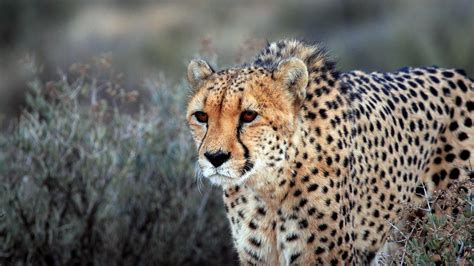
“ The cheetahs coming to Africa are slightly different from the Asian ones which were widespread in India. Those died out due to hunting and human population growth. There are very few Asian cheetahs remaining, mostly in Iran.”
Well they aren’t coming “to” Africa… and why they would transplant African cheetahs rather than Asian cheetah’s seems odd to me. Want to reintroduce then then why not at least import the “native” species?
THE WORLD DOES NOT NEED THESE KILLERS
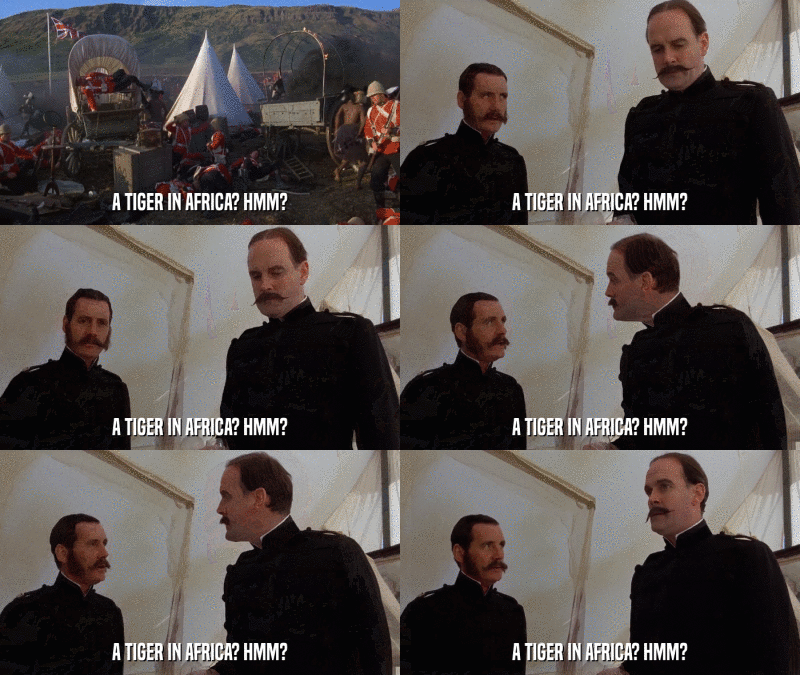
There is talk of reintroducing them to North America, they lived here until the end of the ice age (that’s why pronghorns are unnecessarily fast).
No, they are not dangerous to people and have been kept by Africans for hunting, similar to how falcons are used.
There is a lot of illegal traffic in cheetahs to Arabia where having one for a pet is seen as a status symbol for the wealthy.
Nice to see them back in India.

I thought cheetahs never prospered.
CC
Outdoors/Rural/wildlife/hunting/hiking/backpacking/National Parks/animals list please FR mail me to be on or off . And ping me is you see articles of interest.
That would be awesome.
At least not of humans.
Leopards, which are quite a different cat, are man killers but Cheetahs are not.

.
I met a mountain lion 'up close and personal' on Red Butte
in Douglass County, Oregon once a number of years ago.
While hiking - a wilderness area - alone - unarmed.
The technical term for the situation I was in is -
"Breathing while being abysmally STUPID."
But obviously the Good Lord had more work for me to do down here -
because I'm still here.
And no similar incidents of such massive 'over-the-top' stupidity
on my part have cropped up since. Luckily.
.
So go easy on the big cats Sacajaweau - maybe their part is to weed out
the really outrageously stupid people. Or to provide
'learning opportunities' for said stupid people.
Ya never know.
Hopefully this will help clean up their baboon and overpopulation problem......
Do I win???
Three* different large predators - in addition to tigers, India has a small number of native lions too.
That’s nothin’. We got a cheetah in the Whitehouse.
I had no idea they had any lions.
Disclaimer: Opinions posted on Free Republic are those of the individual posters and do not necessarily represent the opinion of Free Republic or its management. All materials posted herein are protected by copyright law and the exemption for fair use of copyrighted works.