Skip to comments.
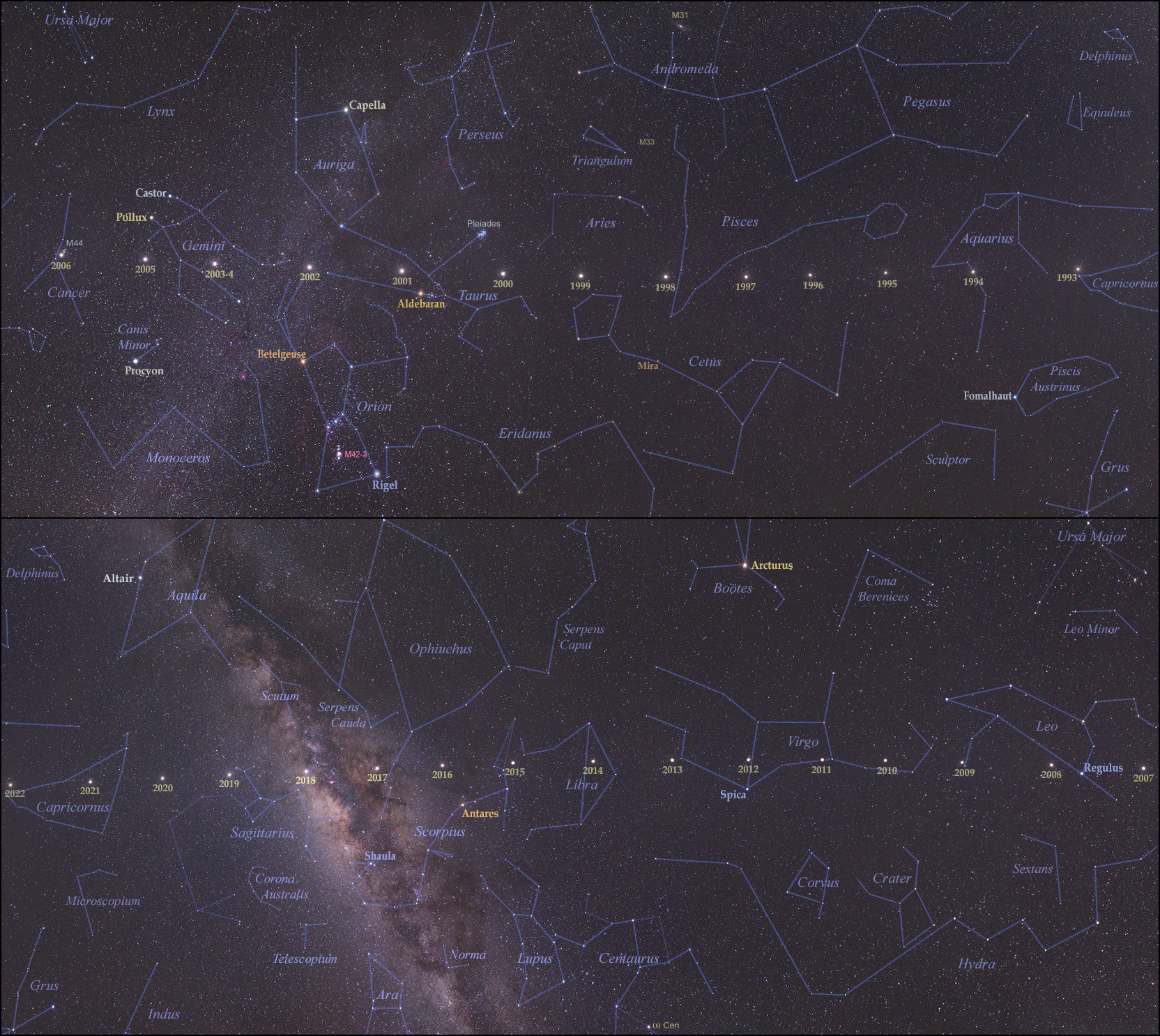
Astronomy Picture of the Day - Saturn: 1993 - 2022
APOD.NASA.gov ^
| 19 Aug, 2022
| Image Credit & Copyright: Tunc Tezel (TWAN)
Posted on 08/19/2022 2:13:28 PM PDT by MtnClimber
Explanation: Saturn is the most distant planet of the Solar System easily visible to the unaided eye. With this extraordinary, long-term astro-imaging project begun in 1993, you can follow the ringed gas giant for one Saturn year as it wanders once around the ecliptic plane, finishing a single orbit around the Sun by 2022. Constructed from individual images made over 29 Earth years, the split panorama is centered along the ecliptic and crossed by the plane of our Milky Way galaxy. Saturn's position in 1993 is at the right side, upper panel in the constellation Capricornus and progresses toward the left. It returns to the spot in Capricornus at left in the lower panel in 2022. The consistent imaging shows Saturn appears slightly brighter during the years 2000-2005 and 2015-2019, periods when its beautiful rings were tilted more face-on to planet Earth.
TOPICS: Astronomy; Astronomy Picture of the Day; Science
KEYWORDS: nasa
To be added or removed from the Astronomy Picture of the Day ping list please send me a request via "Private Reply" (Mail). For more detail go to the link and click on the image for a high definition image. You can then move the magnifying glass cursor then click to zoom in and click again to zoom out. When zoomed in you can scan by moving the side bars on the bottom and right side of the image.
To: MtnClimber
2
posted on
08/19/2022 2:13:54 PM PDT
by
MtnClimber
(For photos of Colorado scenery and wildlife, click on my screen name for my FR home page.)
To: 21stCenturion; 21twelve; 4everontheRight; abb; AFB-XYZ; AFPhys; America_Right; AZ .44 MAG; ...
Pinging the APOD list.
🪐 🌟 🌌 🍔
3
posted on
08/19/2022 2:14:35 PM PDT
by
MtnClimber
(For photos of Colorado scenery and wildlife, click on my screen name for my FR home page.)
To: MtnClimber
4
posted on
08/19/2022 2:18:15 PM PDT
by
DannyTN
To: MtnClimber
it's very difficult to make constellation drawings in space.
- They have to move with the earth
- but be synchronized so they remain lined up with the stars in the constellation.
- They have to be far enough away so that they appeared lined up with the constellation even when two people at opposite sides of the earth are viewing.
- Yet they have to be big enough that people can easily see there is a line there.
5
posted on
08/19/2022 2:22:29 PM PDT
by
DannyTN
To: DannyTN
- And they need to be out of the way of any known satellites, space craft, Space stations, or debris.
The last thing you want to see is some chinese space craft hitting Orion below the belt and warping your constellation drawing into "Oh My Balls".
6
posted on
08/19/2022 2:25:24 PM PDT
by
DannyTN
To: MtnClimber
7
posted on
08/19/2022 3:19:01 PM PDT
by
Larry Lucido
(Donate! Don't just post clickbait!)
To: DannyTN
The last thing you want to see is some chinese space craft hitting Orion below the belt and warping your constellation drawing into "Oh My Balls" Okay, now THAT made me laugh loud enough to scare the parrot. Heh.
8
posted on
08/19/2022 3:24:45 PM PDT
by
AFB-XYZ
(Stand up, or bend over)
To: DannyTN
it's very difficult to make constellation drawings in space. I think they must use colored string. They probably use knots that won't slip off.
9
posted on
08/19/2022 5:35:26 PM PDT
by
MtnClimber
(For photos of Colorado scenery and wildlife, click on my screen name for my FR home page.)
Disclaimer:
Opinions posted on Free Republic are those of the individual
posters and do not necessarily represent the opinion of Free Republic or its
management. All materials posted herein are protected by copyright law and the
exemption for fair use of copyrighted works.
FreeRepublic.com is powered by software copyright 2000-2008 John Robinson