Posted on 07/11/2022 2:22:26 PM PDT by MtnClimber
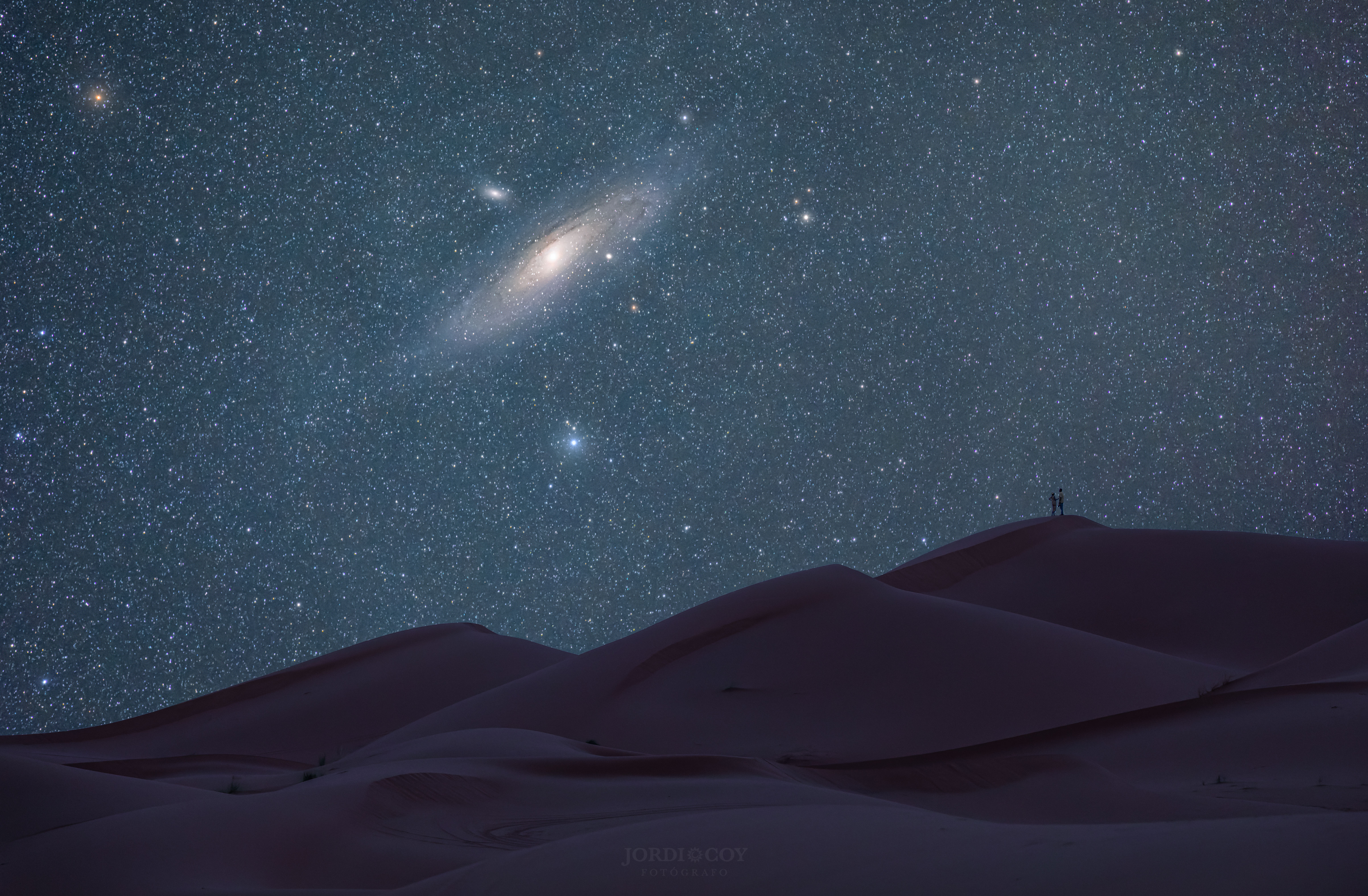
Explanation: What is the oldest thing you can see? At 2.5 million light years distant, the answer for the unaided eye is the Andromeda galaxy, because its photons are 2.5 million years old when they reach you. Most other apparent denizens of the night sky -- stars, clusters, and nebulae -- appear as they were only a few hundred to a few thousand years ago, as they lie well within our own Milky Way Galaxy. Given its distance, light from Andromeda is likely also the farthest object that you can see. Also known as M31, the Andromeda Galaxy dominates the center of the featured zoomed image, taken from the Sahara Desert in Morocco last month. The featured image is a combination of three background and one foreground exposure -- all taken with the same camera and from the same location and on the same calendar day -- with the foreground image taken during the evening blue hour. M110, a satellite galaxy of Andromenda is visible just above and to the left of M31's core. As cool as it may be to see this neighboring galaxy to our Milky Way with your own eyes, long duration camera exposures can pick up many faint and breathtaking details. Recent data indicates that our Milky Way Galaxy will collide and combine with the similarly-sized Andromeda galaxy in a few billion years.
For more detail go to the link and click on the image for a high definition image. You can then move the magnifying glass cursor then click to zoom in and click again to zoom out. When zoomed in you can scan by moving the side bars on the bottom and right side of the image.
Stunning.
very cool
But blatantly Photoshopped. No way in hell could you get such an image with M31 so close to the "horizon".
Spectacular!
I did not realize. I do not like photoshopping my images. As far as I take it is cropping else it’s not photography. My opinion.
I remember sighting from the north star, on a line through the center of Cassiopeia, and it would appear as a blur...
“Also known as M31, the Andromeda Galaxy dominates the center of the featured zoomed image, taken from the Sahara Desert in Morocco last month. The featured image is a combination of three background and one foreground exposure — all taken with the same camera and from the same location and on the same calendar day — with the foreground image taken during the evening blue hour”
This is art, not astrophotography. APOD should be careful to only show actual astrophotography or properly presented actual observatory or satellite obtained images... not “aesthetically” created astronomy related images like this one and all the too many other similar APODs.
Somewhere in Andromeda, an Andromedan is looking at the Milky Way above a neon orange desert.
Nice.
Part of my fascination with the stars is that’s the actual size of that galaxy in the sky. When you look up towards the big dipper where andromeda is, that’s what you’d see. The limitation being the light pollution, pollen and particulates in the atmosphere, and our eyes aren’t designed to collect light that way.
The california nebula loops all around the constellation orion, it’s HUGE. There’s so much out there if only we had the eyes, or the imagination I guess, to see it.
Of course it is. I don’t begrudge the photographer taking some artistic license.
Most of us know it’s photoshopped. It does add an air of fantasy, a science fiction type atmosphere.
It also shows off the photographer’s skills with his hardware and software.
I have two nice scopes, but I don’t have the skills or a camera capable of taking such a picture of M31. I wish I did.🔭🙂
I agree totally. Perhaps APOD could start a similar series parallel to this one, and call it, perhaps, AAPOD, or Artistic Astronomy Picture of the Day?
There are a lot of amateur astronomers who have their own websites and post numerous examples of their work, photoshopped or not.
They might get a lot more exposure to the general public and recognition for all their hard work and talent artistically, which would draw more people to their websites to see even more of their work.
Actually the farthest object you can see with your naked eyes is M33, which is about 3 million light years distance. The limit of human visibility is around +6.0 apparent magnitude, maybe +6.5 if you have very good eyes. M33 is +5.7, just barely within that.
This picture, however, is never something you would see with your own eyes, even under the best conditions. You would only see the core, the brightest part. The spiral arms are much dimmer and require something more. But if you could, they would be about 6 full moons across.
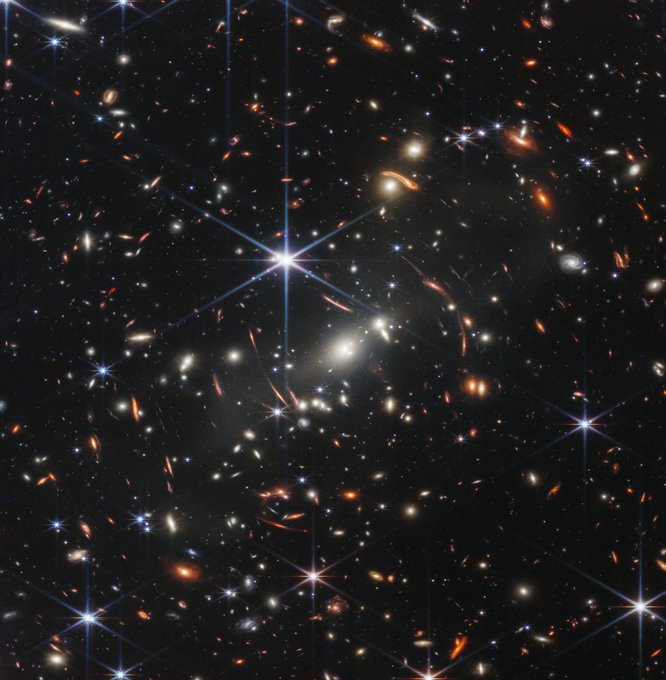
JWST’s first pic, way better.
https://twitter.com/DJSnM/status/1546623692683087872/photo/1
FR’s image posting is so broken, can someone else please embed?
Disclaimer: Opinions posted on Free Republic are those of the individual posters and do not necessarily represent the opinion of Free Republic or its management. All materials posted herein are protected by copyright law and the exemption for fair use of copyrighted works.