Posted on 01/03/2022 3:35:15 PM PST by MtnClimber
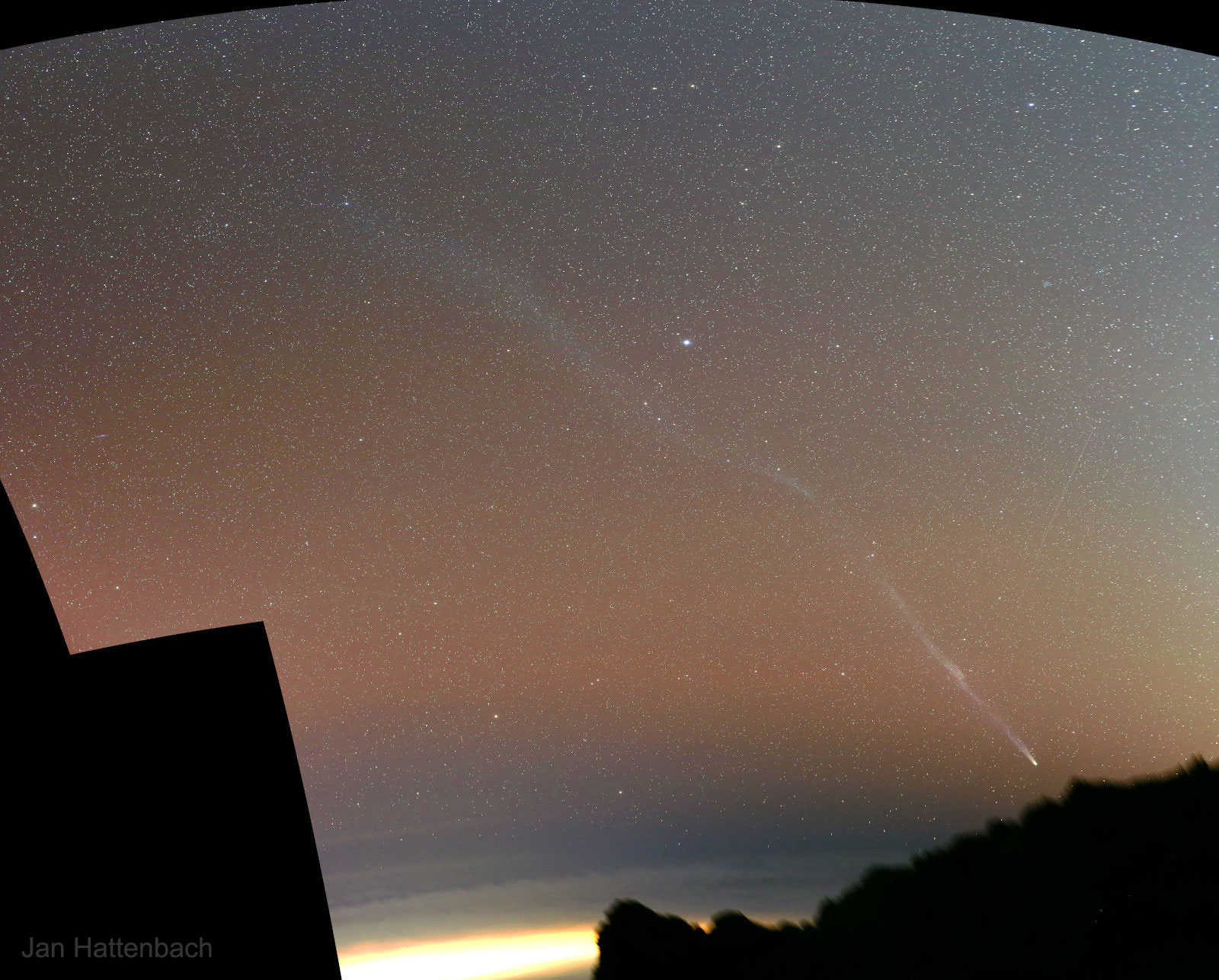
Explanation: You couldn't see Comet Leonard’s extremely long tail with a telescope — it was just too long. You also couldn't see it with binoculars — still too long. Or with your eyes -- it was too dim. Or from a city — the sky was too bright. But from a dark location with a low horizon — your camera could. And still might -- if the comet survives today's closest encounter with the Sun, which occurs between the orbits of Mercury and Venus. The featured picture was created from two deep and wide-angle camera images taken from La Palma in the Canary Islands of Spain late last month. Afterwards, if it survives, what is left of Comet Leonard's nucleus will head out of our Solar System, never to return.
For more detail go to the link and click on the image for a high definition image. You can then move the magnifying glass cursor then click to zoom in and click again to zoom out. When zoomed in you can scan by moving the side bars on the bottom and right side of the image.
Goodbye, Leonard. I'm glad I knew ya.
Magnificent! I was lucky enough to view Comet Leonard through a good pair of binoculars.
Comet Leonard will return. However, not for another 80,000 years.
the solar wind is crazy.
This could lead to...
Interesting how the tail shows the solar wind.
That is a battle damaged starship.
That’s one of my old bottle rockets from the late 70’s 🤪
Disclaimer: Opinions posted on Free Republic are those of the individual posters and do not necessarily represent the opinion of Free Republic or its management. All materials posted herein are protected by copyright law and the exemption for fair use of copyrighted works.