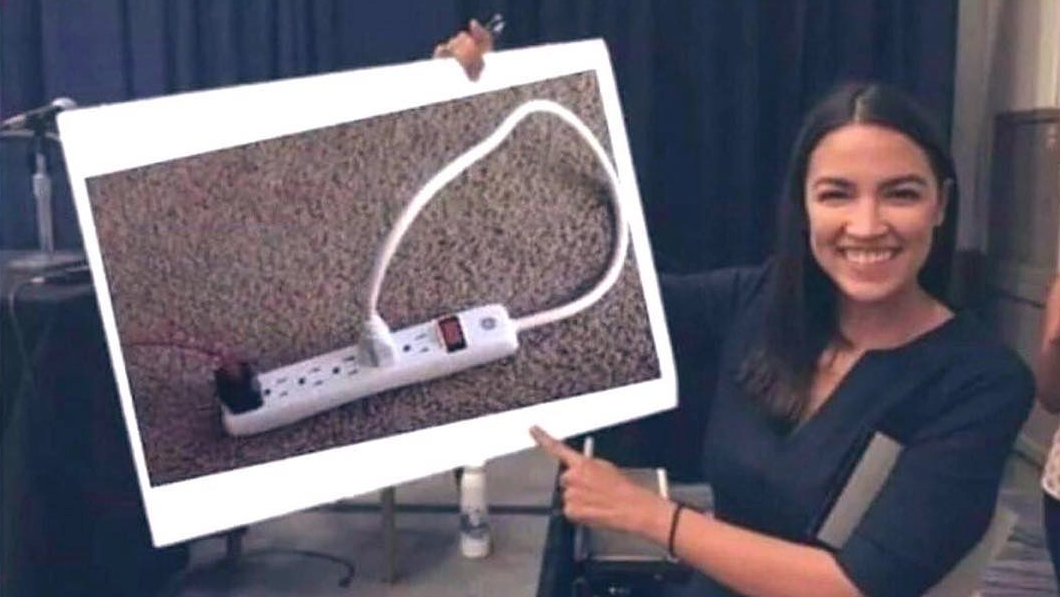
AOC has it all figured out!
Posted on 12/28/2021 8:40:56 AM PST by RicocheT
Compelling new evidence reveals a disconnect between the metrics used to analyze fuel costs and the realities that EV drivers face on the ground.
The More You Consider, the Worse EVs Look Again, the new research is just the first installment in a larger series, but its results are undeniably head-turning. The study found that:
Commercial charging rates are two to four times higher than residential rates.
Level 1 chargers cost an average of $600 to install and can take 20 hours to fully charge an EV.
Level 2 chargers are much faster but cost $1,600.
“Full charge” is a misleading term because charging past 90% is slow, difficult and unadvised, which means you get far fewer miles than the advertised ranges would have you believe. Gas vehicles, on the other hand, are good for 300-400 miles per tank.
Considering all of those factors, and presuming a greater reliance on commercial charging, it would cost $8.58 to fuel a mid-priced gas car that gets 33 mpg for 100 miles at $2.81 a gallon. Comparatively, a mid-priced EV — Tesla Model 3, Nissan Leaf or Chevy Bolt — would cost $12.95 per 100 miles.
Annually, presuming 12,000 miles driven, it would cost $1,030 to drive a gas car versus $1,554 for an EV.
This article originally appeared on GOBankingRates.com: Which Really Costs More: Charging an EV or Filling Up Your Tank With Gas?
(Excerpt) Read more at yahoo.com ...
In many ways, but the Coupflu goes one further in creating a false reason for mail out ballots and rigging elections.
I paid $2.85 in Alabama last night.
Where does the electricity for the charging stations come from?
Cost of charger should be added to vehicle cost. Compare initial costs and then separately compare ongoing costs.
They probably have good points but I would prefer a less biased apples to apples comparison. May sound like nitpicking but I am tired of biased or sloppyreporting from either side of this issue.
Even if costs were same there are so many EV problems that are years away from overcoming.
Even if EV’s were cheaper I would probably not buy one because I need a reasonable distance range or it’s a no go.
I’m wonderin’ where people buy gas for $2.81/gal.
” nor the risk of having a $22K battery needing replacing in 10+/- years.”
Tesla batteries are showing about 90% capacity after 200k miles or 9 years. Battery life can be extended by only replacing the few worst cells.
Elon says this should run $5k-$7k.
Older batteries should be good for 500k miles, newer one for 1,000,000 miles.
In November 2019, Hansjörg Gemmingen reached over 1 million kilometers (621,000 miles) with his 2013 Model S. The car was on its second battery, but the replacement battery was pre-owned. After 476,000 kilometers (300,000 miles) extra on the pre-owned battery, it had degraded 20 percent total. Gemmingen estimated that the battery had been used for 700,000 kilometers (435,000 miles) in total.
What does an EV let me do that I cannot do with an ICE vehicle?
We’ll be buying that juice from Russia shortly......
—
They will bring it in on the same ships they bring in natural gas ...
Proles having the freedom to travel away from where they should be working for the State.
A definite problem for the Slaveholders.
What problem? Liberal boredom.
The push for EV’s are just one piece of the big puzzle. They are also out to ban coal plants, natural gas, and nuclear power. They seem to think a world powered only by renewable fuel is possible. Whether it’s even possible is one thing to debate, but the reality is that it’s not necessary or even useful.
Ethanol is more harmful to the environment on almost every level and is very marginal to saving gasoline. In fact, I'm certain that using ethanol increases the cost of gasoline.
But here we are. Once again bamboozling everyone into thinking they are saving the planet when in fact they are doing far more harm.
Crazy.
That’s when the government steps and starts taxing the hell out of gasoline and ICE vehicles.
I paid $2.56/gallon in Houston yesterday, Exxon station. I paid $2.66/gallon at a Valero in Sherman Texas last week.
People notice when they see the price of their fill up as it is a separate charge each time. You just pay your electric bill each month and generally don’t question if it falls within a normal range for that time of year.
If two guys driving a new Ford truck - one gas and the other electric, both have respectively 1/2 tank and 1/2 charge, which one pays more and how long does the fill up take each one?
It is a very good article. Obviously, some of the numbers were dialed in before the Biden administration caused a huge increase in gasoline prices. But this varies greatly from state to state largely because of taxes. In Washington State when you add in the Federal excise taxes, we are currently paying over $1.20 per gallon and this is scheduled to go up again. Thanks a lot Gov. Dimsley and the Democrat majorities in both houses of our legislature.
Many other states are paying a fraction of that. So what we are seeing locally is not what other people in other parts of the country are experiencing.
One thing they haven’t taken into account is that, if EV use ever gest common, just ignoring all other problems (e.g. from where does the grid get all that electricity), electric cars pay no road tax at all. They are the equivalent of driving a diesel car or truck with “dyed” off road diesel which, thanks to no road taxes, is a LOT cheaper than what you get at a gas station. It’s 20 -30 cents cheaper per gallon, depending on your state.
When a lot of people get electrics, the free ride is over. They’ll probably add a mileage tax. This is problematic, though, for “plug in” hybrids. They may use this excuse to create a mileage tax for all vehicles.
I suspect we’d see something like the gasoline of Even/Odd days where you’d only be allowed to charge your car certain times of the week.
Disclaimer: Opinions posted on Free Republic are those of the individual posters and do not necessarily represent the opinion of Free Republic or its management. All materials posted herein are protected by copyright law and the exemption for fair use of copyrighted works.