Posted on 12/18/2021 4:17:57 PM PST by MtnClimber
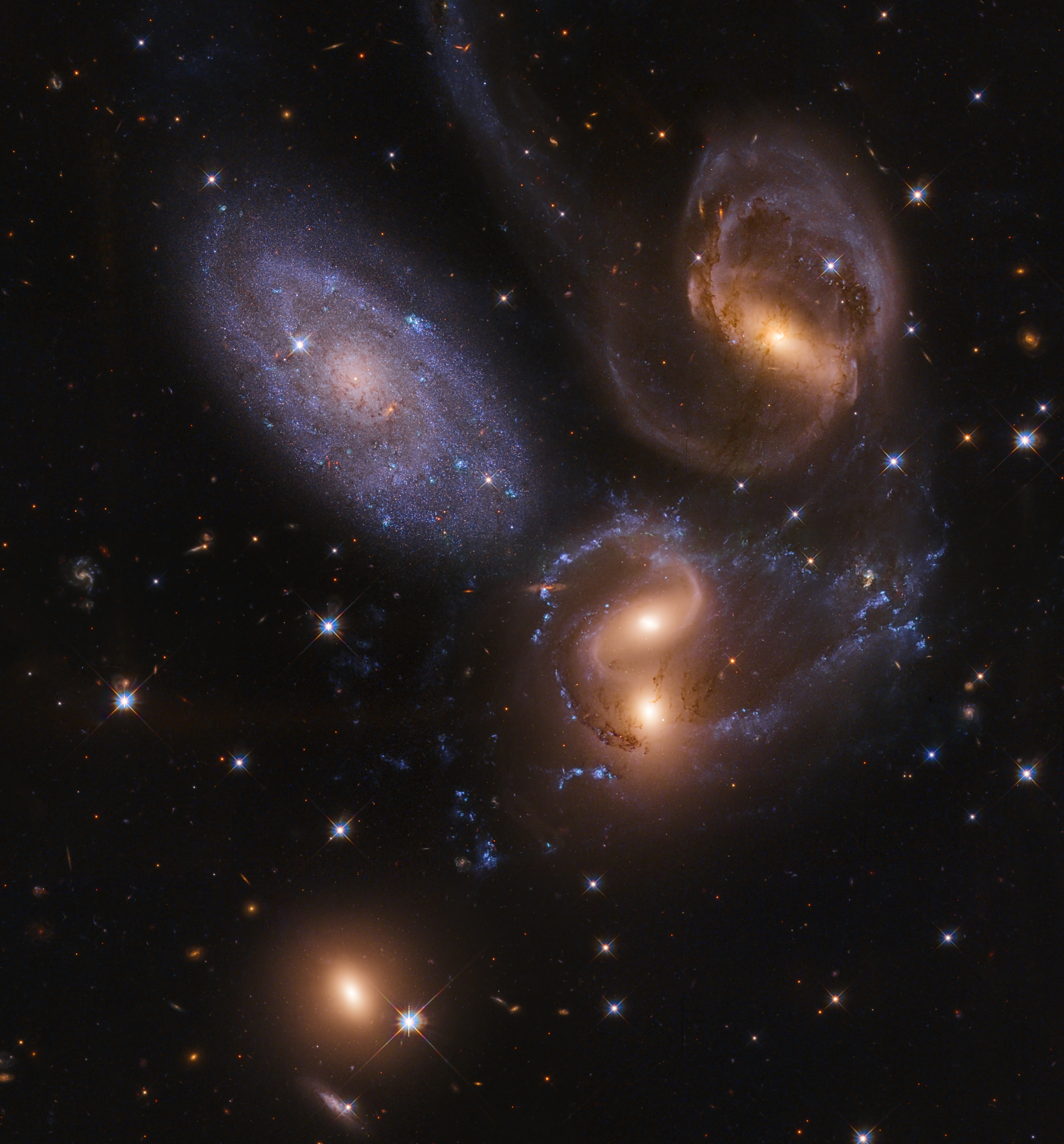
Explanation: The first identified compact galaxy group, Stephan's Quintet is featured in this eye-catching image constructed with data drawn from the extensive Hubble Legacy Archive. About 300 million light-years away, only four of these five galaxies are actually locked in a cosmic dance of repeated close encounters. The odd man out is easy to spot, though. The interacting galaxies, NGC 7319, 7318A, 7318B, and 7317 have an overall yellowish cast. They also tend to have distorted loops and tails, grown under the influence of disruptive gravitational tides. But the predominantly bluish galaxy, NGC 7320, is closer, just 40 million light-years distant, and isn't part of the interacting group. Stephan's Quintet lies within the boundaries of the high flying constellation Pegasus. At the estimated distance of the quartet of interacting galaxies, this field of view spans about 500,000 light-years. But moving just beyond this field, up and to the right, astronomers can identify another galaxy, NGC 7320C, that is also 300 million light-years distant. Including it would bring the interacting quartet back up to quintet status.
For more detail go to the link and click on the image for a high definition image. You can then move the magnifying glass cursor then click to zoom in and click again to zoom out. When zoomed in you can scan by moving the side bars on the bottom and right side of the image.
Beautiful!
Can you imagine what the night sky must look like from planets around stars in those galaxies?
Maybe a stupid question, but I’ve always wanted to ask, and perhaps someone here can clarify:
“Are the bright foreground (points) stars within the Milky Way, or are they something else in deep space?”
Thank You,
MM
Gala lights. Grand openings going om.
LOL .... that's great to hear :) As everything around here is closing (due to lockdown and such) ...
I can’t say absolutely, but certainly generally, if there are refraction spikes on a star’s image they are local to this galaxy.
The bright stars are “foreground”stars, stars in our galaxy. I can remember a fellow club member and myself took our astronomy club’s 18” dobsonion telescope out to our dark sky site, and actually seeing 4 of the 5 galaxies. One was too faint, I can’t remember which one it was, but it was pretty thrilling!
Wow ☄️
Didn’t they sing Oh Donna in the 1950s?
I checked out the “loops and tails” link expecting two kitties chasing each others’ tales... but found a fascinating tale of “the Mice,” two galaxies essentially at war. Thanks!
Disclaimer: Opinions posted on Free Republic are those of the individual posters and do not necessarily represent the opinion of Free Republic or its management. All materials posted herein are protected by copyright law and the exemption for fair use of copyrighted works.