Posted on 11/16/2021 3:19:30 PM PST by MtnClimber
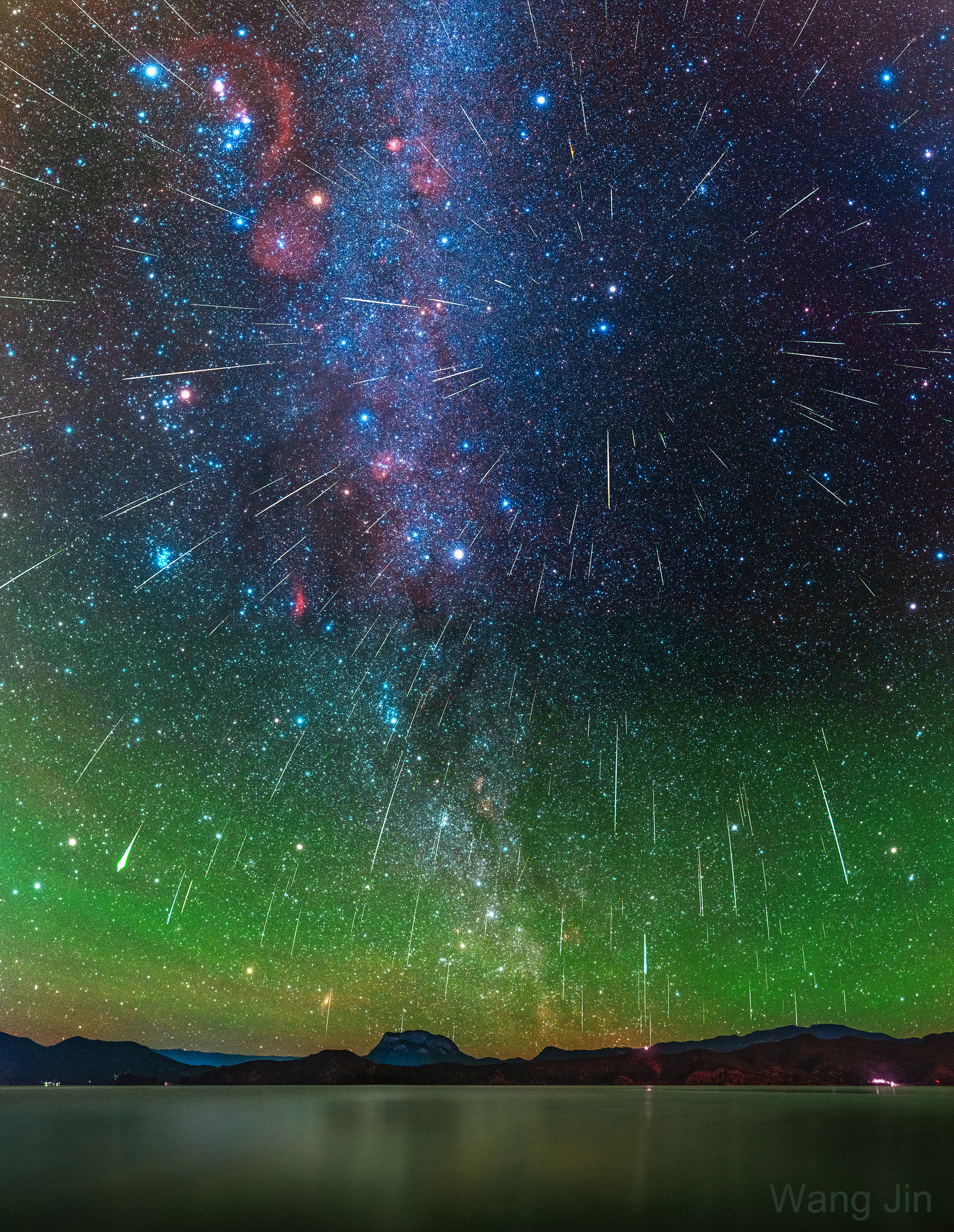
Explanation: Where are all of these meteors coming from? In terms of direction on the sky, the pointed answer is the constellation of Gemini. That is why the major meteor shower in December is known as the Geminids -- because shower meteors all appear to come from a radiant toward Gemini. Three dimensionally, however, sand-sized debris expelled from the unusual asteroid 3200 Phaethon follows a well-defined orbit about our Sun, and the part of the orbit that approaches Earth is superposed in front of the constellation of Gemini. Therefore, when Earth crosses this orbit, the radiant point of falling debris appears in Gemini. Featured here, a composite of many images taken during the 2020 Geminids meteor shower shows over 200 bright meteors that streaked through the sky during the night December 14. The best meteor shower in November, the Leonids, peaks tonight and tomorrow. Unfortunately, this year, dim meteors during the early-morning peak will be hard to see against a sky lit by a bright gibbous moon. Still, a few bright Leonid meteors should be visible each hour.
For more detail go to the link and click on the image for a high definition image. You can then move the magnifying glass cursor then click to zoom in and click again to zoom out. When zoomed in you can scan by moving the side bars on the bottom and right side of the image.
Incredibly beautiful. And amazing.
The bright star in the top left corner is Rigel in Orion. Orion's belt is easily visible. The bright red star nearby is Betelgeuse.
The bright star in the lower center is Capella in Auriga. The bright red star in the center left below Orion is Aldebaran in Taurus.
Meanwhile this Friday morning there will be an almost-total (97%) lunar eclipse. Altogether about 6 hours long with mid-point about 4 a.m. Eastern/3 a.m. Central/1 a.m. Pacific time.
I know I don't like it when my pillow needs fluffing.
Beautiful! Thanks for the description, I was having trouble picking Leo out of all that. I could easily see Orion. What throws me off is the huge amount of sky covered in the picture. Also, where I live the skies just don’t show that many stars. The constellations are easy enough to pick our, however. My hat is off to the photographer.
I don’t know if I’ll be able to get myself out of a warm bed, but I might!
Below is a bit of a close up of M42 I captured a few nights ago. This nebula is about 1300 light years from us.

I want to in a area with dark skies to see such a show.
That is a nice photo!
Thanks, I just made some adjustments to the scope and I’m pretty happy with it.
Disclaimer: Opinions posted on Free Republic are those of the individual posters and do not necessarily represent the opinion of Free Republic or its management. All materials posted herein are protected by copyright law and the exemption for fair use of copyrighted works.