
Posted on 10/20/2021 4:48:38 AM PDT by Oshkalaboomboom
ON almost every day of the year, the beach at La Herradura is a pleasant place for holidaymakers. But a large shorefront sculpture of a sailor in distress recalls an historic event when this same beach saw disaster, destruction and death.
In October 1562, 28 galleys put into the horseshoe-shaped bay that gives the town its name to shelter from strong easterly winds. The ships were filled with soldiers and their families, and supplied for an expedition against the powerful Ottoman Empire.
Double-anchored along the eastern shore, experienced commander Don Juan Hurtado de Mendoza y Carrillo thought his fleet was safe. He had sat out similar storms in this haven twice before. But the winds shifted to the south during the night and high seas started to throw the fragile galleys against each other and the jagged rocks of the headland now called Punta de la Mona.
Of the 28 galleys, 25 were lost, with only the three ships on the extreme seaward side of the fleet – the Mendoza, Sovereign and San Juan – able to round the headland and find the protection of Los Berengueles bay. Soldiers and sailors, with their heavy armour, boots and clothing, were helpless in the strong seas and the death toll was as much as 5,000. (Chroniclers of the time differed in whether or not they included women and slaves among the recorded deaths.)
Only 2,000 survivors made it to the beach through the strong surf and maelstrom of wreckage. Mendoza himself drowned after being hit by a piece of timber when he tried to swim ashore after an unsuccessful attempt to beach his flagship. Of his own crew, only the pilot, nine sailors and 13 galley slaves survived.
The losses included “…Don Alonso de Marañón, knight of the town of Santiago, who drowned in La Herradura…”, as recorded by Miguel de Cervantes in Don Quixote.
Bodies washed up on the beach for the next few weeks and were buried in a mass pit in the sand before having to be cremated after they were washed out again by other storms.
The galley slaves, physically strong and near-naked for their backbreaking work on the oars, made up the majority of the survivors. But, in the harsh winter weather, their misery was just beginning. Desperate and hungry, without clothes or shoes, they roamed the coast looking for help.
However, local resources were not up to the task of feeding or controlling such a large body of enslaved enemies. Months passed before those still alive were recaptured and sent back to the galleys.
In the centuries since, with the shifting of winds, tides and sands, the exact location of the wrecks have become less and less uncertain. Divers still search the bottom in the chance of finding some trace of the galleys, or their crews, but this fine bronze by sculptor Miguel Moreno Romera is the only lasting marker of this tragedy.
https://hdnh.es/el-desastre-naval-de-la-herradura/
See……this is what happen when you don’t check the weather.channel app on your phone.
Beautiful place...thanks for the post.
Wow. One of those “the rest of the story” stories we don’t hear much about.
Beautiful location thanks for posting.

Powerful and well done in my opinion! This was part of the ongoing actions by the Christian Mediterranean Nations against the Ottoman Empire that led to the 1571 Christian victory at Lepanto.
For a "rest of the rest of the story" bit of trivia, the part of the article about the misery of the galley slaves due to the harsh winter in a load of bull. I just came in from working in the garden and I'm wearing shorts and a t-shirt. It has been in the high 70's to low 80's all month and in the 6 years I've lived here it has never come close to freezing. I grow peppers in pots on my terrace and they stay outside all winter.
The galley slaves would have been hungry, thirsty and maybe even naked as mentioned but if they died it wouldn't be from the cold. Even Greta Thuneburg couldn't dream up a scenario where the Costa Tropical would go from frozen white wasteland to the weather it has today in 400 years.
Another little bit of trivia is that this is the only part of Spain where the mountains come right down to the sea. That's the rocks the ships got dashed on. Today it makes it so you can have a nice sea view without having to buy a house right on the beach. Here is a view from our terrace:
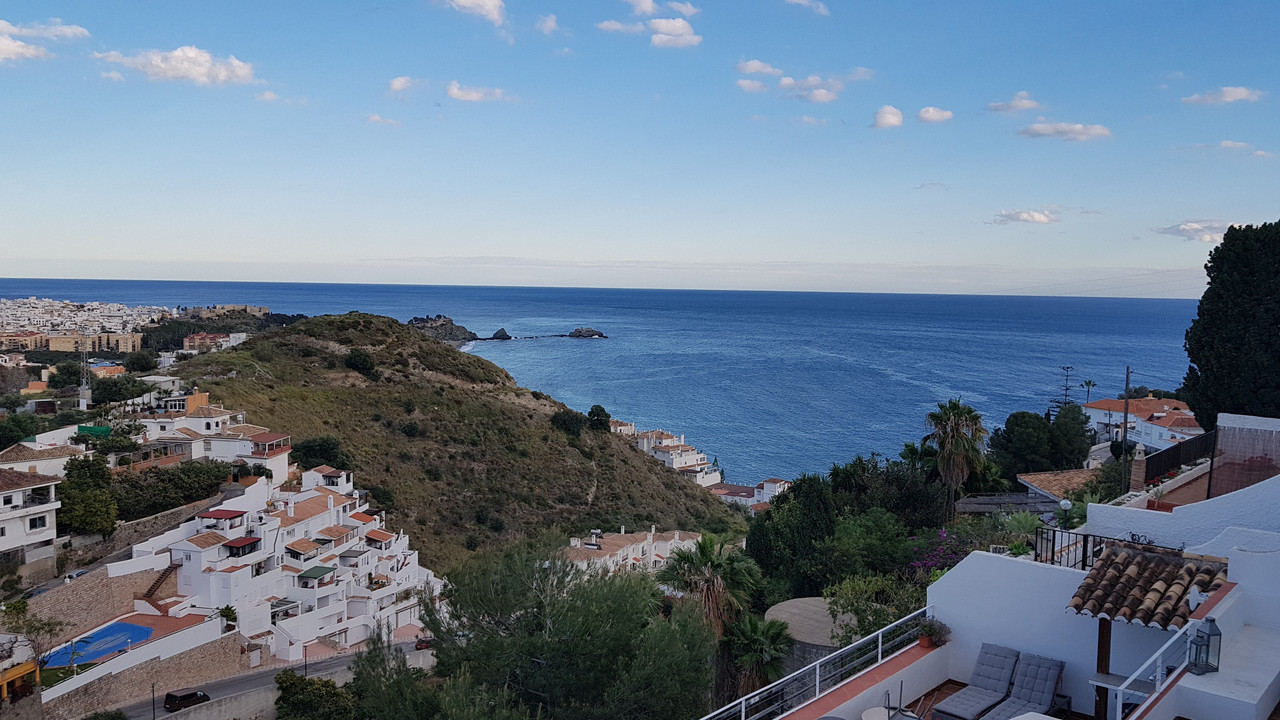
See those 3 rocks jutting out to sea? That marks the location of the old harbor and it also is where in 755 Umayyad Abd ar-Rahman I of Damascus, the founder of the Emirate of Cordoba, arrived from North Africa to establish his kingdom. There is a statue of him at the base of the rock. His relatives are the people who built the Alhambra in Granada, about an hour's drive away from here. The Arab name al-Munakkab, surrounded by mountains, gave origin to the present-day name of Almuñécar. On the top of the rock closest to shore is a huge cross which is lit up at night so it can be seen far out to sea. That was put up to commemorate the expulsion of the dynasty from that same spot by Ferdinand and Isabella in 1489. The cross on top and the statue below also symbolize the victory of Christianity over Islam. We have a lot of history in this area even if you don't count the Naval Disaster.
Disclaimer: Opinions posted on Free Republic are those of the individual posters and do not necessarily represent the opinion of Free Republic or its management. All materials posted herein are protected by copyright law and the exemption for fair use of copyrighted works.