Posted on 06/17/2021 4:09:50 PM PDT by MtnClimber
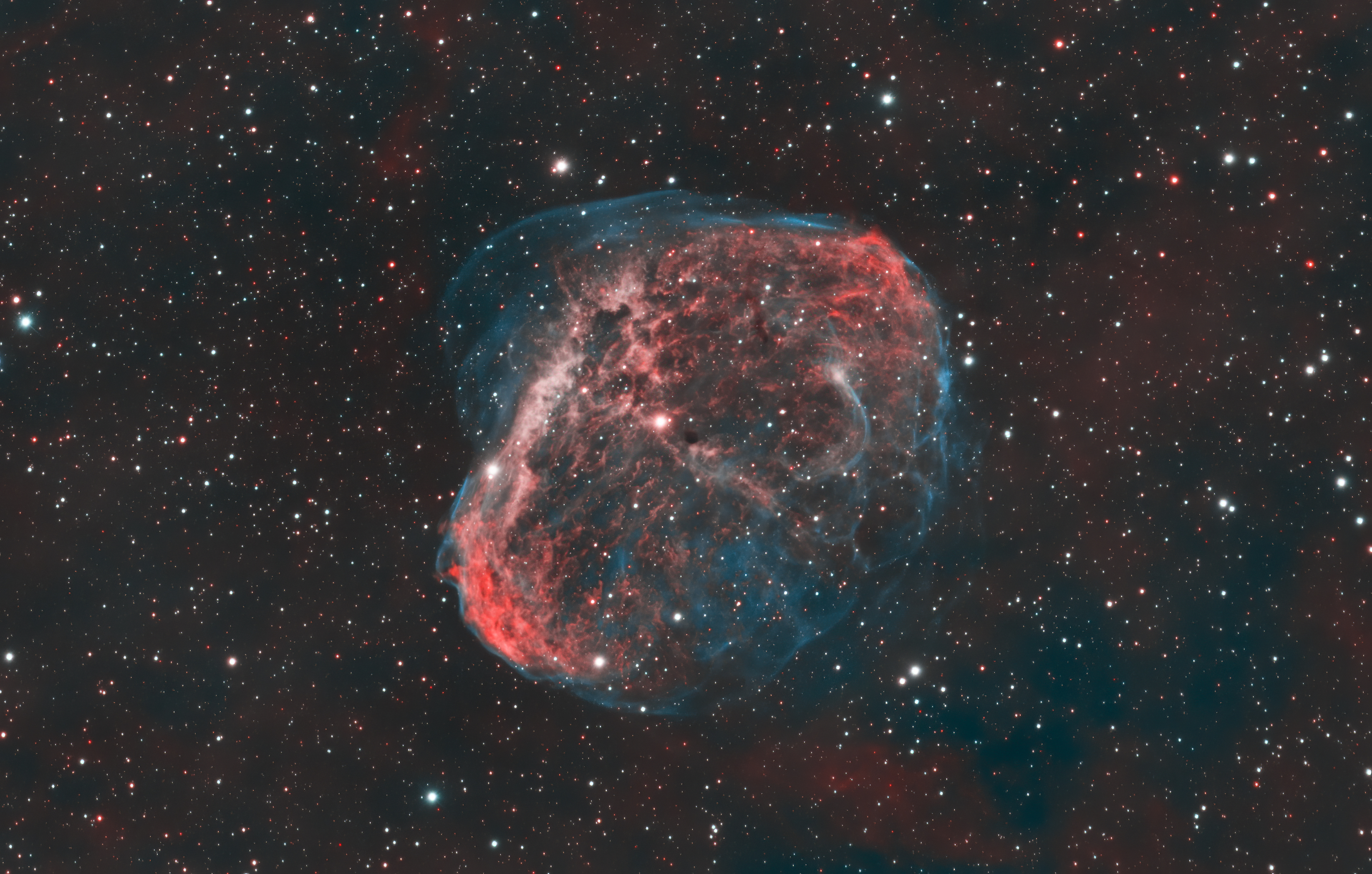
Explanation: NGC 6888, also known as the Crescent Nebula, is a about 25 light-years across blown by winds from its central, bright, massive star. A triumvirate of astroimagers ( Joe, Glenn, Russell) created this sharp portrait of the cosmic bubble. Their telescopic collaboration collected over 30 hours of narrow band image data isolating light from hydrogen and oxygen atoms. The oxygen atoms produce the blue-green hue that seems to enshroud the detailed folds and filaments. Visible within the nebula, NGC 6888's central star is classified as a Wolf-Rayet star (WR 136). The star is shedding its outer envelope in a strong stellar wind, ejecting the equivalent of the Sun's mass every 10,000 years. The nebula's complex structures are likely the result of this strong wind interacting with material ejected in an earlier phase. Burning fuel at a prodigious rate and near the end of its stellar life this star should ultimately go out with a bang in a spectacular supernova explosion. Found in the nebula rich constellation Cygnus, NGC 6888 is about 5,000 light-years away.
For more detail go to the link and click on the image for a high definition image. You can then move the magnifying glass cursor then click to zoom in and click again to zoom out. When zoomed in you can scan by moving the side bars on the bottom and right side of the image.
Nehemiah 9:6
New International Version
6 You alone are the LORD. You made the heavens, even the highest heavens, and all their starry host, the earth and all that is on it, the seas and all that is in them. You give life to everything, and the multitudes of heaven worship you.
Hard to accept that atheists think all this happened by random molecular motion and just happened to turn out this way.
For such majesty and even things like the colors of miles of trees in the autumn, book author and Catholic radio host on EWTN Teresa Tomeo says "It's God showing off again."
Mmmmmmmmmmm, crescents
So you are saying that the Crescent Nebula is God blowing bubbles...? : )
Now I’m hungry, and it’s your fault! :-)
God is owed all the glory. Seeing such wonders makes me lift up praise to God in my heart.
It’s only 25 light years across. It’s a very tiny whiff of a bubble in space.
This one is a hard one to see visually, but, it can be done with an OIII filter.
Nearby is the star P Cyg. It’s a variable star and when in it’s bright phase, is probably the furthest star you can see naked-eye at 6,000 ly. Everything in the night sky that you can see as a star is closer.
Disclaimer: Opinions posted on Free Republic are those of the individual posters and do not necessarily represent the opinion of Free Republic or its management. All materials posted herein are protected by copyright law and the exemption for fair use of copyrighted works.