
Posted on 03/30/2021 5:54:03 AM PDT by Homer_J_Simpson


Continued from March 2 (reply #5)
https://freerepublic.com/focus/f-chat/3938855/posts#5


James Lee McDonough, William Tecumseh Sherman: In the Service of My Country, A Life

With Lincoln in the White House: Letters, Memoranda, and Other Writings of John G. Nicolay, 1860-1865, edited by Michael Burlingame


Mary Chesnut’s Diary, Edited by Isabella D. Martin and Myrta Lockett Avary
CINCINNATI, April 2, 1861.
DEAR UNCLE: — Before this reaches you, you will no doubt learn that the Union-saving avalanche has overtaken us, and that my little potato patch went down with the rest. To prevent a general break-up of the Fusion, both wings agreed as far as possible, to vote an open ticket without scratching. By the aid of oceans of money and a good deal of sincere patriotism in behalf of Union, the plan was carried out with perfect success. It did not in the least disappoint me.
Now, what to do next and how to begin? My term expires next Monday. I shall keep my eyes open, and meditate making you a short visit before finally settling. I have enough cash on hand, or available, to support me for a year, even if I should fail to get business enough to do it, which I do not anticipate. Nothing unpleasant has occurred in the whole course of the canvass. I am quite as well content as one who has drawn a blank ever is, or can be.
R. B. HAYES.
S. BIRCHARD.
SOURCE: Charles Richard Williams, editor, Diary and Letters of Rutherford Birchard Hayes, Volume 2, p. 8
https://civilwarnotebook.blogspot.com/2014/03/rutherford-b-hayes-to-sardis-birchard_23.html
CHARLESTON, April 2, 1861.
We arrived here yesterday morning and I find very little change in the appearance of things since we were here eighteen months ago. You meet a good many soldiers, but that is about the only difference. The people are all strongly in hopes that Fort Sumter will be evacuated very soon. Some think to-day, and that the reason why it has been put off so long was on account of the New England elections. Your father has gone down to-day to visit the fortifications and has had the Lady Davis put at his command.
SOURCE: Louise Wigfall Wright, A Southern Girl in ’61, p. 35
https://civilwarnotebook.blogspot.com/2015/06/diary-of-louise-wigfall-april-2-1861.html
The following day I started early, and performed my pilgrimage to “the shrine of St. Washington,” at Mount Vernon, as a foreigner on board called the place. Mr. Bancroft has in his possession a letter of the General's mother, in which she expresses her gratification at his leaving the British army in a manner which implies that he had been either extravagant in his expenses or wild in his manner of living. But if he had any human frailties in after life, they neither offended the morality of his age, nor shocked the susceptibility of his countrymen; and from the time that the much maligned and unfortunate Braddock gave scope to his ability, down to his retirement into private life, after a career of singular trials and extraordinary successes, his character acquired each day greater altitude, strength, and lustre. Had his work failed, had the Republic broken up into small anarchical states, we should hear now little of Washington. But the principles of liberty founded in the original Constitution of the colonies themselves, and in no degree derived from or dependent on the Revolution, combined with the sufferings of the Old and the bounty of nature in the New World to carry to an unprecedented degree the material prosperity, which Americans have mistaken for good government, and the physical comforts which have made some States in the Union the nearest approach to Utopia. The Federal Government hitherto “let the people alone” and they went on their way singing and praising their Washington as the author of so much greatness and happiness. To doubt his superiority to any man of woman born, is to insult the American people. They are not content with his being great — or even greater than the great: he must be greatest of all; — “first in peace, and first in war.” The rest of the world cannot find fault with the assertion, that he is “first in the hearts of his countrymen.” But he was not possessed of the highest military qualities, if we are to judge from most of the regular actions, in which the British had the best of it; and the final blow, when Cornwallis surrendered at Yorktown, was struck by the arm of France, by Rochambeau and the French fleet, rather than by Washington and his Americans. He had all the qualities for the work for which he was designed, and is fairly entitled to the position his countrymen have given him as the immortal czar of the United States. His pictures are visible everywhere — in the humblest inn, in the Minister's bureau, in the millionnaire's gallery. There are far more engravings of Washington in America than there are of Napoleon in France, and that is saying a good deal.
What have we here? The steamer which has been paddling down the gentle current of the Potomac, here a mile and more in breadth, banked in by forest, through which can be seen homesteads and white farm-houses, in the midst of large clearings and corn-fields — has moved in towards a high bluff, covered with trees, on the summit of which is visible the trace of some sort of building — a ruined summer-house, rustic temple — whatever it may be; and the bell on deck begins to toll solemnly, and some of the pilgrims uncover their heads for a moment. The boat stops at a rotten, tumbledown little pier, which leads to a waste of mud, and a path rudely cut through the wilderness of briers on the hill-side. The pilgrims, of whom there are some thirty or forty, of both sexes, mostly belonging to the lower classes of citizens, and comprising a few foreigners like myself, proceed to climb this steep, which seemed in a state of nature covered with primeval forest, and tangled weeds and briers, till the plateau, on which stands the house of Washington and the domestic offices around it, is reached. It is an oblong wooden house, of two stories in height, with a colonnade towards the river face, and a small balcony on the top and on the level of the roof, over which rises a little paltry gazebo. There are two windows, a glass door at one end of the oblong, and a wooden alcove extending towards the slave quarters, which are very small sentry-box huts, that have been recently painted, and stand at right angles to the end of the house, with dog-houses and poultry-hutches attached to them. There is no attempt at neatness or order about the place; though the exterior of the house is undergoing repair, the grass is unkempt, the shrubs untrimmed, — neglect, squalor, and chicken feathers have marked the lawn for their own. The house is in keeping, and threatens to fall to ruin. I entered the door, and found myself in a small hall, stained with tobacco juice. An iron railing ran across the entrance to the stairs. Here stood a man at a gate, who presented a book to the visitors, and pointed out the notice therein, that “no person is permitted to inscribe his name in this book who does not contribute to the Washington Fund, and that any name put down without money would be erased.” Notwithstanding the warning, some patriots succeeded in recording their names without any pecuniary mulct, and others did so at a most reasonable rate. When I had contributed in a manner which must have represented an immense amount of Washingtoniolatry, estimated by the standard of the day, I was informed I could not go up-stairs as the rooms above were closed to the public, and thus the most interesting portion of the house was shut from the strangers. The lower rooms presented nothing worthy of notice —some lumbering, dusty, decayed furniture; a broken harpsichord, dust, cobwebs — no remnant of the man himself. But over the door of one room hung the key of the Bastille.* The gardens, too, were tabooed; but through the gate I could see a wilderness of neglected trees and shrubs, not unmingled with a suspicion of a present kitchen-ground. Let us pass to the Tomb, which is some distance from the house, beneath the shade of some fine trees. It is a plain brick mausoleum, with a pointed arch, barred by an iron grating, through which the light penetrates a chamber or small room containing two sarcophagi of stone. Over the arch, on a slab let into the brick, are the words: “Within this enclosure rest the remains of Gen. George Washington.” The fallen leaves which had drifted into the chamber rested thickly on the floor, and were piled up on the sarcophagi, and it was difficult to determine which was the hero's grave without the aid of an expert, but there was neither guide nor guardian on the spot. Some four or five gravestones, of various members of the family, stand in the ground outside the little mausoleum. The place was most depressing. One felt angry with a people whose lip service was accompanied by so little of actual respect. The owner of this property, inherited from the “Pater Patriӕ,” has been abused in good set terms because he asked its value from the country which has been so very mindful of the services of his ancestor, and which is now erecting by slow stages the overgrown Cleopatra's needle that is to be a Washington Monument when it is finished. Mr. Everett has been lecturing, the Ladies' Mount Vernon Association has been working, and every one has been adjuring everybody else to give liberally; but the result so lately achieved is by no means worthy of the object. Perhaps the Americans think it is enough to say — “Si monumentum quӕris, circumspice" But, at all events, there is a St. Paul's round those words.
On the return of the steamer I visited Fort Washington, which is situated on the left bank of the Potomac. I found everything in a state of neglect — gun-carriages rotten, shot piles rusty, furnaces tumbling to pieces. The place might be made strong enough on the river front, but the rear is weak, though there is low marshy land at the back. A company of regulars were on duty. The sentries took no precautions against surprise. Twenty determined men, armed with revolvers, could have taken the whole work; and, for all the authorities knew, we might have had that number of Virginians and the famous Ben McCullough himself on board. Afterwards, when I ventured to make a remark to General Scott as to the carelessness of the garrison, he said: “A few weeks ago it might have been taken by a bottle of whiskey. The whole garrison consisted of an old Irish pensioner.” Now at this very moment Washington is full of rumors of desperate descents on the capital, and an attack on the President and his Cabinet. The long bridge across the Potomac into Virginia is guarded, and the militia and volunteers of the District of Columbia are to be called out to resist McCullough and his Richmond desperadoes.
* Since borrowed, it is supposed, by Mr. Seward, and handed over by him to Mr. Stanton. Lafayette gave it to Washington; he also gave his name to the Fort which has played so conspicuous a part in the war for liberty — “La liberté des deux mondes,” might well sigh if he could see his work, and what it has led to.
SOURCE: William Howard Russell, My Diary North and South, p. 55-9
https://civilwarnotebook.blogspot.com/2015/04/diary-of-william-howard-russell-monday.html
Today’s posts:
“William Tecumseh Sherman: In the Service of My Country,” reply #22 (excerpts from this book today and tomorrow are to set up the April 4 excerpt which derives from a letter written on that date - HJS)
John G. Nicolay, #23
Mary Boykin Chesnut, #24
Letters from Rutherford B. Hayes and Charlotte Wigfall (wife of ex-Senator Wigfall) and William Howard Russell’s diary entry, #25.
I just noticed I cut off the last line of the footnote from Mary B. Chesnut’s diary entry (reply #24) about Gov. Means. He was killed at 2nd Bull Run.
The tension is getting to me. How much longer before something breaks?


James Lee McDonough, William Tecumseh Sherman: In the Service of My Country, A Life

Mary Chesnut’s Diary, Edited by Isabella D. Martin and Myrta Lockett Avary
Colonel Joseph G. Totten to Simon Cameron, April 3, 1861 (Long memo from U.S. Army Chief Engineer to War Sec. advising surrender of Forts Sumter and Pickens)
https://civilwarnotebook.blogspot.com/2016/09/colonel-joseph-g-totten-to-simon.html
Gustavus V. Fox to Dr. Lowery, April 3, 1861 (“War will commence at Pensacola.” Everybody is a prophet.)
https://civilwarnotebook.blogspot.com/2018/04/gustavus-v-fox-to-dr-lowery-april-3-1861.html
Captain Truman Seymour & Lieutenant George W. Snyder to Major Robert Anderson, April 3, 1861 (Report on batteries on Morris Island firing into U.S. flagged schooner Rhoda B. Shannon earlier today.)
https://civilwarnotebook.blogspot.com/2016/10/captain-truman-seymour-lieutenant.html
Diary of William Howard Russell: Monday, April 3, 1861 (Russell interviewed the Southern Commissioners and then made the diplomatic rounds. Another excellent eye-witness account by the Irish journo.)
https://civilwarnotebook.blogspot.com/2015/04/diary-of-william-howard-russell-monday_12.html


Bruce Catton, The Coming Fury


David Herbert Donald, Lincoln

Abraham Lincoln: Speeches and Writings 1859-1865, edited by Don E. Fehrenbacher

James Lee McDonough, William Tecumseh Sherman: In the Service of My Country, A Life

Mary Chesnut’s Diary, Edited by Isabella D. Martin and Myrta Lockett Avary
Simon Cameron to Captain Gustavus V. Fox, April 4, 1861 (War Sec orders Capt. Fox to resupply and reinforce Sumter)
https://civilwarnotebook.blogspot.com/2018/04/simon-cameron-to-captain-gustavus-v-fox.html
Simon Cameron to Captain Gustavus V. Fox, April 4, 1861 (War Sec summons Capt. Fox)
https://civilwarnotebook.blogspot.com/2018/04/simon-cameron-to-captain-gustavus-v-fox_21.html
Brevet Lieutenant-General Scott to Lieutenant-Colonel Henry L. Scott, April 4, 1861 (Gen. Scott orders to army officer to provide troops and supplies for Sumter operation)
https://civilwarnotebook.blogspot.com/2018/05/brevet-lieutenant-general-scott-to.html
Commander Andrew Hull Foote to Gideon Welles, April 4, 1861 (Commander Foote at NY Navy Yard acknowledges orders from Navy Sec to prepare for Fort Pickens operation)
https://civilwarnotebook.blogspot.com/2018/04/commander-andrew-hull-foote-to-gideon_12.html
Colonel Lorenzo Thomas to Col. D. D. Tompkins, Wednesday, April 4, 1861 (Col. Thomas at War Dept. orders army Quartermaster at NY to charter ships necessary for Ft. Sumter operation)
https://civilwarnotebook.blogspot.com/2018/04/colonel-lorenzo-thomas-to-col-d-d.html
Major Robert Anderson to Colonel Lorenzo Thomas, April 4, 1861 (Maj. Anderson explains why he didn’t engage secessionist forces that fired into a U.S. flagged schooner yesterday.)
https://civilwarnotebook.blogspot.com/2016/10/major-robert-anderson-to-colonel.html
1st Lieutenant George W. Snyder to Major Robert Anderson, April 4, 1861 (Report of Maj. Anderson’s officer who visited Gov. Pickens under truce and was apologized to by the Gov. for the attack on the schooner yesterday)
https://civilwarnotebook.blogspot.com/2016/11/1st-lieutenant-george-w-snyder-to-major.html
Diary of William Howard Russell: April 4, 1861 (Russell has a long and fascinating interview with Sec. Seward, then dines at home of Stephen A. Douglas with several high government officials.)
https://civilwarnotebook.blogspot.com/2015/04/diary-of-william-howard-russell-april-4.html
Today’s posts:
“The Coming Fury,” reply #32
“Lincoln,” #33
Letter from Simon Cameron to Maj. Anderson, not delivered, #34
“William Tecumseh Sherman: In the Service of My Country,” #35
Mary Boykin Chesnut, #36
8 items from Civil War Notebook, #37
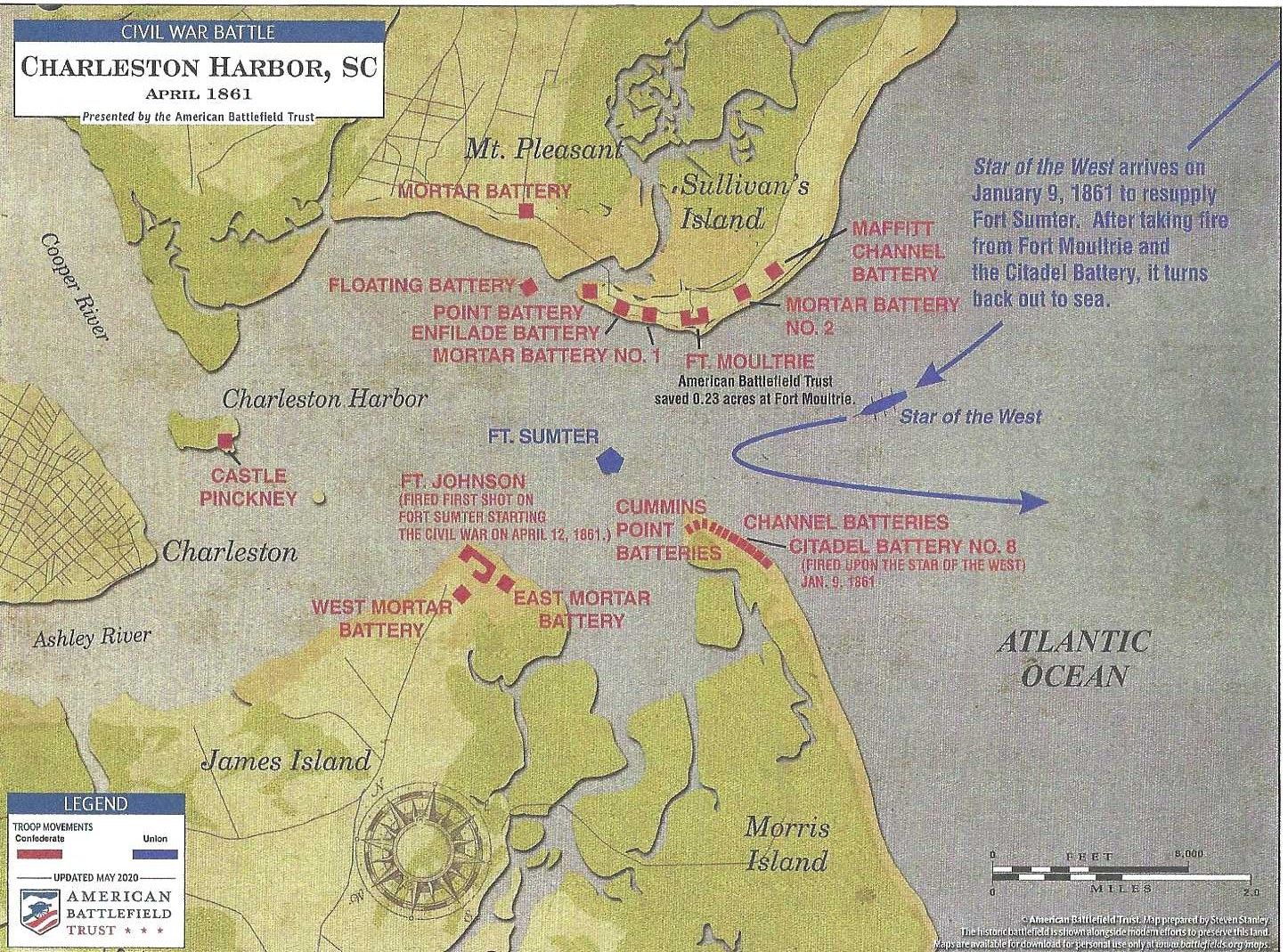
That is so cool. Helps you see why Ft. Sumter was in such trouble.
Disclaimer: Opinions posted on Free Republic are those of the individual posters and do not necessarily represent the opinion of Free Republic or its management. All materials posted herein are protected by copyright law and the exemption for fair use of copyrighted works.
