Rocks on Mars
A variety of rock types and sediments have been found on Mars. Many are similar to rocks on Earth.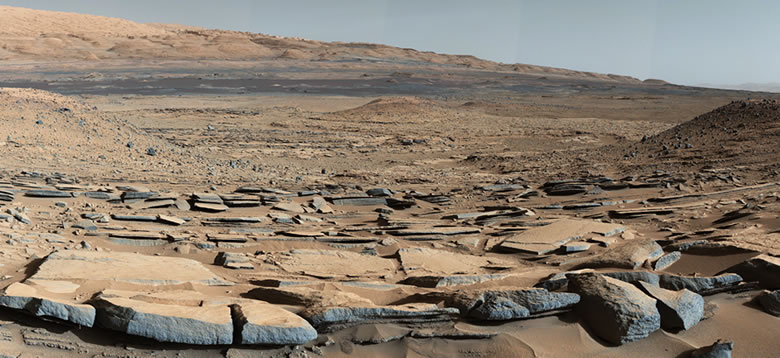
Mudstone: This photograph, taken by NASA's Mars Rover Curiosity in 2015, shows sedimentary rocks of the Kimberley Formation in Gale Crater. The crater contains thick deposits of finely laminated mudstone that represent fine-grained sediments deposited in a standing body of water that persisted for a long period of time - long enough to allow sediments to accumulate to significant thickness. Image by NASA. Enlarge image. [8]

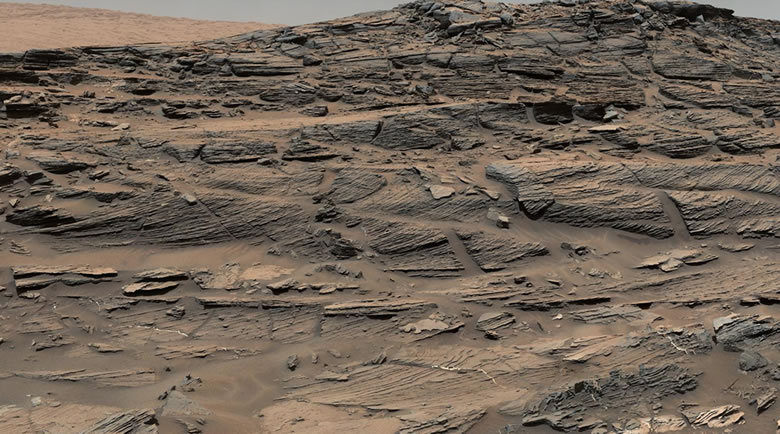
Sandstone: This photograph was taken by NASA's Mars Rover Curiosity on August 27, 2015 using its mast camera. It shows an outcrop of cross-bedded sandstone on the lower slope of Mars' Mount Sharp. The cross-bedding is very similar to the wind-blown sand outcrops commonly found in the U.S. Southwest. NASA directly compared this image to an outcrop of the Navajo Sandstone in Utah. Image by NASA. Enlarge image. [7]

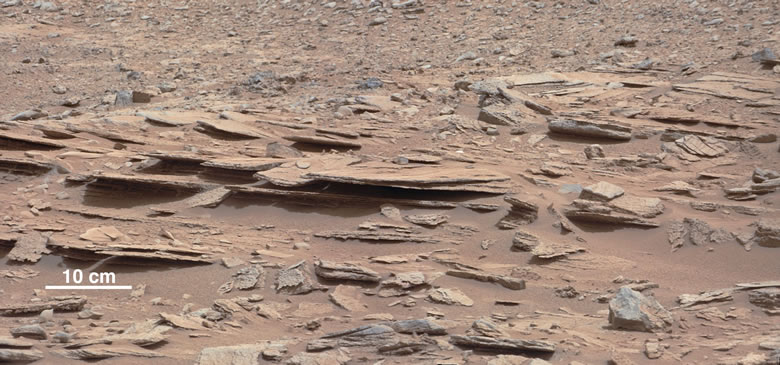
Shale: This photograph was taken by NASA's Mars Rover Curiosity in 2012 using its mast camera. It shows a portion of an outcrop inside the Gale Crater. This view shows an area about one meter wide. The color has been balanced to make the scene look as if it were on Earth.
Visible in this image are rocks that are very similar to the shales found on Earth. They are fine-grained, thinly layered and fissile (meaning they easily break into thin sheets). Rocks on Earth that break this way are usually made up of clay minerals or mica grains that settled out of an aqueous suspension. Their plate-shaped grains deposited on the bottom in a parallel orientation. This gives the rock the ability to be split into thin layers. Clay minerals are known to be abundant on Mars, so it is likely that these rocks are composed of clay minerals.
Martian impact craters are a great place to observe rocks because the impact blasted a hole in the planet's surface with outcrops exposed in the crater walls. In this scene, large amounts of fine-grained sediments can be seen covering the ground. Sediments on the surface of Mars are a product of millions of years of asteroid impacts and mechanical weathering. They are reworked by the wind today, and in the past, they were moved, deposited, and reworked by flowing water. Image by NASA. Enlarge image. [1]

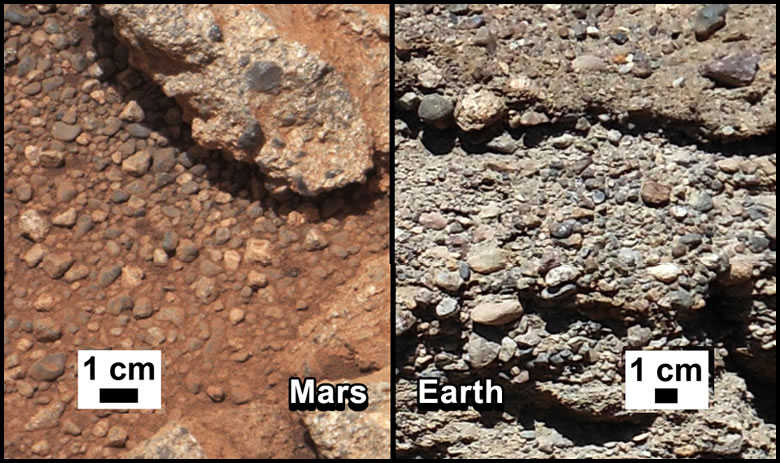
Conglomerate: The photograph on the left was taken by NASA's Mars Rover Curiosity in 2012 using its mast camera. It shows a portion of an outcrop of a rock similar to the conglomerates found on Earth. The pebbles below the rock are clasts that have been weathered from the rock. The photo on the right is a conglomerate outcrop from Earth to show similarity.
The presence of conglomerate and sandstones on Mars is evidence of moving water. Wind is not strong enough to pick up pebbles over one centimeter in diameter and carry them along in the current. The pebbles in this rock show a high level of rounding which implies a significant distance of transport. The red color is thought to be iron staining, which is nearly ubiquitous on Mars and gives it the name "Red Planet." The "cement" that binds the particles in these rocks could be a sulfate mineral. Image by NASA. Enlarge image. [2]

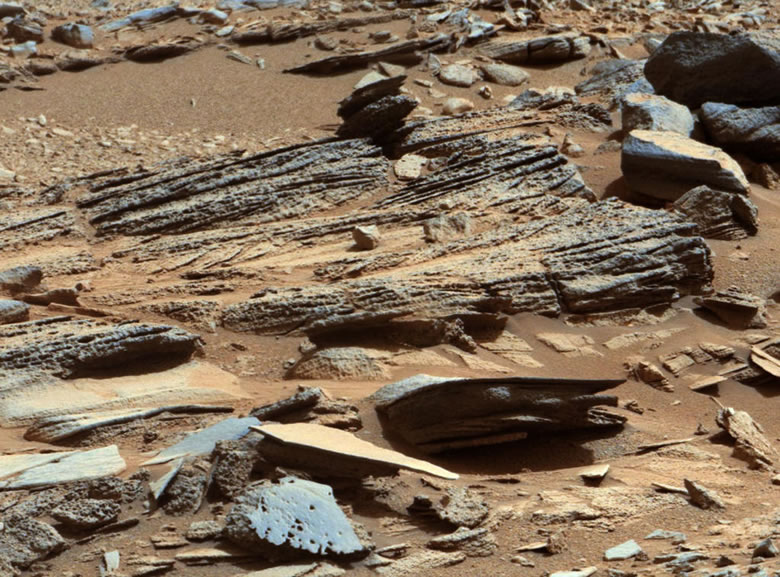
Cross bedding: This is another photograph taken by NASA's Mars Rover Curiosity in 2012 using its mast camera in the Gale Crater. It shows a portion of an outcrop with a sedimentary structure similar to the cross-bedded sandstones found on Earth. When a sedimentary rock that was deposited in nearly horizontal layers has internal layering that is inclined at a different angle, the structure is known as "cross bedding." The large-scale layering in these rocks is inclined to the left; however, the smaller internal layers are inclined at various angles. Multiple angles of cross bedding reveal that the direction of wind or water flow changed over time. Image by NASA. Enlarge image. [3]
