 http://www.kathrynsreport.com/2020/01/tm-1-thunder-mustang-fatal-accident.html
Posted on 01/06/2020 7:32:26 AM PST by BenLurkin
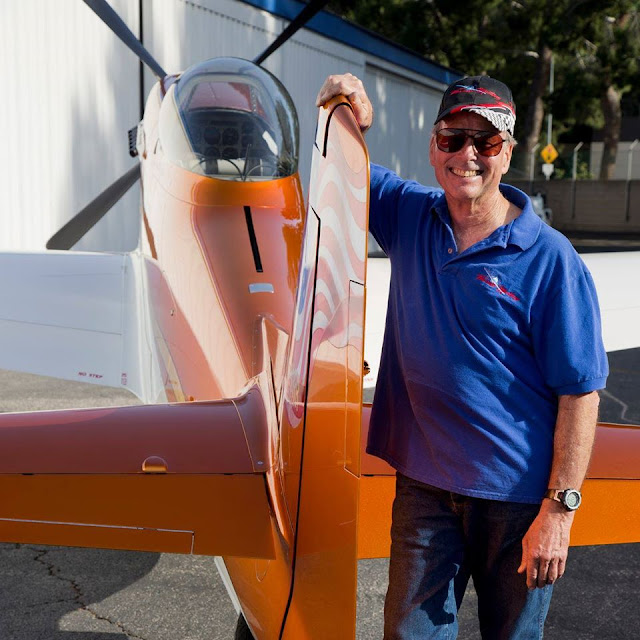
Officials have not released his name, but friends identified the pilot as Wayne Richards. The aircraft, a home-built TM-1 Thunder Mustang, was registered under his name.
"Very sweet, very loving and very active in the community," Jennifer Pearl said of her fellow pilot. "It’s a big loss."
He was the only occupant of the plane that plummeted near the Newhall Avenue off-ramp just after 10 a.m. Saturday, according to the Los Angeles County Fire Department. The aircraft had taken off from Van Nuys Airport, according to the FAA.
"He had flames coming out of his motor... It looked like he was trying to land it. Once he impacted, I heard a loud bang and then a fireball, and that was it," said Brett Fox, who was cycling in the area when the incident happened.
(Excerpt) Read more at ktla.com ...
http://www.kathrynsreport.com/2020/01/tm-1-thunder-mustang-fatal-accident.html
These scaled down replicas of the Mustang are terrific airplanes. They even run a v-12 like the originals, but just a bit smaller. There speeds are similar.
R.I.P.
 https://www.thundermustang.com/about-tm/ Thunder Mustang Details and Specifications Powerplant 640 HP Falconer V-12 @ 4800 rpm Displacement 601 cubic inches Propeller MT 94.5“ four blade constant speed Length 24.2 feet Frontal Area 8.1 square feet Wing Span 23.8 feet Wing Area 104 square feet Wing Loading 28.84 lbs./sq. ft. Power Loading 5 lbs./hp Gross weight 3,200 pounds Empty Weight 2,100 pounds Useful Load 1,100 pounds Standard Fuel Capacity 102 gallons Baggage Capacity 6.5 cu. ft. Design Limit Load Factor +9/-6 Gs Performance Rate of climb @ 3000 lbs. gross wt. 5,500 feet per minute Maximum level speed, sea level 390 mph/340 knots Cruise speed @75% power 340 mph/295 knots Range Approximately 1,000 nm @ econ. cruise Service ceiling 24,000 feet Limiting and Recommended Airspeeds Vx (best angle of climb) 100 mph/87 knots Vy (best rate of climb) 175 mph/155 knots Va (design maneuvering) 255 mph/222 knots Vfe (max flaps extended) 190 mph/165 knots Vle (max landing gear extended) 170 mph/148 knots Vne (never exceed) 505 mph/439 knots Vs1 (stall, clean) 88 mph/78 knots Vso (stall, in landing configuration) 79 mph/69 knots Best glide 176 mph/153 knots
Home built airplanes seem quite dangerous. I can understand loving to fly, buy why not use a commercially built airplane?
Sorry to hear about someone dying young over such a thing.
Home builts are usually kits. They have different safety standards to meet than but still have an inspection process. The folks who build home builts are usually both proficient pilots and mechanics. Ultralights, well, that may be a different story.
Orville and Wilbur thought so too.
Ran out of altitude, airspeed and ideas all at thee same time. Bad combination.
Because a 1/2 scale Mustang costs a hell of a lot less than the 1.9 to 2.9 million dollar full sized one.
Any and all aircraft can have engine failures, etc that may cause a crash.
“...why not use a commercially built airplane?”
1/2 of the price of a ready made aircraft is just for insurance.
It’s virtually impossible to purchase a normal aspirated aircraft that can fly at 390 MPH — to make that speed you need a PT-6 XX which is a turbine engine, expect to pay $800,000 for one and $175,000 for a prop and hub.
Experimental aircraft can be very safe and fast, the market providing to the consumer what a corporation cannot (at a competitive price).
Sure, a Coast Guard cutter can sink, too. But it's always the people in the little open boats who venture too far out to sea that seem to capsize and drown around here (Columbia river outlet at Astoria).
The Arizona Republic: Home-built aircraft causing concern
Or, got directly to the NTSB: The Safety of Experimental Amateur-Built Aircraft where we learn:
Experimental amateur-built (E-AB) aircraft represent nearly 10 percent of the U.S. general aviation fleet, but these aircraft accounted for approximately 15 percent of the total-and 21 percent of the fatal-U.S. general aviation (GA) accidents in 2011. Experimental amateur-built aircraft represent a growing segment of the United States' general aviation fleet-a segment that now numbers nearly 33,000 aircraft.
Seems like he had an engine fire with smoke cutting off all of his visibility.
The trial lawyers drove the small plane manufacturers out of business. If you crashed a 50-year old Cessna that had been rebuilt multiple times, you could still sue Cessna.
https://www.nytimes.com/1986/10/12/business/it-s-touch-and-go-for-small-planes.html
They now sell kits that you build yourself, that way if you crash it's your fault and not theirs and the trial lawyers can't go after them. Theoretically.
That really looks good. I am sure he enjoyed building and flying it.
He would have been safer staying at home watching TV or golfing everyday. /s
Most homebuilder/pilots aren’t the long distance types flyers. More take offs and landings for every 100 hrs, by far, I assume. Low level flight means less time to try to recover or adjust for a problem. In this man’s case, the fire was possibly a broken fuel or oil cooler line. There are fuel shutoff valves on every plane I’ve ever worked on, which when shut off kill the engine. The only way to stop the flow oil flow is to kill the engine. Either way, low altitude, no power, populated area= bad situation.
The witness said he heard it sputter. That sounds like fuel starvation. Oil starvation just slows the engine to a stop when finally seizes.
Two recent fatal crashes of smaller ac killed about 14 (Mitchell, SD, and Lafayette, LA), and were factory built and turbine powered. Both shortly after taking off.
Most homebuilt aircraft models are not available as equivalent commercial aircraft. The fundamental risk is in being in a small, single-engine aircraft. That risk can be mitigated by a careful, disciplined pilot who avoids marginal flying conditions, follows safety rules and precautions, and avoids over-stressing his aircraft.
They now sell kits that you build yourself, that way if you crash it's your fault and not theirs and the trial lawyers can't go after them. Theoretically.
We truly live in Clown World. And the lawyers are the worst part of Clown World, they are always creating bizzaro situations like this.

Thanks for everyone who helped educate me about small planes And, I neglected to mention it previously, but RIP to the pilot.
They are all quite dangerous. It's a dangerous hobby. Lots of things can go wrong, even in an expertly maintained plane. Those who love it just accept the risks.
Disclaimer: Opinions posted on Free Republic are those of the individual posters and do not necessarily represent the opinion of Free Republic or its management. All materials posted herein are protected by copyright law and the exemption for fair use of copyrighted works.