
If The Titanic Sank Today."
Posted on 09/20/2019 5:33:07 AM PDT by rlmorel
If The Titanic Sank Today."
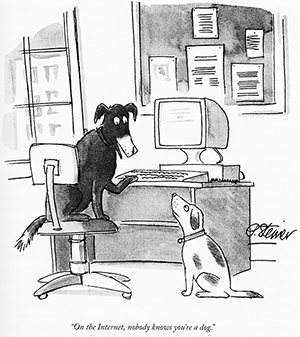
This brilliant cartoon illustrates a point covered here, made available by the very medium I wish to both praise and criticize.
Let me preface this: I am not a Luddite. I am and have always been mostly an early adopter as a consumer, in the vanguard of change. So this is not an expression of nostalgia for "the good old days". These are just my thoughts on The Internet and computer technology in general, and the effects these things have had on our world.
The Internet isn’t in and of itself a bad idea...it’s a great and wonderful thing. However, like most things, there is a fundamental binary nature to it in that it may have both good and bad effects on things.
The problem with the Internet is, it was an agent of change so vast and rapid that nobody could reasonably comprehend in advance what was going to change in culture and society, and that change happened in a head-spinning rapid way over such a vast swath of humanity.
Very quickly, covering the earth, involving everything from dating to artificial intelligence.
Over a time span of what...thirty years for most people? Astonishing. There has never been anything like it that has effected such change in such a short amount of time. The Industrial Age, mass production, I don’t even think the invention of the wheel rivals it for profound change in a short time.
Perhaps television would begin to rival it. (I don’t watch television at all. I simply cannot stomach it.)
That the Internet has vast potential good is undeniable. For a questing mind, the Internet is like a drug to an addict. We have great amounts of information at the tip of our fingers for the asking, available in seconds from nearly ANYWHERE on the face of the earth where there is a significant level of human habitation. We can access it from 35,000 feet in the air inside a pressurized metal tube, from a ship at sea, or from deep underground.
The information on nearly any subject is there for our perusal, we only have to look for it and wade through it. The result is, this took us out of a situation where we had to often physically go to where information could be found. Now, we can bring the information to us.
Instantly.
I like to tell the story that illustrated it for me. When I was in the US Navy, the squadron I was in was called “The Clansmen” and our officers wore kilts and glengarry hats for formal occasions such as change of command, etc. They wore the MacDougal Tartan, a traditional mix of red, black and green that was specific to the MacDougal clan. One of our ports of call in 1976 was Edinburgh in Scotland, and our officers were greeted and feted by representatives of the MacDougal clan IIRC.
Back in the late Seventies, after I got out of the Navy, I wanted to reproduce our squadron logo but I didn’t have an accurate color picture of it. I couldn’t remember exactly what the MacDougal tartan looked like, the pattern, the mix of colors. I could have gone to a library, but I doubt I would have found it. I might have been able to find a Scottish or genealogical society, but...how would I even find them? Ask someone at the library? A friend who was into genealogy? (I didn’t have any friends like that!) I might have written to an embassy or something. Or I might have even written a letter to the squadron, but...what was the address? It was a dead end, and I simply forgot about it.
Just a couple of years ago I thought about recreating the logo again (the squadron is defunct now) and I went online. I found a sample of the MacDougal tartan in literally 10 seconds! Ten seconds.
And that is just one example of the access to information that is possible with the Internet. The access to information is vast and immediate, and there are many, MANY positive things about that to a curious and engaged mind.
Let me digress quickly: If you have never read it, I highly recommend “As We May Think” and yes...it is a relative of George H. W. Bush, his uncle in fact. During WWII, Vannevar Bush headed the U.S. Office of Scientific Research and Development (OSRD), through which almost all wartime military R&D was carried out. This article came out in July 1945, and is unsettling in its uncanny foretelling of the future. Read this passage below, and I defy the reader to visualize the Personal Computer (Memex in the article) and hyperlinks (”trails”)
(Excerpt from Vannevar Bush’s “As We May Think” from The Atlantic in July 1945)
Consider a future device for individual use, which is a sort of mechanized private file and library. It needs a name, and, to coin one at random, “memex” will do. A memex is a device in which an individual stores all his books, records, and communications, and which is mechanized so that it may be consulted with exceeding speed and flexibility. It is an enlarged intimate supplement to his memory.
It consists of a desk, and while it can presumably be operated from a distance, it is primarily the piece of furniture at which he works. On the top are slanting translucent screens, on which material can be projected for convenient reading. There is a keyboard, and sets of buttons and levers. Otherwise it looks like an ordinary desk.
In one end is the stored material. The matter of bulk is well taken care of by improved microfilm. Only a small part of the interior of the memex is devoted to storage, the rest to mechanism. Yet if the user inserted 5000 pages of material a day it would take him hundreds of years to fill the repository, so he can be profligate and enter material freely.
Most of the memex contents are purchased on microfilm ready for insertion. Books of all sorts, pictures, current periodicals, newspapers, are thus obtained and dropped into place. Business correspondence takes the same path. And there is provision for direct entry. On the top of the memex is a transparent platen. On this are placed longhand notes, photographs, memoranda, all sorts of things. When one is in place, the depression of a lever causes it to be photographed onto the next blank space in a section of the memex film, dry photography being employed.
There is, of course, provision for consultation of the record by the usual scheme of indexing. If the user wishes to consult a certain book, he taps its code on the keyboard, and the title page of the book promptly appears before him, projected onto one of his viewing positions. Frequently-used codes are mnemonic, so that he seldom consults his code book; but when he does, a single tap of a key projects it for his use. Moreover, he has supplemental levers. On deflecting one of these levers to the right he runs through the book before him, each page in turn being projected at a speed which just allows a recognizing glance at each. If he deflects it further to the right, he steps through the book 10 pages at a time; still further at 100 pages at a time. Deflection to the left gives him the same control backwards.
A special button transfers him immediately to the first page of the index. Any given book of his library can thus be called up and consulted with far greater facility than if it were taken from a shelf. As he has several projection positions, he can leave one item in position while he calls up another. He can add marginal notes and comments, taking advantage of one possible type of dry photography, and it could even be arranged so that he can do this by a stylus scheme, such as is now employed in the telautograph seen in railroad waiting rooms, just as though he had the physical page before him.
All this is conventional, except for the projection forward of present-day mechanisms and gadgetry. It affords an immediate step, however, to associative indexing, the basic idea of which is a provision whereby any item may be caused at will to select immediately and automatically another. This is the essential feature of the memex. The process of tying two items together is the important thing.
When the user is building a trail, he names it, inserts the name in his code book, and taps it out on his keyboard. Before him are the two items to be joined, projected onto adjacent viewing positions. At the bottom of each there are a number of blank code spaces, and a pointer is set to indicate one of these on each item. The user taps a single key, and the items are permanently joined. In each code space appears the code word. Out of view, but also in the code space, is inserted a set of dots for photocell viewing; and on each item these dots by their positions designate the index number of the other item.
Thereafter, at any time, when one of these items is in view, the other can be instantly recalled merely by tapping a button below the corresponding code space. Moreover, when numerous items have been thus joined together to form a trail, they can be reviewed in turn, rapidly or slowly, by deflecting a lever like that used for turning the pages of a book. It is exactly as though the physical items had been gathered together from widely separated sources and bound together to form a new book. It is more than this, for any item can be joined into numerous trails.
The owner of the memex, let us say, is interested in the origin and properties of the bow and arrow. Specifically he is studying why the short Turkish bow was apparently superior to the English long bow in the skirmishes of the Crusades. He has dozens of possibly pertinent books and articles in his memex. First he runs through an encyclopedia, finds an interesting but sketchy article, leaves it projected. Next, in a history, he finds another pertinent item, and ties the two together. Thus he goes, building a trail of many items. Occasionally he inserts a comment of his own, either linking it into the main trail or joining it by a side trail to a particular item. When it becomes evident that the elastic properties of available materials had a great deal to do with the bow, he branches off on a side trail which takes him through textbooks on elasticity and tables of physical constants. He inserts a page of longhand analysis of his own. Thus he builds a trail of his interest through the maze of materials available to him.
And his trails do not fade. Several years later, his talk with a friend turns to the queer ways in which a people resist innovations, even of vital interest. He has an example, in the fact that the outraged Europeans still failed to adopt the Turkish bow. In fact he has a trail on it. A touch brings up the code book. Tapping a few keys projects the head of the trail. A lever runs through it at will, stopping at interesting items, going off on side excursions. It is an interesting trail, pertinent to the discussion. So he sets a reproducer in action, photographs the whole trail out, and passes it to his friend for insertion in his own memex, there to be linked into the more general trail...
Astonishing to read. Fast forward from July 1945 to today, and ponder the effect on all of us this rapid and dramatic upheaval brought about by the instantaneous access to an enormous amount of information.
What thinking person could possibly think this is a bad thing in any way? (that is rhetorical, by the way)
But that stupendous access to a curious humanity is also the lure and the trap.
There is also so much information on every subject imaginable that it takes a careful and discriminating mind to winnow through it. If you did a search for “treatment of boils on horse’s hindquarters” what you get back is mindboggling in volume, deep in variety, and ranges from snot-spurting hilarious to deeply offensive and disturbing.
And it appears in front of your face with just a few keyboard strokes and a click of a mouse.
And yes, to a curious mind, it is addictive. Factor in social media, online purchasing, pornography, news dissemination, and the door is open for a type of cultural upheaval both good and bad not seen before in history.
The potential for evil is profound.
Think: Google.
Google has become the defacto source of information by humans. And access with queries for that information via Google is being shaped, modified, and fed back to unknowing people who simply accept it without understanding that things don’t just appear at the top of the list of returns by accident. Money can put them there which is fine if you understand it, but far worse, ideological shaping by dedicated Leftists at Google put them at the top of the first page returned too.
And Google fully understands that few people dig beyond the first page of returns, and even fewer beyond the second page. I’ll bet if you did a graph of Google returned pages viewed per query, it falls off exponentially past the first page served up by Google. But even more perilous, they accept the Google answers to queries as unbiased or oddly, truthful, and there is NOTHING further from the truth.
When Socrates was asked a question, his questioner might expect to get back an answer from Socrates that would drive him or her to find the truth on their own, with their own thought process, using their own mind.
When an Internet user asks Google a question, Google does not answer as Socrates did.
Google answers as Joseph Goebbels would have if he had the technology, not by helping the questioner find the truthful answer, but by attempting to give the questioner the answer that Google wants them to have.
And I see a deep and profound danger to the world, and to our republic in this. Because any tool that is used for good can also be used for evil, all it takes is evil intent, even if masked by good intentions. And there is no shortage of evil capability in Mankind.
But I also believe that, in cases where technology outstrips the capability of humans to reasonably have the ability to adapt to change, events can take on a life of their own.
Look at the way people now seem to barely be "in the moment". They are always taking a video or picture of it. Instead of talking to someone facing them, they are texting, their head inclined at an angle. And they do this walking down the road, driving the car, or even flying a plane or steering a train.
I believe one of the downsides is the way this technology has physically isolated many people, even as it has given many people who ARE physically isolated the ability to interact...as we do here on Free Republic and other such forums.
I hope we will see on this thread some interesting (and likely irrelevant but interesting or funny anecdotes!)
Thought you both might be interested!
My opinion (for what it’s worth) — the internet and PC’s are a “magnifying glass”. They expand both the good and bad that already exist in society and have a wider potential distribution for both ends of the spectrum. More opportunities for a greater number of people to both do positive and negative things.
With the internet, we have almost all of the collective knowledge of all of humanity at our fingertips. This is a tremendous good.
It also gives all the village idiots a means to communicate and coagulate. This is a tremendous evil.

"....and that's the way it was and we liked it!"
AND YOU KIDS GET OFF MY LAWN!!
Yes, the Internet contains a vast store of “knowledge” - both actual fact, and fanciful derivations of those facts, whether only slightly distorted, or a full-blown fabrication.
Thus it is possible to pick and choose whatever conglomeration of “facts” you want to present, and arrive at conclusions wholly at odds with reality, but plausible to many.
History and science become highly malleable commodities, ready to be dispensed to the highest bidder, and the winning bid has the tacit authority to suppress any “fact” inconvenient to the predetermined outcome of events.
Fifty percent of everything you may believe to be the absolute, incontrovertible truth, shall within your lifetime, turn out to be totally wrong.
There is no way to determine which half that will be.
for this discovery of yours will create forgetfulness in the learners’ souls, because they will not use their memories; they will trust to the external written characters and not remember of themselves. The specific which you have discovered is an aid not to memory, but to reminiscence, and you give your disciples not truth, but only the semblance of truth; they will be hearers of many things and will have learned nothing; they will appear to be omniscient and will generally know nothing; they will be tiresome company, having the show of wisdom without the reality. - Plato, Phaedrus 360 BC.
This is an unnerving book, especially if you know young people and see what is happening to the ability of many of them to concentrate and sustain attention:
https://www.amazon.com/dp/B07WX1DFZW/ref=dp-kindle-redirect?_encoding=UTF8&btkr=1
“It also gives all the village idiots a means to communicate and coagulate. This is a tremendous evil.”
Yup, it gave the nutters a means to find other nutters, increasing the sum total of nuttiness dramatically.
I feel bad for the generations that have only known the 24 hour news cycle, (un)social media, and smartphones. The amount of folks who only know how to be passively entertained by some sort of screen is staggering, just imagine the wave of madness that will rise if it ever goes away.
Freegards
Were it not for the internet distributing that one, critical video of Hillary nearly passing out and being thrown into the Scooby van, she would now be President.
That makes it worthwhile.
man's sinful nature + "good intentions" + lack of wisdom + lack of self control + natural urges & desire for unearned power and wealth = evil
Interesting, but not a fan of Nick Carr. He was wrong about IT, technology 10+ years ago.
The cartoon is not brilliant, but it illustrates what WOULD have happened.
The internet doesn’t do anything. It is a network. A means of interconnecting infinite numbers of computers. Networks do not take action. They provide the means for it. Logically no different from the telephone network.
The effect of using the internet depends on the individual and the use made of it.
Well nobody’s always right about everything. I’ve seen a lot of what he cautions in ‘Shallows’ happening to people, including myself.

Symantically, “The Internet” is composed of everything from servers routers and high end hardware at places like Amazon right down to the desktop browser in an individual PC.
All of these things contribute to make “The Internet”.
As for “effect of using the internet depends on the individual and the use made of it” the same could be said of manuscripts written by monks centuries ago.
But the multiplying effect of “The Internet” changes it completely.
LOL...one can only imagine what they would have thought of all this!
The way I see it, one of the biggest problems is the veracity of data, not accessing the data itself.
One thing I DO love about the Internet is when I simply cannot remember that thing that I know that I knew! A search for “What is that blue thing one puts in a blah blah blah” makes me go “Damn! Why couldn’t I remember that???”
Otherwise I would stew on it for days, asking friends who would look blankly at me, until it popped unbidden back into my brain!
Disclaimer: Opinions posted on Free Republic are those of the individual posters and do not necessarily represent the opinion of Free Republic or its management. All materials posted herein are protected by copyright law and the exemption for fair use of copyrighted works.