Posted on 06/19/2019 10:45:30 PM PDT by ETL
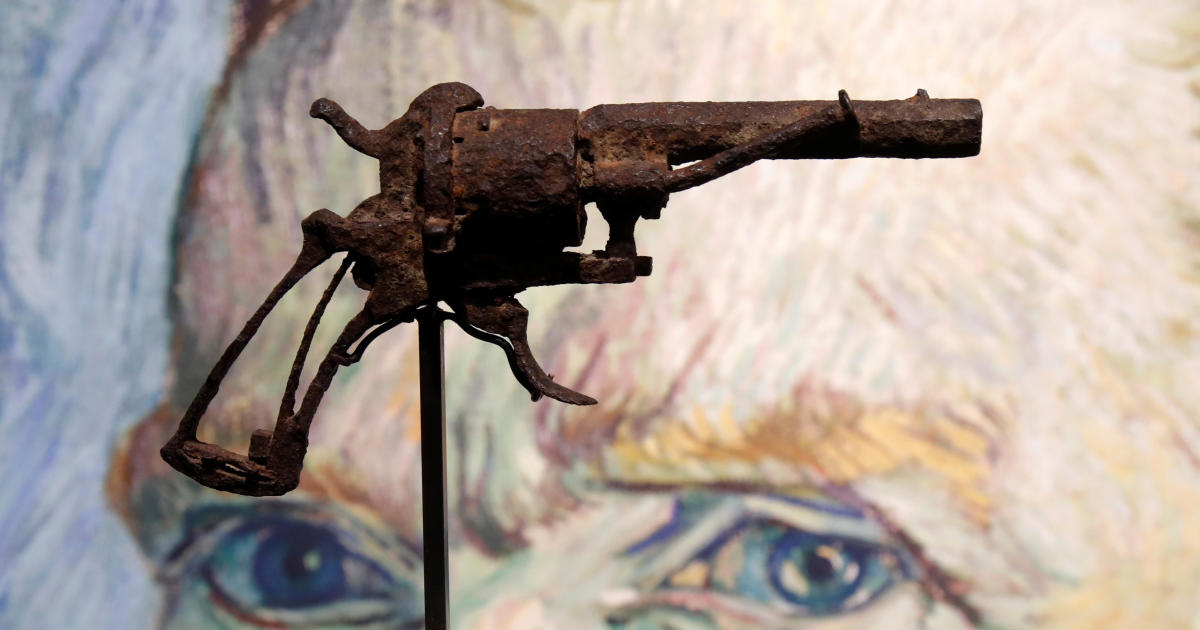
PARIS (AP) — A revolver believed used by Dutch painter Vincent van Gogh to kill himself has sold for about $146,000 at an auction in Paris.
An individual buyer whose name was not released bought the 7mm pocket revolver for 130,000 euros plus taxes on Wednesday.
The weapon was discovered in the 1960s in fields in the northern French village of Auvers-sur-Oise.
Van Gogh is widely believed to have shot himself in the chest there in 1890.
The family of former owners of the inn where the painter died two days later decided to sell the revolver after it was featured in a 2016 exhibit at Amsterdam’s Van Gogh Museum that charted his descent into mental illness.
Van Gogh’s suicide was questioned in a book by Pulitzer Prize-winning authors who concluded he was fatally shot by two teenagers.
(Excerpt) Read more at foxnews.com ...


French or Belgian lefauchaux pinfire revolver. Very common for the time period.
CC
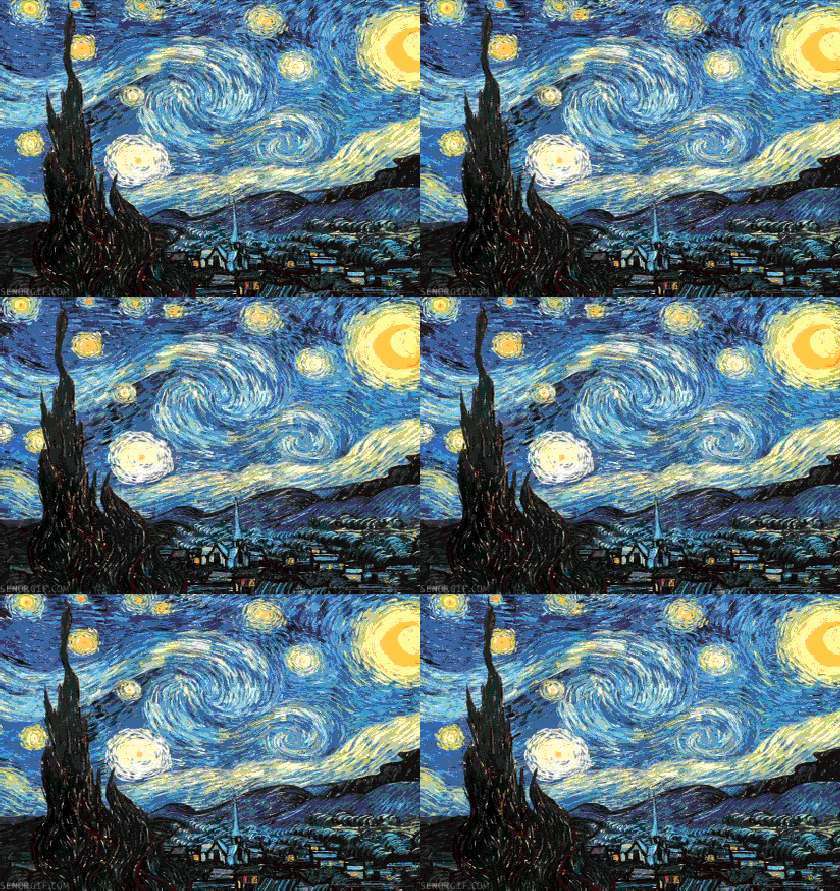
Well, you’ve gotten rid of anybody with motion sickness or epilepsy.
CC
Lol! It’s making me a little sick too.

Van Gogh painted “The Starry Night” in the asylum where he was staying in Saint-Rémy, France, in 1889, the year before his death.
“This morning I saw the countryside from my window a long time before sunrise, with nothing but the morning star, which looked very big,” he wrote to his brother Theo.
A combination of imagination, memory, emotion and observation, the oil painting on canvas depicts an expressive swirling night sky and a sleeping village, with a large flame-like cypress, thought to represent the bridge between life and death, looming in the foreground.
The painting is currently housed at the Museum of Modern Art in New York, NY.
Credit goes to Ian McCollum of “ Forgotten Weapons” for a thorough education.
CC
In reality there is nothing to connect this revolver to the death of Van Gogh.
Ninety years after the fact some one finds this rusted revolver in a field nearby in a country that has seen two great wars since the firearm was manufactured and naturally assumes it is connected to a famous murder or suicide that happened nearby.
Well, it can neither be proven nor disproven so the buyer can claim that it is the weapon that killed Van Gogh with out fear that anyone can call him a liar.
The gun being auctioned in Paris next week is a Belgian-made 7mm Lefaucheux revolver — a popular small caliber handgun at that time.
The gun matches the description of the 7mm bullet taken from Van Gogh’s body by his doctor, and it is theorized that its low power may be why Van Gogh didn’t die immediately, but staggered back to his hotel with the bullet still lodged in his chest.
The pistol was found by a farmer in 1965 — 75 years after Van Gogh’s death — in a field at Auvers, badly corroded and beyond use. It was then given to the family who owned the hotel where Van Gogh died.
Grégoire Veyrès, the auctioneer for Auction Art who is conducting the sale, told Live Science that an investigation by the writer Alain Rohan determined that the corroded weapon had been buried in the ground for at least 50 years.
Since Vincent van Gogh’s death in 1890, the works of this Dutch expressionist have become some of the most sought-after paintings in the world.
Rohan’s investigative work was accepted as valid by the Van Gogh Museum in Amsterdam, which displayed the gun in a 2016 exhibition about the artist’s mental illness, Veyrès said.
According to Rohan’s investigation, the location where the gun was found matched the description of a field where Van Gogh had been painting, and where he is said to have shot himself.
The gun was also found with its trigger unlocked, which could indicate that it had been fired before it was discarded.
Death debated
According to Van Gogh expert Martin Bailey, who writes regularly on the artist for the Art Newspaper in London, the gun is accepted among many Van Gogh scholars as the weapon that he used to take his own life.
“I believe it highly likely, although not certain, that it is the actual gun,” Bailey told Live Science, adding that the Van Gogh Museum had also stated there was a “strong possibility” that this was the gun he used.
While the 2011 biography by Smith and Naifeh was “excellent,” he said, many Van Gogh experts didn’t accept their theory.
“I am convinced that it was suicide, not murder or manslaughter,” he said. “Van Gogh’s family and close friends believed it was suicide.”
Naifeh, who won a Pulitzer Prize with Smith in 1991 for their biography of the American painter Jackson Pollock, said his discussions with forensic experts had strengthened his belief that Secrétan shot the artist.
“I have only become more convinced that it is more likely that he was shot in a scuffle than that he wasn’t,” he told Live Science.
Naifeh noted that there was no evidence linking the gun either to Van Gogh or to the manner of his death.
“What forensic evidence is there to tie Vincent van Gogh to this gun?
And, even if there were forensic evidence tying Vincent to this gun, what does this say about who pulled the trigger?” he asked: “Those are the two big questions, and I do not see any answers.”
Although Van Gogh is one of the most famous artists in the world — one of his paintings of a farmed field, completed a year before his death, sold for $81 million in 2017 — he sold only one painting during his lifetime, for 400 francs.
The most expensive Van Gogh painting to date was sold for $82 million in 1990, the “Portrait of Dr. Gachet” from 1890. Gachet was the doctor who would ultimately attend his death later that year.
https://www.livescience.com/65725-van-gogh-pistol-debate.html
“Or vertigogh.”
((Rimshot))
He’s here all week, folks!
CC
A piece of rusty junk.
(That’s funny)


https://www.livescience.com/65725-van-gogh-pistol-debate.html
What piece of crap.
There is a theory that when Van Gough painted “Starry Night”, he actually painted what he was seeing. His medication was affecting his perception!
Disclaimer: Opinions posted on Free Republic are those of the individual posters and do not necessarily represent the opinion of Free Republic or its management. All materials posted herein are protected by copyright law and the exemption for fair use of copyrighted works.