
Posted on 12/12/2018 9:31:34 AM PST by ETL
When we hear the word "stereo" today, we might simply think of a sound system, as in "turn on the stereo."
But stereo actually is a specific technology, like video streaming or the latest expresso maker.
Sixty years ago, it was introduced for the first time.
Whenever a new technology comes along – whether it's Bluetooth, high-definition TV or Wi-Fi – it needs to be explained, packaged and promoted to customers who are happy with their current products.
Stereo was no different. As we explore in our recent book, "Designed for Hi-Fi Living: The Vinyl LP in Midcentury America," stereo needed to be sold to skeptical consumers. This process involved capturing the attention of a public fascinated by space-age technology using cutting-edge graphic design, in-store sound trials and special stereo demonstration records.
The rise of 'hi-fi' sound
In 1877, Thomas Edison introduced the phonograph, the first machine that could reproduce recorded sound. Edison used wax cylinders to capture sound and recorded discs became popular in the early 20th century.
By the 1950s, record players, as they came to be called, had become a mainstay of many American living rooms. These were "mono," or one-channel, music systems. With mono, all sounds and instruments were mixed together. Everything was delivered through one speaker.
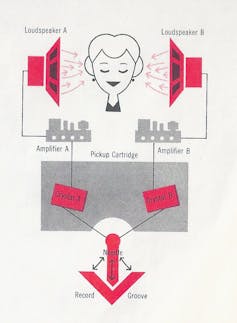
A graphic detail, from an RCA inner sleeve, shows listeners how new stereo technology operates.
Credit: From the collection of Janet Borgerson and Jonathan Schroeder, Author provided
_____________________________________________________________
Stereophonic sound, or stereo, was an important advance in sound reproduction. Stereo introduced two-channel sound, which separated out elements of the total sound landscape and changed the experience of listening.
Audio engineers had sought to improve the quality of recorded sound in their quest for "high fidelity" recordings that more faithfully reproduced live sound. Stereo technology recorded sound and played it back in a way that more closely mimicked how humans actually hear the world around them.
British engineer Alan Dower Blumlein paved the way for two channel recording in the 1930s. But it wasn't until the 1950s that stereo technology was incorporated into movie theaters, radios and television sets.
With stereo, the sound of some instruments could come from the left speaker, the sound of others from the right, imitating the setup of a concert orchestra. It also was possible to shift a particular sound from left to right or right to left, creating a sense of movement.
Although Audio-Fidelity Records offered a limited edition stereo record for industry use in 1957, consumers needed to wait until 1958 for recordings with stereo sound to become widely available for the home.
A sonic 'arms race' to sell the sound
When stereo records were introduced to the mass market, a "sonic arms race" was on. Stereo was aggressively promoted as the latest technological advancement that brought sophisticated sound reproduction to everyone.
Each of the era's major record labels started pushing stereo sound. Companies like Columbia, Mercury and RCA, which sold both stereo equipment and stereo records, moved to convince consumers that stereo's superior qualities were worth further investment.
A key challenge for selling stereo was consumers' satisfaction with the mono music systems they already owned. After all, adopting stereo meant you needed to buy a new record player, speakers and a stereo amplifier.
Something was needed to show people that this new technology was worth the investment. The "stereo demonstration" was born – a mix of videos, print ads and records designed to showcase the new technology and its vibrant sound.
Stereo demonstration records showed off the innovative qualities of a new stereo system, with tracks for "balancing signals" or doing "speaker-response checks." They often included compelling, detailed instructional notes to explain the new stereo sound experience.
Stereo's potential and potency stormed retail showrooms and living rooms.
Curious shoppers could hear trains chugging from left to right, wow at the roar of passing war planes, and catch children's energetic voices as they dashed across playgrounds. Capitol Records released "The Stereo Disc," which featured "day in the life" ambient sounds such as "Bowling Alley" and "New Year's Eve at Times Square" to transport the listener out of the home and into the action.
A particularly entertaining example of the stereo demonstration record is RCA Victor's "Sounds in Space." Appearing a year after the successful launch of the Soviet's Sputnik satellite in 1957, this classic album played into Americans' growing interest in the space race raging between the two superpowers.
"The age of space is here," the record begins, "and now RCA Victor brings you 'Sounds in Space.'" Narrator Ken Nordine's charismatic commentary explains stereophonic sound as his voice "travels" from one speaker channel to another, by the "the miracle of RCA stereophonic sound."
Record companies also released spectacular stereo recordings of classical music.

Listening at home began to reproduce the feeling of hearing music live in the concert hall, with stereo enhancing the soaring arias of Wagner's operas and the explosive thundering cannons of Tchaikovsky's "1812 Overture."
Today, rousing orchestral works from the early stereo era, such as RCA Victor's "Living Stereo" albums from the Chicago Symphony Orchestra, are considered some of the finest achievements of recorded sound.
Visualizing stereo
Stereo demonstration records, in particular, featured attractive, modern graphic design. Striking, often colorful, lettering boasted titles such as "Stereorama," "360 Sound" and "Sound in the Round."
Some stereo demonstration records focused on the listening experience. The ecstatic blond woman on the cover of Warner Bros. Records' "How to Get the Most Out of Your Stereo" sports a stethoscope and seems thrilled to hear the new stereo sound. World Pacific Records "Something for Both Ears!" offers a glamorous model with an ear horn in each ear, mimicking the stereo effect.
These eye-catching design elements became an important part of the record companies' visual branding. All were deployed to grab the attention of customers and help them visualize how stereo worked. Now they've become celebrated examples of midcentury album cover art.
By the late 1960s, stereo dominated sound reproduction, and album covers no longer needed to indicate "stereo" or "360 Sound." Consumers simply assumed that they were buying a stereo record.
Today, listeners can enjoy multiple channels with surround sound by purchasing several speakers for their music and home theater systems. But stereo remains a basic element of sound reproduction.
As vinyl has enjoyed a surprising comeback lately, midcentury stereo demonstration records are enjoying new life as retro icons – appreciated as both a window into a golden age of emerging sound technology and an icon of modern graphic design.

Explore further: The Beatles Return to Mono
He took us to his house and demonstrated the system he built. He said our jaws would drop, and he was right.
Later I “upgraded” to the latest digital offerings and scrapped all that old stuff. I sure wish I at least kept the receiver and speakers.
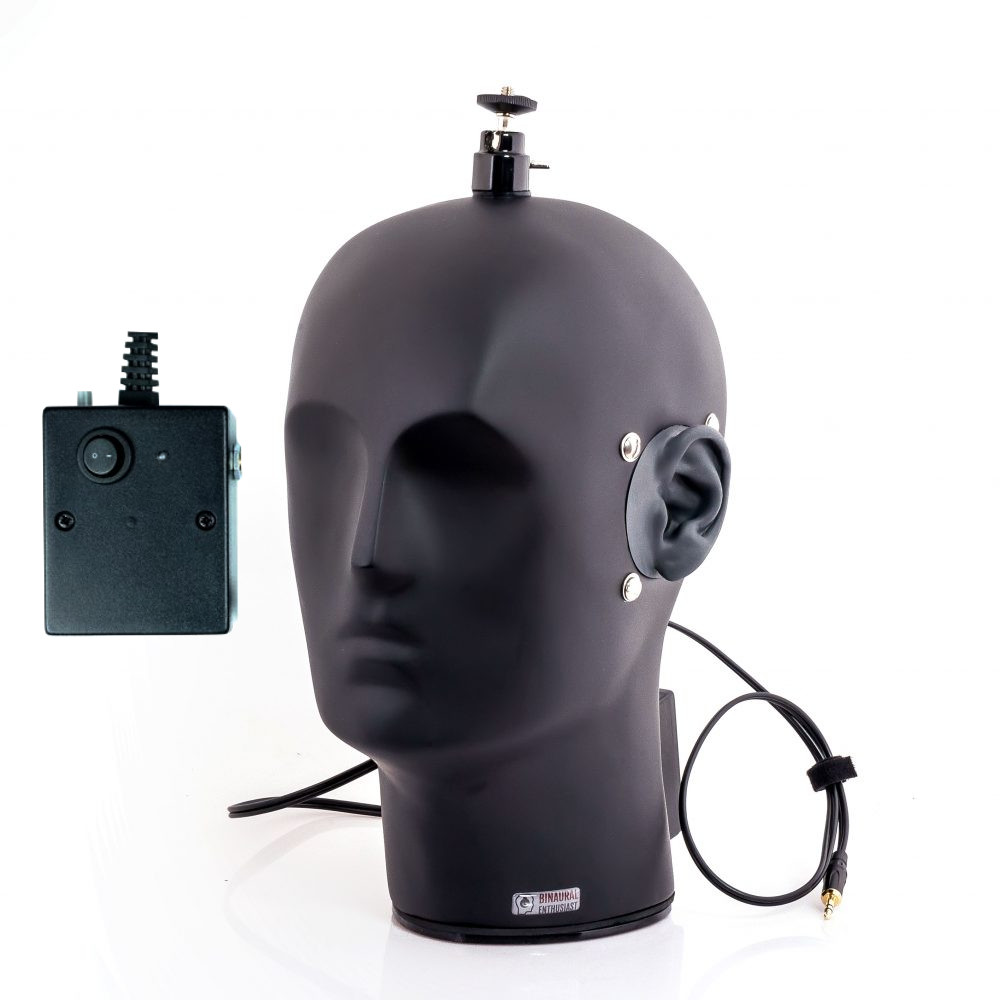
And then came Quadraphonic, which bombed.
For my first stereo circa 1968 I bought a stereo cartridge for an old mono turntable, an amp board from Laffette Radio and a new pair of Pioneer headphones.
Loved the l-r pan in “Hello I Love You”. Still do.
More on my quad era later. Started with the Dynaco hookup and went onto QSD.
I have heard an experimental stereo recording of the Count Basie Orchestra made around 1930. The quality was astoundingly good.
I was amazed as a young adult to learn how FM stereo worked.
They transmit an A+B signal, and A-B subchannel. The receiver does a little quadratic equation and separates them out into A and B.
And I was so certain that algebra was useless.
Our local wine shop has that receiver.
My son drug home a Luxman receiver he bought at a yard sale. It read “Left channel doesn’t work”. A little Deoxit sprayed into the A/B switch and it was working again. I have it playing through a pair of Klipsh KG-4’s that someone gave me.
The version I heard probably wasn't the version done by the Ames Brothers, but a later version. The record would first play it in mono, then switch it to stereo, so you could hear the difference between the two. I vaguely remember they using a portion of "Victory at Sea" too. I can remember as a teen sitting on the floor in front of that stereo, and listening to music whenever I could. I was the baby of the family. My siblings were all out of school and working, so I had the console all to my self, especially during the summer.
Bfl
I am still astonished, to this day, how well phonographs work. The amount of sound reproduced from a vibrating needle is amazing!
Because humans have two, not four, ears.
Apparently that was obvious to everyone except
to engineers at RCA.
We had a stereo, a nice one too! My parents had a neighbor who moved and sold a whole bunch of stuff, and one of the things that I bought from him was a homemade corner speaker and a wonderful tube amplifier that was high fidelity. He had gotten the plans for the speaker cabinet out of some magazine years before and made a very nice cabinet. I purchased that system for $20 and it was the best sounding system I’ve ever had in my entire life. I think High Fidelity actually sounds better. When you go to a concert more often than not you’re listening the high fidelity.
I think HiFi duplicates the a live sound more accurately than some studio feat of engineering.
“Fifty watts per channel, babycakes!”
(I think it was from a Fretter commercial)

I had a buddy who had a stereo system with 4 speakers that did quad by phase shifting the sound (do NOT remember the brand).
If you played Pink Floyd’s Money through it, you could hear the cash registers each coming out of their own speakers. It was awesome!
I remember the first Stereo broadcast in the SF area. Radio station KIOI(I believe) initiated this and I recall the first time I saw the stereo light pop on on my radio. (Purchased before stereo but with an FM stereo receiver inside. Not much separation but James Gabbert was the pioneer who ushered in this new sound and I loved it.
You could sit there and see the sound move from one side to the other. I was sold. Later became an electrical engineer and a telecommunications instructor. Good stuff.

But I will note that Bob Carver has made my listening life much more enjoyable. With a bit more than 50 watts per channel. And on the even funnier side, you can get new manufacture tube amps, from Amazon, or if you’ve got the big bucks, from Mr. Carver.
Good stuff!
Disclaimer: Opinions posted on Free Republic are those of the individual posters and do not necessarily represent the opinion of Free Republic or its management. All materials posted herein are protected by copyright law and the exemption for fair use of copyrighted works.