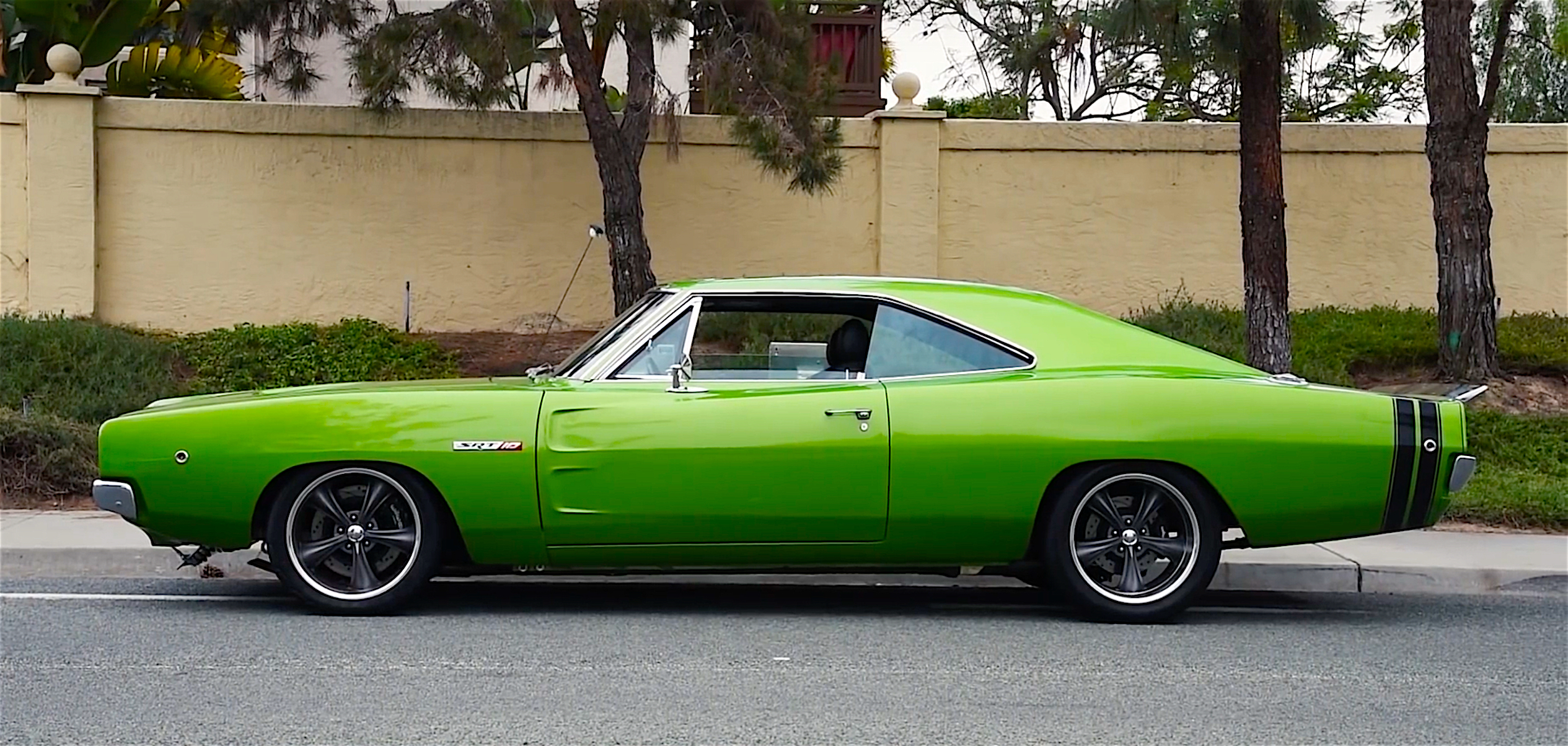
Dodge Charger
____________________________________________________

Plymouth Roadrunner
Posted on 09/29/2018 6:57:49 AM PDT by ETL
Sometimes a bird in the hand will get you two in the bush. And by “bush” I mean garage.
An Ebay seller is currently auctioning a pair of 1970 Plymouth Superbirds that were stored for over 30 years until he purchased them after a chance meeting last month.
He’d just paid $187,000 for another one of the iconic muscle cars at a car auction in Maine when someone sidled up to him and told him about his secret stash.
Within days, he’d bought the pair for an undisclosed amount and dug them out of the cluttered, dusty garage they’d been sitting in.
The man who sold them was only the second owner, having picked them up in 1978. But he let their registrations expire in the mid-1980s and they’ve been parked ever since.
Aside from getting resprays, both are nearly all original and have numbers-matching 440 cubic-inch V8s with four-barrel carburetors. One is equipped with a manual transmission, the other an automatic, and they have just 27,000 and 42,000 miles on their odometers.
They haven’t run in all these years, but their mechanic owner filled them with pure anti-freeze and Marvel Mystery Oil before he put them away.
Their bodies remain straight, but the interior of one is in much better condition than the other. Apparently, that’s not much of an issue to collectors.
As of this writing, the bidding on each car has surpassed $125,000, and may go much higher before the auctions end in a week. According to the Hagerty Price Guide, the cars are worth over $250,000 if fully restored.
And don’t think the seller doesn’t know that. He’s set reserves on the cars that have not yet been met.
(Excerpt) Read more at foxnews.com ...
The “SuperBird”(Roadrunner) and “Daytona”(Charger) nose additions cover up the clear differences there.
Dodge Charger
____________________________________________________
Plymouth Roadrunner
The differences are minimal. I can see differences, sure, but at the end of the day, they are basically THE SAME CAR.
Like I said in an earlier post, you are quibbling over slight cosmetic differences. To me that doesn’t discount these from being 2 unrelated cars. They are twins in my eyes just like all the other Dodge/Plymough twins. How do YOU not see this?
The cars in my post 102 have many styling differences, some subtle, some not-so.
Doesn’t look like much, but it’s supposedly “ultra-rare”.

“You won’t believe the history of this 1970 Hemi Coronet R/T Convertible that rolled into the Graveyard Carz shop.”
An Ultra-Rare 1970 Hemi Coronet RT Convertible:
https://www.youtube.com/watch?v=-9cWOgtNsho
I read this last week- I’ve always been fascinated with the Superbirds! Loved your photos as I’m a Mopar supporter. Unfortunately, not in position to be an owner again. Forever regret being a broke 20 year old and selling my 68 Barracuda (same color as the third from the bottom). At that time, my brother had a 70 Charger and a friend with 68 in greasy green. Maybe when the kids are done with school? Sigh....
Kind of depends on your definition of same.
Most of the B-bodies are VERY similar across the brands. (Plymouth Belvedere/Satellite/GTX/Road Runner and Dodge Coronet/Super Bee), yet the Dodge Charger is substantially different. Of course under the sheet metal, the mechanical portions are identical.
Similarly, the two E-bodies are similar (Plymouth Barracuda and Dodge Challenger), yet not a single piece of sheet metal is interchangeable. The Challenger also has a 2 inch longer wheelbase. Again, mechanically the two are the same.
Also, you might even say that the B-bodies and E-bodies are the same. The E-bodies are merely shortened B-bodies. Same firewall and mechanical components.
So it all comes down to what you want to say constitutes “same.”
Subtle differences and styling cues, but the same exact car.


See what I did there?
Basically I say they are the same even with those differences, as the differences are slight. I guess the most glaring difference with the Charger and RoadRunner is the wheel base or rather the ass end of the Roadrunner is longer, but to me that is a difference without a distinction.
Yes, they are obviously the same car, except for the likely interchangeable tail lights.
Don't know what you mean by, do I see what you did.
Yes, they are obviously the same car, except for the likely interchangeable tail lights.
This is a very different situation than the Charger vs Roadrunner/GTX/Satellite.
Both the small block 340 and big block 440 were available with three 2-bbl carburetors. Dodge called them "Six Pack" and Plymouth called them "6 Barrel."
The small block version was only available in 1970 in the Dodge Challenger T/A and the Plymouth 'Cuda AAR.
The big block version was originally released in the 1969 Dodge Super Bee and Plymouth Road Runner. In 1970 and 1971 it was available in many more models including the Cuda and Challenger, and a few other B-bodies. Not available in 1972 year models.
I tend to agree with you. I always called the Camaro and Firebird the same car. They had unique sheet metal for a bit like the Mopar cars we were speaking about, yet unlike the Mopars, their drive trains were different by brand.
I don't believe the 440 was ever offered with dual quads, just the 413, 426 wedge and the 426 Hemi.
You're thinking of the "Max Wedge" versions of the 413 and 426 with their cross ram intake manifolds. The original race version of the 426 Hemi in 1964 had a similar set up (although the street 426 Hemi introduced in 1966 had a more conventional dual quad set up).
They are basically the same, at least in appearance, obvious main difference being the front end area.

1968 Chevy Camaro

1968 Pontiac Firebird
There were a lot converted to dual quads. Perhaps that was the case with the one I am familiar with.

I dug out my old interchange manual and most parts are the same for the model pairs that you 2 are discussing .... including challengers and cudas.
Disclaimer: Opinions posted on Free Republic are those of the individual posters and do not necessarily represent the opinion of Free Republic or its management. All materials posted herein are protected by copyright law and the exemption for fair use of copyrighted works.