Posted on 07/25/2018 11:18:26 PM PDT by Simon Green
The sun may appear to be the largest star in the sky but that's just because it's the closest. On a stellar scale, it's really quite average — about half of the known stars are larger; half are smaller. The largest known star in the universe is UY Scuti, a hypergiant with a radius around 1,700 times larger than the sun. And it's not alone in dwarfing Earth's dominant star. The largest of all
In 1860, German astronomers at the Bonn Observatory first cataloged UY Scuti, naming it BD -12 5055. During a second detection, the astronomers realized it grows brighter and dimmer over a 740-day period, leading astronomers to classify it as a variable star. The star lies near the center of the Milky Way, roughly 9,500 light-years away.
Located in the constellation Scutum, UY Scuti is a hypergiant, the classification that comes after supergiant, which itself comes after giant. Hypergiants are rare stars that shine very brightly. They lose much of their mass through fast-moving stellar winds.
Of course, all stellar sizes are estimates, based on measurements taken from far away.
"The complication with stars is that they have diffuse edges," wrote astronomer Jillian Scudder of the University of Sussex. "Most stars don't have a rigid surface where the gas ends and vacuum begins, which would have served as a harsh dividing line and easy marker of the end of the star."
Instead, astronomers rely on a star's photosphere, where the star becomes transparent to light and the particles of light, or photons, can escape the star.
"As far as an astrophysicist is concerned, this is the surface of the star, as this is the point at which photons can leave the star," Scudder said.
(Excerpt) Read more at space.com ...
Tom Hanks?
The biggest star is the sun.
(I don’t want to piss it off)
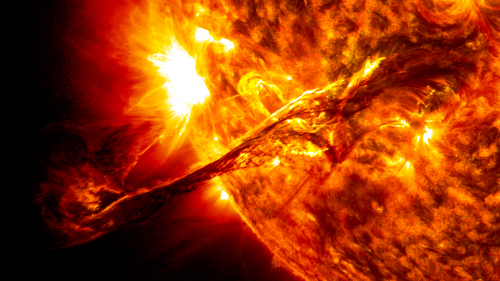
CMEs happen when solar prominences break off and fly into space. Solar prominences form as giant plasma arcs which follow magnetic lines of force across the surface.
The sun sucker appears to be a low-pressure void in the coronasphere which has gas flowing into it from the photosphere. The flow forms into a vortex or vortexes naturally just like water going down a drain.
The vortexes aren’t really mysterious, but the voids are, at least to me. The coronasphere is the atmosphere of the sun. Imagine if a huge bubble of hard vacuum from outer space intruded into the Earth’s atmosphere down to within a few miles of the surface. There would be atmosphere flowing into the vacuum bubble at all points but the flow would be the greatest into the part of the bubble that was nearest the surface, where the atmosphere is denser and under higher pressure. Massive vortexes (tornadoes) would form where the flow is highest.
Whatever it may be that’s causing the enormous void and sucking up gas from the sun, if it came to Earth it could envelope the entire planet and strip off the atmosphere!
Number 4 and number 7 fit the photino bird (who inhabit the Dark Mater realm of the Universe - the largest part) theory used by Baxter in his novels.
Disclaimer: Opinions posted on Free Republic are those of the individual posters and do not necessarily represent the opinion of Free Republic or its management. All materials posted herein are protected by copyright law and the exemption for fair use of copyrighted works.