Posted on 01/18/2018 11:58:09 AM PST by Red Badger
The company has big plans to make electric cars cool.
t’s an exciting time for solid state batteries. BMW announced last month that it’s teamed up with Colorado-based battery developer Solid Power, which could see the automaker ditch the liquid electrolyte lithium-ion cells of yesteryear in favor of a solid alternative that’s safer, higher-energy, and simpler.
“I don’t wanna sit here and claim that all the technical challenges are solved,” Doug Campbell, the CEO of Solid Power, tells Inverse. “It’s a vote of confidence in that some of the fundamental historical concerns for solid state, I think this is a reflection that these have been solved, at least from a feasibility standpoint.”
Long touted as a dream alternative to current batteries, it’s estimated that solid state batteries could store twice as much energy. In the case of the second-generation Tesla Roadster, it could help double the 620-mile range from its 200 kilowatt-hour battery.
It’s not unreasonable to think Tesla could adopt the cells, either: Elon Musk alluded to “the most significant [battery] breakthrough in a while” that “could be made to work” in an August 2017 investor call. Los Angeles to Seattle on a single charge, anyone?
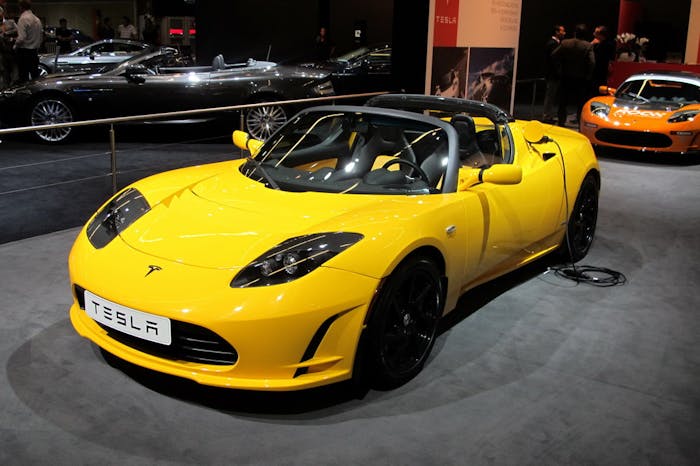
A first-generation Tesla Roadster. _______________________________________________________________________________________________________________________________________
However, it’s not as easy as it sounds to swap out existing materials for new ones. SolidEnergy, a company that spun out of MIT in 2012, ended out using a combination of solid and liquid electrolytes to maintain the same levels of conductivity while providing the added capacity. Sakti3, a subsidiary of Dyson, made a breakthrough last year when it employed a thin-film deposition process to stop the electrodes from touching.
Solid Power, which uses “proprietary inorganic materials”, has a functioning five amp-hour battery in the lab. That’s around double the size of a conventional smartphone battery, and the company believes that smaller batteries could reach some industries within the next three to five years. Because the process uses many of the materials and processes of classic lithium-ion batteries, Campbell is confident that these cells will offer similar cost-per-kilowatt efficiency savings found in current batteries.
One of the biggest hurdles in getting this dream car on the roads is the qualification process. That means getting manufacturing up to scale, passing through regulatory hurdles, and ensuring the technology is safe for roads. Because of this, Campbell believes we’ll be able to drive a solid state battery car in the next five to 10 years from now. Anything sooner than that is unrealistic.
“I know [Toyota] have been involved in this space for a very long time, and they have a lot of resources,” Campbell says. “I can say just through the interactions I’ve had with partners of Toyota, I deduce that they’re not any further than we are, but I’m not operating on any privileged information.”
Another major hurdle is recharge time. While Tesla touts half-hour recharge times from its 120-kilowatt supercharging stations, it’s a rate that takes its toll on the battery.
“As compared to lithium-ion, it is still limited on charge rate,” Campbell says.
It’s going to be hard to persuade people to sit around for hours waiting for their car to charge, especially if these batteries enter the market after years of electric vehicle adoption. Nonetheless, the future of alternative fuel cars is looking decidedly solid.
I-5 through Oregon and Washington doesn’t cross any mountain passes.
At the San Jose Innovation Center, Intel is hosting BMW as they co-develop electric smart cars. They are doing this with the help of Mobile Eye, an Israeli company that Intel purchased.
It’s a very big garage and lab. Both companies are pouring untold sums into it, expecting it to be the next big thing. Every day a semi full of cash drops a load out front.
Which causes me to raise the question: Who the hell wants a BMW that drives itself?
It’s tulips all over again.
Humm I thought it did must be misremembering.
That means getting manufacturing up to scale, passing through regulatory hurdles, and ensuring the technology is safe for roads. Because of this, Campbell believes we’ll be able to drive a solid state battery car in the next five to 10 years from now.
...
Oh brother. Nothing but hype for now.
It will when CA slides into the ocean................
And most everyone of them most likely Electrical fires that have nothing to do with the Gas tank. Occasionally a leaky fuel line in the wrong place will do it however.
Again? When were they ever great?
> You regularly sit on 20 gallons of gasoline without concern. What are you worrying about Li-Ion for?
Because I’ve had 2 cell phones (Motorola and Samsung) blow up while they sat on my desk charging overnight. I’ve never had a car blow up on me (not that they couldn’t; they just haven’t yet).
My rich relative will visit Germany later this year, and plans to check out the new Porsche E Mission.
It is a 4 door lux sedan, all electric, 4 power levels (400, 500, 600 HP)
Range is 300+ miles, recharges to 85% in 15 minutes.
Cost near their current Panamera (which he already has).
I study this segment of the market for a living.
The auto industry is all-in on AV.
They know the market for AV is going to come down to a single feature - trust.
Nobody will buy a self-driving car that poses unnecessary risk.
As such, they wrote a standard, and it is pretty stringent. It’s the first time I’ve seen an industry get ahead of the regulatory issue. I have to say I’m impressed.
There are levels, ASIL A through D, and for tools, components, MEMS, etc. There are litigation tests like ALARP (As Low As Reasonbly Possible) that they are inviting themselves to be held to.
The money involved is astounding. It feels like a space-race - first one to an L4 AV wins.
This entire product runs on trust, not volts. Fascinating to watch.
The incidents I’ve encountered were quite clearly a gasoline problem.
Cell batteries have an extreme motivation for “thin” - as in the battery’s case must be as thin-walled as possible, the air gap between that and contents as thin as possible (both non-zero), and the energy density as high as possible so the storage materials can be as thin as possible. That’s led to some “too thin” situations, and they arced over.
Car batteries don’t need such extreme minimization of casing. Instead, they have some serious impact tolerance requirements - reducing the odds of a short & fire substantially. Considering the far-higher power containment, that too leads to better mitigation of shorting risks.
They are making the assumption there is no inherent joy to driving, or that there is not an irrational fear...generally in the population...of robots/AVs.
At best I expect a 20% penetration in the large, west coast cities in the next 20 years.
Maybe I’m naive. But I consider myself an astute observer of human nature...and I believe the AV is squarely contrary to human nature.
I cannot imagine an incentive that would cause me to buy one, or (more likely) use the services of.
Uber on steroids will be big in the cities and will supplant taxis with AV.
I think you’ll be surprised how many people don’t want to drive, and are comfortable with telling the GPS map “take me to 321 Foobar Lane” literally doing it. Wealthy people in particular, who want the services of a professional driver without actually hiring one. It would be freaky at first, but methinks most people would quickly get used to spending the time staring at the phones that they’re already trying to while driving.
I’d especially like one when making 1000+ mile drives to visit family. I’ll take control around the endpoints, but once on the freeway I’d rather just let the car keep itself between lanes & other cars, and even self-charge periodically at rest-area superchargers while I nap.
I vaguely recall the same arguments about automatic transmissions.
It’s not going to happen at once.
If you’ve ever been to NYC, there are very few personally owned vehicles on the road.
BMW and Mercedes are already rolling out a subscriber business model wherein you can use the car you want on an extremely temporary basis.
The car can drive itself to your location.
Extend that, and any purpose-built auto you need can be yours by cell in minutes. No car payment.
Cars will be like a utility, at least that’s where they think its going.
It won’t stop people from owning them, but there will be districts where personal driving will be prohibited. That I can see.
The insurance companies will decide.
Disclaimer: Opinions posted on Free Republic are those of the individual posters and do not necessarily represent the opinion of Free Republic or its management. All materials posted herein are protected by copyright law and the exemption for fair use of copyrighted works.