Posted on 05/11/2015 11:50:47 PM PDT by Swordmaker
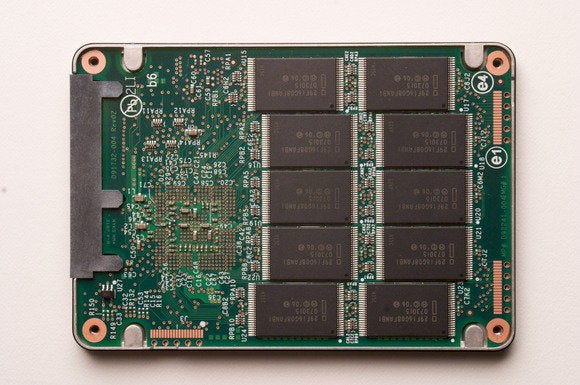
If you’ve got an unused computer with solid state storage inside, you might want to back up its data before too long.
A new research presentation shows that solid state drives can lose data over time if they aren’t powered on, especially in warmer environments. A powered-off drive in 104 degrees Fahrenheit may start seeing data loss after a couple of weeks.
The information comes from Seagate’s Alvin Cox, who was part of a presentation to the Joint Electron Device Engineering Council (JEDEC). Though the presentation is a couple of months old, it was recently picked up by ZDNet, Slashdot and other sites.
Cox’s presentation shows basic performance requirements for both consumer and enterprise SSDs. It notes that consumer SSDs, when powered-off in 86 degrees Fahrenheit (30 degrees Celsius), should retain data for about a year. Bumping up the temperature by 9 degrees Fahrenheit (5 degrees Celsius) reduces the time of data retention by half. Store your SSD in 131 degree heat, and it might start losing data after a couple of days.

We’re in the process of digging into this more, but a comment on Slashdot notes that these figures are merely what JEDEC requires. It’s entirely possible that a good SSD will fare better, even in warm weather.
The impact on you: In reality, there’s probably not much risk to your primary computer unless you leave it in excessively high heat, in which case you may have other problems to address. But as more devices come with solid state storage as the standard, you may end up with some older computers whose data will deteriorate after a couple years' neglect.
(Excerpt) Read more at pcworld.com ...
I believe that some SSD’s have procedures built into their firmware to “read/re-write” stale sectors over the original data in the background in order to refresh them and keep the cells “topped off”. Of course, the device has to be powered in order to do this. I had no idea that this problem could manifest itself so quickly.
I have very old computers (some >30 years old) with UVEPROMS (an older programmable read-only technology). When those came out, they were guaranteed to retain data only ~10 years (maybe later, 20 years). I’ve backed up images of them, but so far, not one bit has changed (they are checksummed).
I have an SUV with a dying battery that's doing exactly that, and higher temperatures exacerbate the problem. New battery time.
I seem to remember that a giant dell laptop I had weighed 8 or 9 lbs!
Shouldn’t there have been a warning label or something/=>
This is no joke either.
The memory in my data collectors use up two AA cells every three days, and if you forget them for a week, the data is completely lost, and they are small by comparison with the SS drives in most computers.
I use a Deltran Battery Tender Plus on my garaged modern car, because the electronics kill the battery after a couple of weeks not starting it. It has a coupler that can be detached and covered, and easily tucked out of sight when using the car. Good for a garaged car. If yours is outdoors, there are solar chargers available to keep your car battery charged when the car is not being used daily. Sometimes I won't use mine for months.
I use a SSD as my boot drive on my computers, and use externally attached regular hard drives for large capacity storage that also have backups of the SSD's. I'm amazed that some people don't do regular backups at all, naive people think they will never lose data but they will.
“I still see no reason to move to a SSD.”
Eleven seconds from power-on to desktop ... and that includes spinning up two HD’s.
I never heard anything like that before. That is definitely a major flaw.
That's pretty much my setup as well. Works like a champ.
> I'm amazed that some people don't do regular backups at all, naive people think they will never lose data but they will.
Hey, I heard the other day that there are still people who go dating and having unprotected sex with people they just met. Similar mindset.
;-)
As for PCs, I've lost data on some hard drives but was able to restore from backups. Hard drives would be working one day and then not the next. A couple were due to the controllers failing, but most from the platters getting corrupted so the drive would be thrown out. One SSD got corrupted when I unmounted it, strange as I had done it many times to others. Had to reformat it. So data can be lost on SSD drives. I have also had USB stick drives go bad. If it's important, have multiple copies on different storage media in different locations and you won't lose sleep over loss of data.
But I thought SSD drives were suppose to be less prone to data loss than physical drives....
Disclaimer: Opinions posted on Free Republic are those of the individual posters and do not necessarily represent the opinion of Free Republic or its management. All materials posted herein are protected by copyright law and the exemption for fair use of copyrighted works.