Posted on 04/18/2015 10:32:41 AM PDT by ProgressingAmerica
The United States does not have a living and breathing constitution. So then, how do we build it into one?
Earlier today, I posted the full text of Louis Brandeis' address "The Living Law", which is quite an interesting work. On the one hand, Brandeis does accurately capture public feeling regarding mistreatment by their employers. On the other hand, Brandeis' uses this address to stand back, marvel at his own work, and act like an innocent bystander.
The big key in the address is the court case "Muller v. Oregon", to which Brandeis had a hand in. He doesn't mention that in the address.
The Muller case is important because of the famous(I prefer to look at it as the infamous) 'Brandeis Brief'. Brandeis himself notes the importance of the repercussions of the case in his own writing, I encourage you to read it. To summarize, just a few years after the Lochner and Ritchie cases the courts reversed themselves in regard to legal working hours.
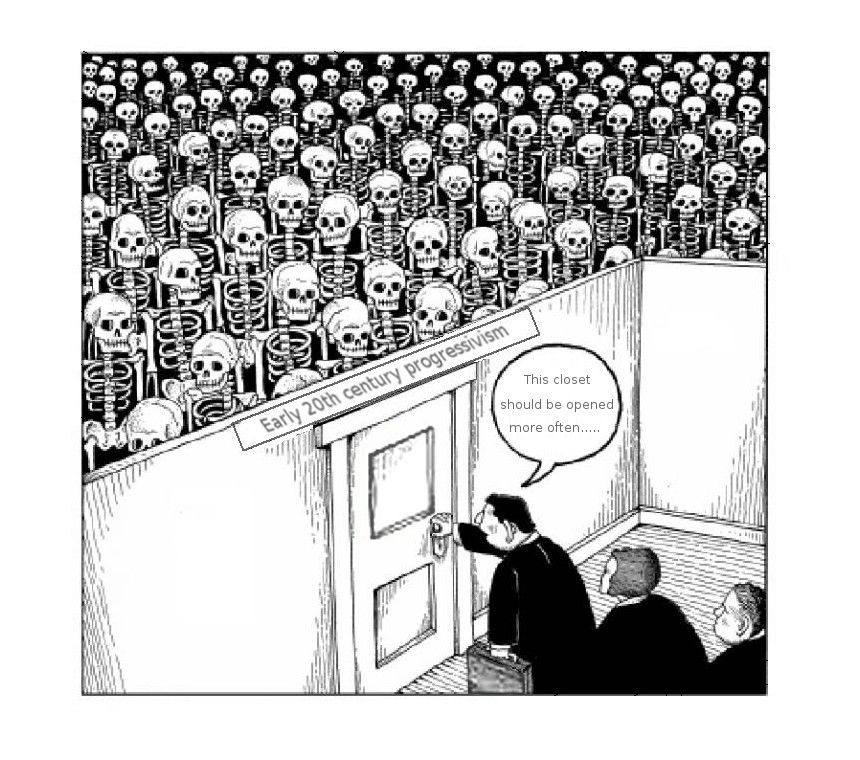
The Brandeis Brief is another great example of what I wrote regarding John Dewey. I will summarize this so that I can move forward. Not all that encompasses progressivism is written in their words, there is also their deeds. In other words, early progressivism is only partially quotable. The real danger of progressivism is the culture of progressivism. The Brandeis Brief is an exemplary example of propaganda by deed. Norman Risjord, in his book Populists and Progressives (page 177), explains this fairly well. Brandeis saw an opportunity and exploited it. Here's how this particular situation works:
1) Louis Brandeis engages in propaganda by deed, abusing the legal system in Muller v Oregon to achieve a particular end.
2) He then publishes his essay on 'The Living Law', which mates the propaganda to the deed and complete the process.
It's a two part activity split apart by 8 years. This also shows the patience progressives have in subverting our way of life.
As to how this plays into the 'living and breathing Constitution', it has been via the courts more than any other that the progressives have had their greatest success in breaking apart the protections that are there in the document to defend we the people against an out of control government. What the Muller case ends up achieving is one break-away, free from constitutional constraint. Peckham's dissent was not an open invitation, yet Brandeis walked through the door anyways. The end result is that instead of the Constitution itself being the de-facto standard by which law is decided, the tit-for-tat comings and goings of the employee vs the employer become the sole standard.
Voila, living and breathing law under a living and breathing constitution. At this point, progressive judges and legalists are not honestly using the constitution as a model, they're pulling quotes and 'sound bites' out of it in order to advance their viewpoints.
A few other things of note: The Supreme Court does not have to hear all cases. It can pick and choose, and defer back to the states. The states have their own constitutions for such things. This sort of nationalism has taken place because the progressives have no use for, as Theodore Roosevelt put it, "squabbling contemptible commonwealths".
Other such court cases which have broken the courts away from constitutional constraint include the J. W. Hampton, Jr. & Co. v. United States case.(1928)
Again, we see the patience of progressives on display. Hampton was 20 years after Muller.
For additional background on how progressives moulded our Constitution into a 'living and breathing' document, see one of the two study papers I have written: Honestly questioning the notion of a Living and Breathing Document - The British Constitution.
The country currently has a virulent case of COPD — Constitution Offends Progressives & Democrats ...
When the Left talks about a “living Constitution” they are talking about judicial activism which is judges and Justices amending the Constitution from the bench. What they really mean is “We need more government regardless of constitutional limitations.” That doesn’t reflect a “living Constitution”, that reflects treason and tyranny.
The Constitution AS WRITTEN AND ORIGINALLY UNDERSTOOD AND INTENDED is as alive as the truths it reflects - among others, that governments govern best that govern least. It is as living as freedom is living in the hearts of men and women. As long as freedom is living in the hearts and minds of the American People, the Constitution is a living, breathing document.
The Left gets away with this nonsense because they love to confuse truth with fact. Certain truths never change. But facts always change. The truth that the federal government needs to be limited and decentralized doesn’t change. What make the Constitution a living, breathing document is that you can apply its unchanging truths of the charter of limited government to whatever changing facts are before you.
The Constitution with its unchanging truths of freedom and limited government is designed for the precise purpose of being applied to whatever are the changing facts in a changing world. Therefore, the Constitution AS WRITTEN AND ORIGINALLY UNDERSTOOD AND INTENDED is as alive and relevant as it ever was.
Bump
Unfortunately it was used to support Brown v. Bd. of Education on the shifting sands of school science, when instead as Judge Bork wrote the separate but equal standard went against the direct prohibition of the 14thA but the justices ducked the literal text,
I believe it was Judge Scalia who remarked: “The Constitution is an enduring document, not a living one”.
I believe he is correct.
He also gave full-throated endorsement to Wickard and then some in Raich =>
Where necessary to make a regulation of interstate commerce effective, Congress may regulate even those intrastate activities that do not themselves substantially affect interstate commerce.
Scalia the Elastic, concurring in Raich
Living and breathing where every unborn child has a right to live and breath free.
thx for posting it was a “good” read. not really good but historic.
Scalia: “Where necessary to make a regulation of interstate commerce effective, Congress may regulate even those intrastate activities that do not themselves substantially affect interstate commerce.”
I can’t wrap my mind around how wrong that statement is specifically from Scalia. I can understand the perspective, the reasoning, but it goes against the Constitution as I understand it.
Such confusion is a reason I wish the wording could be changed from “regulate interstate” commerce to adjudicating interstate commerce. Eliminate the Fed as regulators, or we continue on with the mess we have.
 Do We Have A Living Constitution?
"Until the people have, by some solemn and authoritative act, annulled or changed the established form, it is binding upon them collectively, as well as individually; and no presumption or even knowledge of their sentiments, can warrant their representatives [the executive, judiciary, or legislature]; in a departure from it prior to such an act." - Alexander Hamilton
In the first of the eighty-five "Federalist Papers," Alexander Hamilton emphasized that:
... it seems to have been reserved to the people of this country, by their conduct and example, to decide the important question, whether societies of men are really capable or not of establishing good government fromreflection or choice, or whether they are forever destined to depend for their political constitutions on accident and force."
The Framers knew that the passage of time would surely disclose imperfections or inadequacies in the Constitution, but these were to be repaired or remedied by formal amendment, not by legislative action or judicial construction (or reconstruction). Hamilton (in The Federalist No. 78) was emphatic about this:
"Until the people have, by some solemn and authoritative act, annulled or changed the established form, it is binding upon them collectively, as well as individually; and no presumption, or even know ledge of their sentiments, can warrant their represen tatives in a departure from it prior to such an act."
The Congress, unlike the British Parliament, was not given final authority over the Constitution, which partly explains why the judicial authority was lodged in a separate and independent branch of government. In Britain the supreme judicial authority is exercised by a committee of the House of Lords, which is appropriate in a system of parliamentary supremacy, but, although it was suggested they do so, the Framers refused to follow the British example.
The American system is one of constitutional supremacy, which means that sovereignty resides in the people, not in the King-in-Parliament; and the idea that the Constitution may be changed by an act of the legislature-even an act subsequently authorized by the judiciary-is simply incompatible with the natural right of the people to determine how (and even whether) they shall be governed.
Unlike in Britain where, formally at least, the queen rules by the grace of God (Dei gratia regina), American government rests on the consent of the people; and, according to natural right, the consent must be given formally. In fact, it must be given in a written compact entered into by the people. Here is Madison on the compacts underlying American government:
"Altho' the old idea of a compact between the Govt. & the people be justly exploded, the idea of a compact among those who are parties to a Govt. is a fundamental principle of free Govt.
"The original compact is the one implied or presumed, but nowhere reduced to writing, by which a people agree to form one society. The next is a compact, here for the first time reduced to writing, by which the people in their social state agree to a Govt. over them." (In a letter to Nicholas P. Trist, February 15, 1830)
Neither civil society (or as Madison puts it, "the people in their social state') nor government exists by nature. By nature everyone is sovereign with respect to himself, free to do whatever in his judgment is necessary to preserve his own life - or, in the words of the Declaration of Independence, everyone is endowed by nature with the rights of life, liberty, and the pursuit of a happiness that he defines for himself. Civil society is an artificial person (constituted by the first of the compacts), and it is civil society that institutes and empowers government. So it was that they became "the People of the United States" in 1776 and, in 1787-88, WE, THE PEOPLE ordained and established "this Constitution for the United States of America."
In this formal compact THE PEOPLE specified the terms and conditions under which "ourselves and posterity," would be governed: granting some powers and withholding others, and organizing the powers granted with a view to preventing their misuse by the legislative, the executive, and the judicial branches alike. WE THE PEOPLE were authorized by natural right to do this, and were authorized to act on behalf of posterity only insofar as the rights of posterity to change those terms and conditions were respected. This was accomplished in Article V of the Constitution, the amending article, which prescribed the forms to be followed when exercising that power in the future.
What THE PEOPLE were not permitted to do in 1787-88 was to deprive - or pretend to deprive - posterity of their natural right to do in the future what the founding generation had done in 1776. Nor could they, by pretending to delegate it to Congress, the President, or the Supreme Court, deprive them of their sovereign power to change the Constitution. Instead, that power was recognized in the Constitution's provisions in Article V.
The Framers had designed a constitutional structure for a government which would be limited by that structure - by the distribution of power into distinct departments, a system of legislative balances and checks, an independent judiciary, a system of representation, and an enlargement of the orbit 11 within which such systems are to revolve" And to the judges they assigned the duty, as "faithful guardians of the Constitution," to preserve the integrity of the structure, for it is by the structure (more than by "parchment barriers") that the government is limited. It would he only a slight exaggeration to say that, in the judgment of the Founders, the Constitution would "live" as long as that structure was preserved.
Now, almost 200 years later, one can read Hamilton's words in Federalist No. 1 and conclude that, under some conditions, some "societies of men" are capable of "establishing good government," but that most are not. This is not for lack of trying; on the contrary, constitutions are being written all the time - of some 164 countries in the world, all but a small handful (seven by the latest count) have written constitutions - but most of them are not long-lived.
In September 1983, the American Enterprise Institute sponsored an international conference on constitution writing at the Supreme Court of the United States; some twenty-odd countries were represented. With the exception of the Americans, the persons present had themselves played a role - in some cases a major role - in the writing of their countries' constitutions, most of them written since 1970. Only the constitution of the French Fifth Republic predated 1970; and the Nigerian, so ably discussed and defended at the 1983 conference by one of its own Framers, had subsequently been subverted, much as the four previous French republican constitutions had been subverted. It would seem that many peoples are experienced in the writing of constitutions, but only a few of them - conspicuous among these the people of America - have an experience of stable constitutional government. In that sense, we surely have "a living Constitution." That is not, however, the sense in which the term is ordinarily used in the literature of constitutional law as shall be explored herein.
In the language of many today, a "living Constitution" is not first of all one that is long-lived; rather, its longevity is a secondary or derivative quality which is attributed to its "flexibility" or better, its "adaptability." It is this quality " adaptability" that allows it to be "kept in tune with the times," as the members of this school of thought sometimes say. According to them, a living Constitution is first of all a protean constitution - one whose meaning is not fixed, but variable.
In this respect, it is similar to the Constitution as understood by the "judicial power" school. Some judicial power advocates go so far as to say that, until the judges supply it in the process of adjudication, the Constitution has no meaning whatever. Here are the words of judge Lynn D. Compton of California, writing in 1977 in the pages of the Los Angeles Times:
"Let's be honest with the public. Those courts are policy-making bodies. The policies they set have the effect of law because of the power those courts are given by the Constitution. The so-called "landmark decisions" of both ofU.S. Supreme Court and the California Supreme Court were not compelled by legal precedent. Those decisions are the law and are considered "right" simply because the court had the power to decree the result. The result in any of those cases could have been exactly the opposite and by the same criteria been correct and binding precedent.
"In short, these precedent-setting policy decisions were the products of the social, economic and political philosophy of the majority of the justices who made up the court at a given time in history .."
So extreme a view of judicial power is not likely ever to be expressed in the official reports; there (perhaps in order to be dishonest with the public) even the most inventive judge will claim to be expounding the Constitution, if not its explicit provisions then, at least its emanations, penumbras, or lacunae (Griswold v. Connecticut). What is of interest is that a judge should be willing to express it anywhere - for what it means is that a constitutional provision can be interpreted, but not misinterpreted, construed but not misconstrued. More to the point here is that it means that the Constitution is a living charter of government only because it is repeatedly being reinvented by the judiciary.
The 'Living Constitution' school and the 'Judicial Power' school may be indistinguishable at the margins, but they derive from unrelated and distinct sources. 'Judicial Power' is a product or an extension of legal realism, the school of thought whose advocates, from the beginning of the twentieth century, have argued that the essence of the judicial process consists not in interpreting law, whether statute or constitutional, but in making it. Its advocates today speak with a certain nonchalance of "creating" constitutional rights (Moore v. City of EastCleveland), and, when pressed to cite their authority for doing so are likely to point to the work of contemporary legal theorists like Ronald Dworkin and his bookTaking Rights Seriously . It is Dworkin who has purportedly given this sort of "constitutional lawmaking" what it has always lacked a philosophical underpinning. As he sees it, rights cannot be taken seriously until there has been "a fusion of constitutional law and moral theory," and to make it clear that he is not referring to any particular moral theory that may have informed the Constitution as written, he finishes that sentence by saying that that fusion "has yet to take place."
As it turns out, however, the moral theory he propounds, and which he hopes to "fuse" with constitutional law, proves to be nothing more than a fancy way of justifying what the judge Comptons among us have been doing all along. And what they have been doing is, essentially, treating the Constitution as a thing without form or substance, except insofar as it authorizes the judges to give it substance.
The living Constitution school also claims to have a source more venerable than legal realism or Ronald Dworkin - justice John Marshall. A former president of the American Political Science Association argues that the idea of a " 'living Constitution'...can trace its lineage back to John Marshall's celebrated advice in McCulloch v. Maryland (1819): 'We must never forget that it is a Constitution we are expounding...intended to endure for ages to come, and consequently to be adapted to the various crises of human affairs' " The words quoted are certainly Marshall's but the opinion attributed to him is at odds with his well-known statements that, for example, the "principles" of the Constitution "are deemed fundamental [and] permanent" and, except by means of formalamendment, "unchangeable" (Marbury v. Madison). It is important to note that the discrepancy is not Marshall's; it is largely the consequence of the manner in which he is quoted - ellipses are used to join two statements separated by some eight pages in the original text. Marshall did not say that the Constitution should be adapted to the various crises of human affairs; he said that the powers of Congress are adaptable to meet those crises. The first statement appears in that part of his opinion where he is arguing that the Constitution cannot specify "all the subdivisions of which its great powers will admit;" if it attempted to do so, it would "partake of the prolixity of a legal code" (McCulloch v. Maryland), In the second statement, Marshall's subject is the legislative power, and specifically the power "to make all laws which shall be necessary and proper for carrying into execution" the explicitly granted powers.
Neither Marshall nor any other prominent members of the founding generation can be 'appropriated' by the living Constitution school to support their erroneous views. Marshall's and the Founders' concern was not to keep the Constitution in tune with the times but, rather, to keep the times to the extent possible, in tune with the Constitution. And that is why the Framers assigned to the judiciary the task of protecting the Constitution as written.
They were under no illusions that this would prove to be an easy task. Nevertheless, they had reason to believe that they had written a constitution that deserved to endure and, properly guarded, would endure. Hence, Madison spoke out forcefully against frequent appeals to the people for change. Marshall had this Madisonian passage in mind when, in his opinion for the Court in Marbury, he wrote:
"That the people have an original right to establish, for their future government, such principles as, in their opinion, shall most conduce to their own happiness, is the basis on which the whole American fabric has beenerected. The exercise of this original right is a very great exertion; nor can it, nor ought it, to be frequently repeated. The principles, therefore, so established, are deemed fundamental: and as the authority from which they proceed is supreme, and can seldom act, they are designed to be permanent."
At this point, it is well to remember Hamilton's strong warning about unwarranted presumptions by those in government of a power to depart from the people's established form as quoted in the title of this essay.
Marshall referred to the "principles" which he called "permanent," and the "basis on which the whole American fabric has been erected" Yet Marshall also chose to address the much broader issue of the general scope of the national powers. The Constitution must be construed to "...allow to the national legislature that discretion, with respect to the means by which the powers it confers are to be carried into execution, which will enable that body to perform the high duties assigned to it, in the manner most beneficial to the people." It is these powers, not the Constitution, which are flexible and adaptable to meet the crises of "human affairs."
Ironically, the very case cited by the "living Constitution" school, when properly read, demonstrates that John Marshall, at least, saw, no need for flexibility in the Constitution.
What has been undertaken here has been providing (within a very brief compass indeed) an accurate statement of the principles underlying the American Constitution: pointing to (but by no means elaborating) the political theory from which they derive and the constitutional conclusions to which they lead. Among the latter is the untenability of the proposition that constitutional limitations can be jettisoned, constitutional power enhanced, or the constitutional division of powers altered, by means other than formal constitutional amendment.
It will not be argued that it may sometimes be convenient to allow the Senate to originate a bill "for raising revenue," but convenience is not a measure of constitutionality. There is much to be said in favor of the legislative veto - Who would, in principle, deny the need of checks on administrative agencies? - but, as the Supreme Court correctly said, the Framers anticipated that Congress might find reason to employ such devices and, when designing the so-called "presentment clause" in Article 1, Section 7, forbade them ( Immigration and Naturalization Service v. Chadha). And from a particular partisan perspective it is understandably frustrating, simply because the required number of states had not yet ratified the Equal Rights Amendment, to be denied the power to promote the cause of sexual equality; but frustration alone cannot justify a judicial attempt to preclude the necessity of formal ratification, as Justice Brennan is said to have wished to do. In Frontiero v. Richardson (411 U.S. 677, 1973) the Supreme Court was divided on the issue of whether sex, like race, should be treated as a suspect classification. We are told that Justice Brennan circulated a draft opinion in which he proposed to declare classification by sex virtually impermissible and that he knew this would have the effect of "enacting" the pending ERA. "But Brennan was accustomed to having the Court out in front, leading any civil rights movement," a major publication stated. Hence, we are further told, he saw "no reason to wait several years for the states to ratify the amendment." No reason, that is, other than the fact, which Brennan implicitly acknowledged, that the Constitution as then written, and which had not yet been rewritten by the only people authorized to rewrite it, did not support the role he would have the Court hand down.
Those who would use "convenience" or "frustration" as reason, or who insist that it lies within the powers of the Court (or the Congress or the Executive) to effect constitutional change, can be charged with a lack of respect for the principles on which, as Marshall wisely observed: "the whole American fabric has been erected."
We are told that it is unreasonable - even foolish - to expect that the Framers could have written a Constitution suitable alike for a society of husbandman and a society of multinational corporations, to say nothing of one as well adapted to the age of the musket and sailing ship as to the age of intercontinental nuclear-tipped missiles. As the problems have changed, the argument goes, so must the manner in which they are confronted and solved, and the Constitution cannot be allowed to stand in the way. Indeed, there is no reason to allow it to stand in the way, we are told, because the Framers intended it to be flexible. And we are told that John Marshall would support this position. But it was Marshall, in McCulloch v. Maryland, who stated: "Throughout this vast republic, from the St. Croix to the Gulf of Mexico, from the Atlantic to the Pacific, revenue is to be collected and expended, armies are to be marched and supported." The United States, in this view was not intended to be a simple society of husbandmen, and Marshall Clearly saw that the Constitution empowered Congress to do what was required to meet the crises of the Republic, and to maintain the Constitutional structure intended by the Framers, changing it only when such change would be in keeping with the structure itself.
That the American Constitution is long-lived, has enduring qualities, and was intended for the ages cannot be doubted. That it was founded on enduring principles, and that it was based on the authority of a people who are sovereign has been attested to by many of its leaders. That it can be changed when, and if, the people ordain such change is a part of its own provisions. For these reasons, it can be said to be a "Living Constitution" - but let that not be claimed by those who would use the language to subvert the structure.
“A living Constitution is a dead letter.”
The “living Constitution” concept is a natural conclusion from the leftist assumption, based on their religion of Humanism, that those alive today are far more knowledgeable and capable and ethical than anyone in the past (sometimes including their past selves!).
Therefore, it is “immoral” to them for the present set of leaders to be bound by “lesser” standards written in the past.
All of this phony baloney Leftist crap comes down to one simple thing: the value of freedom does not diminish with the passage of time and neither does its corollary, the need to restrain government and destroy tyranny. All the Constitution does is create and then limit the federal government. The Constitution AS WRITTEN AND ORIGINALLY UNDERSTOOD AND INTENDED is the guardian of our God-given rights to Life, Liberty, and Free Pursuit the value of which is not subject to the passage of time, and neither is the relevancy to "preserve, protect and defend" it as the Supreme law of the land.
The Leftists' attempt to justify mischievous use and trampling of the Constitution is actually anarchy followed by tyranny. Anarchy and tyranny seem opposite but they are actually close and one follows the other. Tyranny is a form of anarchy. The French Revolution was a good example.
Rejection, nullification, and rebellion against the current government and its laws is not necessarily anarchy. The American Revolution was a good example.
Today's Leftists are anarchists and tyrants. We who love freedom must pierce their phony justifications and rationale and stand opposed. For example, ALL law is "in the past" - so their argument is an argument for anarchy.
Maybe the strongest argument against them is exposing their deliberate confusion of the unchanging value of freedom that is not subject to the passage of time, with the ever-changing facts and circumstances of life and whims of men.
The Constitution AS WRITTEN AND ORIGINALLY UNDERSTOOD AND INTENDED will always be applicable because the stand for freedom and against tyranny will always be applicable to circumstantial reality, so that we henceforth be no more children, tossed to and fro, and carried about with every wind of doctrine, by the sleight of men, and cunning craftiness, whereby they lie in wait to deceive, but speaking the truth in love, may grow up (Eph 4:14). We need to grow up and once again be the home of the brave so we can once again be the land of the free.
Bump for later. Looks like an excellent post.
I enjoy you posts - the Left wants the Constitution to go away and unless we coalesce with a united front, I fear they will manage to make it irrelevant to the way they conduct business. Then we are all screwed.
I think we’re back to whether we’re willing to fight and pay whatever price needs to be paid for our freedom and the Constitution which protects our freedom.
At our beginnings, life wasn’t easy and men were tough. Today, I think we’re softer and not as rugged and freedom may not seem as important as the inconvenience and discomfort of fighting for it.
Another reason why Cruz scares the hell out of the Left - he is a proponent of the People wresting their Freedoms back from an oppressive tyranny...
“thx for posting it was a “good” read. not really good but historic.”
Maybe for the lawyer types, but didn’t make any sense to me as it name drops case law, but doesn’t say what the case was about.
Well, we’re going to need leaders like that, but more than just one. We’re going to need courage and bravery to emerge from among the American People also if we are to have this rebirth of freedom. I’m a-hopin’. :)
Disclaimer: Opinions posted on Free Republic are those of the individual posters and do not necessarily represent the opinion of Free Republic or its management. All materials posted herein are protected by copyright law and the exemption for fair use of copyrighted works.