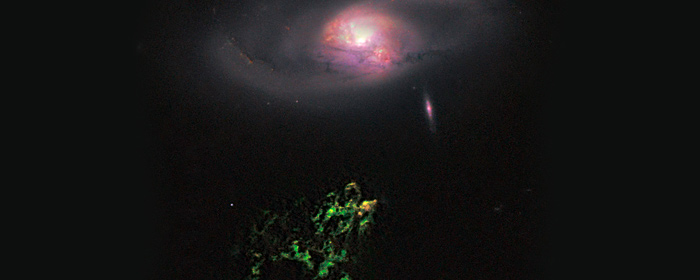
Hubble Zooms in on a Space Oddity
Press Release - 10 January 2011
A strange, glowing green cloud of gas that has mystified astronomers since its discovery in 2007 has been studied by Hubble. The cloud of gas is lit up by the bright light of a nearby quasar, and shows signs of ongoing star formation.
One of the strangest space objects ever seen is being scrutinised by the penetrating vision of the NASA/ESA Hubble Space Telescope. A mysterious, glowing green blob of gas is floating in space near a spiral galaxy. Hubble uncovered delicate filaments of gas and a pocket of young star clusters in the giant object, which is the size of the Milky Way.
The Hubble revelations are the latest finds in an ongoing probe of Hanny’s Voorwerp (Hanny’s Object in Dutch). It is named after Hanny van Arkel, the Dutch schoolteacher who discovered the ghostly structure in 2007 while participating in the online Galaxy Zoo project. Galaxy Zoo enlists the public to help classify more than a million galaxies catalogued in the Sloan Digital Sky Survey. The project has expanded to include Galaxy Zoo: Hubble, in which the public is asked to assess tens of thousands of galaxies in deep imagery from the Hubble Space Telescope.
In the sharpest view yet of Hanny’s Voorwerp, Hubble’s Wide Field Camera 3 and Advanced Camera for Surveys have uncovered star birth in a region of the green object that faces the spiral galaxy IC 2497, located about 650 million light-years from Earth. Radio observations have shown an outflow of gas arising from the galaxy’s core. The new Hubble images reveal that the galaxy’s gas is interacting with a small region of Hanny’s Voorwerp, which is collapsing and forming stars. The youngest stars are a couple of million years old.
The greenish Voorwerp is visible because a searchlight beam of light from the galaxy’s core has illuminated it. This beam came from a quasar — a bright, energetic object that is powered by a black hole. The quasar is thought to have turned off less than 200 000 years ago.
Astronomer Bill Keel of the University of Alabama in Tuscaloosa, USA, leader of the Hubble study, is presenting his results on this object today at the American Astronomical Society meeting in Seattle, USA. Read more about his preliminary findings in the NASA news release linked below.