Astronomy Picture of the Day
Discover the cosmos! Each day a different image or photograph of our fascinating universe is featured, along with a brief explanation written by a professional astronomer.
2003 November 20 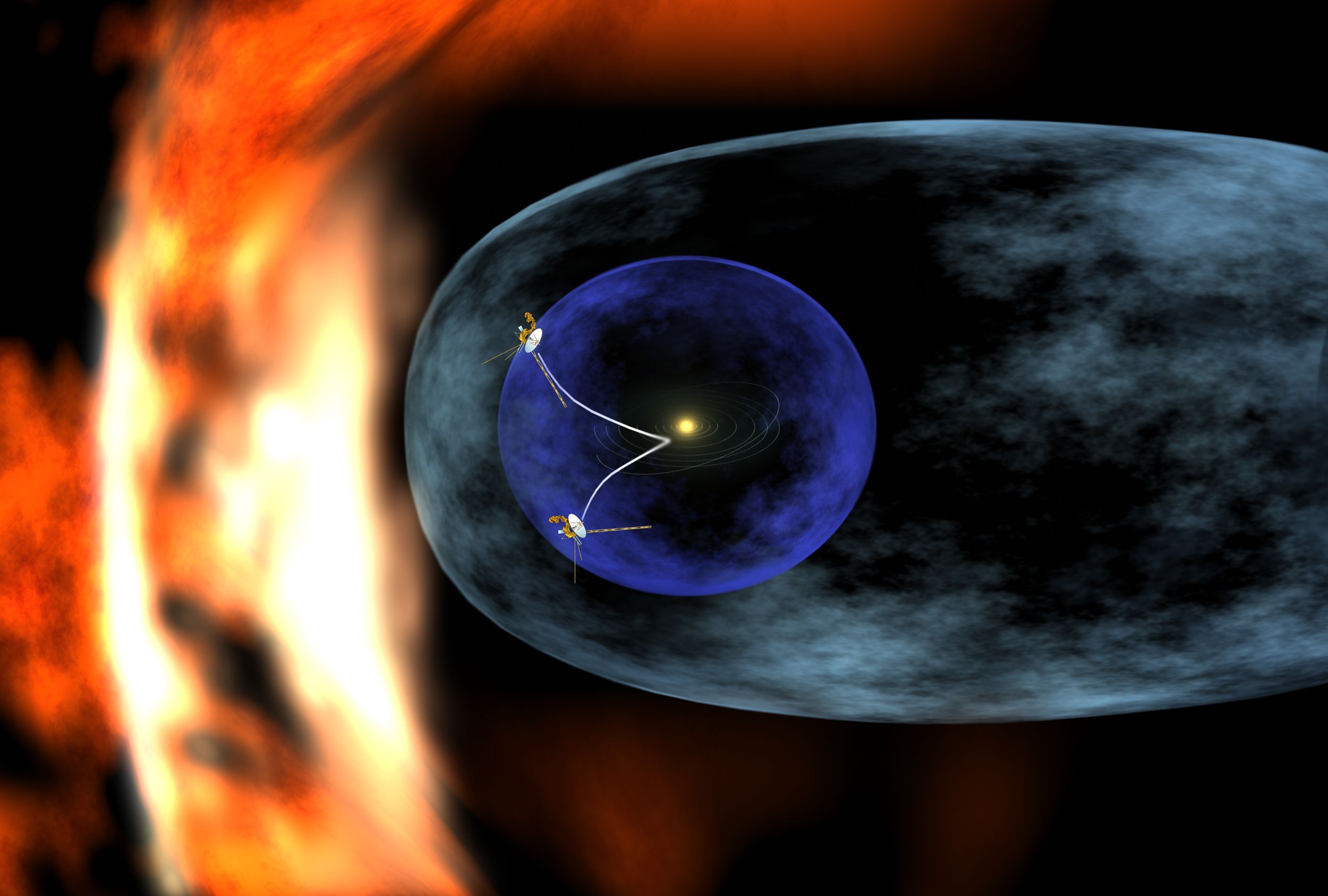
Posted on 11/20/2003 3:21:49 AM PST by petuniasevan
Discover the cosmos! Each day a different image or photograph of our fascinating universe is featured, along with a brief explanation written by a professional astronomer.
2003 November 20
Explanation: Launched in 1977, Voyager 1 is now about 12 light-hours or 90 astronomical units (AU) from the Sun, making this spacecraft humanity's most distant ambassador to the cosmos. Well beyond the orbits of the outer planets, Voyager 1 is believed to be entering the realm of deep space near the edge of the heliosphere, the region dominated by the solar wind and magnetic field. Causing some debate, new results from instruments still operating have given indications that the spacecraft could finally be encountering a fluctuating boundary known as the solar wind's termination shock. Illustrated above, the bubble-shaped termination shock is produced when the wind from the Sun slows dramatically and piles up as it runs in to the tenuous interstellar gas. Still farther out, beyond the heliopause, solar wind and interstellar gas begin to mix, while the heliosphere's motion through interstellar space creates a bow shock, analogous to a boat moving through water. Estimates are that both Voyager 1 and 2 have enough power and fuel to operate until about the year 2020. The spacecraft continue to coast toward interstellar space at over 3 AU per year.
A U.S. Navy communications satellite is undergoing final pre-launch activities at Cape Canaveral for launch next month aboard a Lockheed Martin Atlas 3B rocket.
The Ultra-High Frequency Follow-On F11 spacecraft, built by Boeing, was shipped from its manufacturing plant in El Segundo, California, to Florida's East Coast last week.
 The UHF F11 spacecraft arrives at the Cape aboard a transport aircraft. Credit: Boeing |
Liftoff is scheduled for December 15 during a two-hour launch window opening at 9:38 p.m. EST.
The satellite will fly in geostationary orbit 22,300 miles above the planet. With a new ultra-high frequency digital receiver onboard, it will offer additional UHF channels and greater flexibility for communication services.
The UHF F11 is based on the Boeing 601-model satellite. It is the eleventh in a series of UHF Follow-On spacecraft launched by Atlas rockets since 1993, replacing older Navy satellites used to relay communications.
"The UHF mobile service is the backbone of military communications today, supporting warfighters on land, at sea and in the air," said Dave Ryan, vice president and general manager of Boeing Satellite Systems. "We're proud of the enhancements in this eleventh spacecraft, and confident that it is ready to provide additional communications capacity for our nation's armed forces."
The UHF Follow-On spacecraft were built under a contract originally awarded in July 1988 that now totals approximately $2.1 billion, according to Boeing. An agreement reached in 1999 led to the construction of this eleventh satellite to sustain the UHF fleet until the next generation of communications satellites would begin taking over.
At pad 36B, the Atlas 3B rocket completed a launch day dress rehearsal on October 23. The rocket is now awaiting the arrival of its payload to begin the final pre-launch campaign in early December.
This will mark the fourth flight of the Atlas 3 rocket, which is distinguished by the Russian-made RD-180 first stage main engine. The previous missions have been successful.
But before the UHF F11 launch, Lockheed Martin plans to fly an Atlas 2AS rocket from Vandenberg Air Force Base in California on December 2. The booster will deploy a classified National Reconnaissance Office payload into space.

Advertised as the most efficient rocket motor. Maybe the most efficient large rocket motor. It is hot, no doubt about it.
Disclaimer: Opinions posted on Free Republic are those of the individual posters and do not necessarily represent the opinion of Free Republic or its management. All materials posted herein are protected by copyright law and the exemption for fair use of copyrighted works.