Posted on 08/29/2026 8:35:53 PM PDT by SunkenCiv
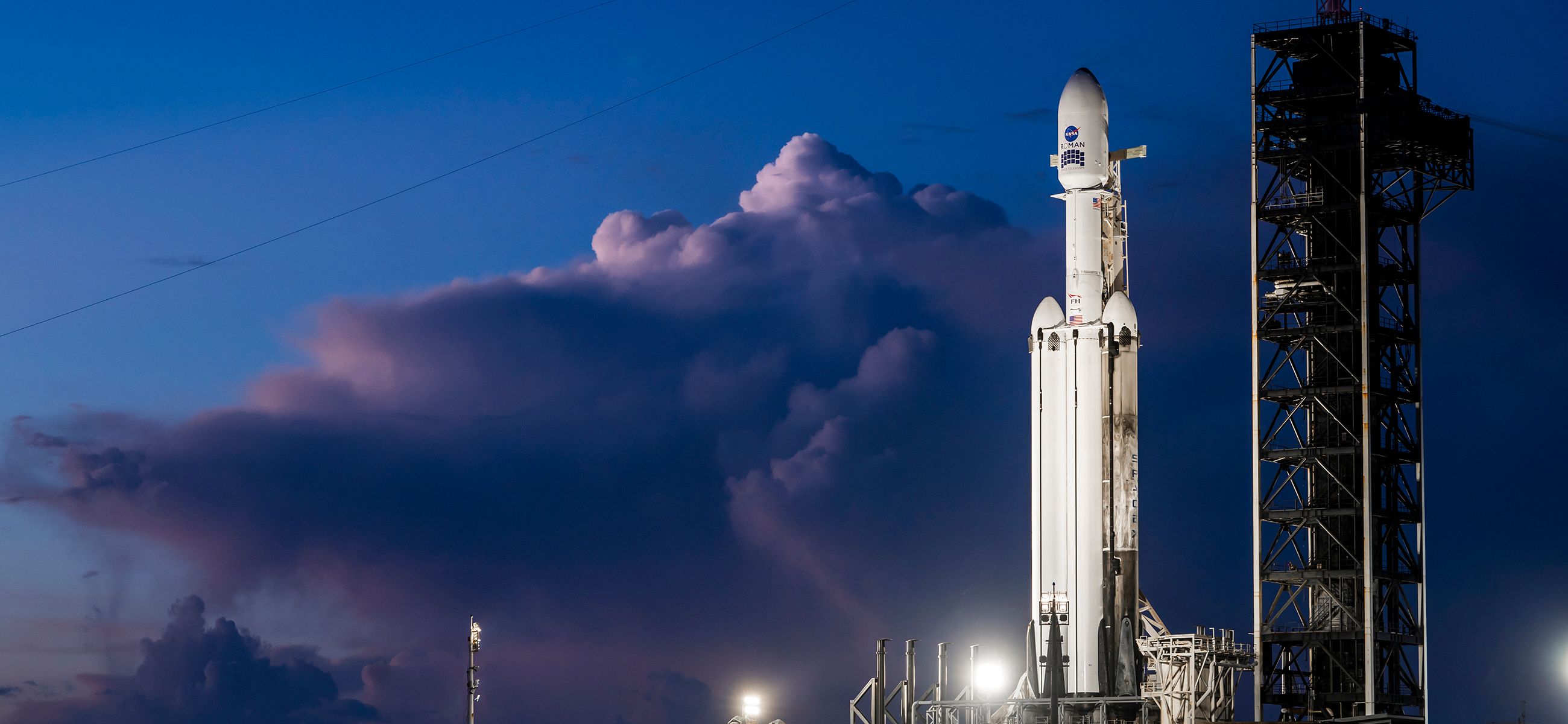
SpaceX is targeting Sunday, August 30 for Falcon Heavy’s launch of NASA’s Roman Space Telescope mission from Launch Complex 39A (LC-39A) at NASA’s Kennedy Space Center in Florida. Liftoff is targeted for 7:26 a.m. ET, with a backup opportunity available on Monday, August 31 at 7:22 a.m. ET.
A live webcast of this mission will begin about one hour prior to liftoff, which you can watch here and on X @SpaceX.
This is the first and third flight for the two first stage side boosters supporting this mission, which previously launched the GOES-U and Viasat-3 F3 missions. Following stage separation, Falcon Heavy’s two side boosters will land on SpaceX’s Landing Zones 2 and 40 (LZ-2 and LZ-40) at Cape Canaveral Space Force Station in Florida.
The Roman Space Telescope is a NASA flagship observatory designed to study dark energy and dark matter to help scientists unravel mysteries of the universe. Once at its final destination at Sun-Earth Lagrange Point 2, Roman will have an unobstructed view of the universe, and with a wide field of view at least 100 times larger than the Hubble Space Telescope, Roman will be able to map billions of galaxies, discover new exoplanets, study black holes, and more.
(Excerpt) Read more at spacex.com ...
The Nancy Grace Roman Space Telescope is NASA's incredible new flagship space telescope that will help humanity unlock even more knowledge about our universe than ever before.
This new space telescope is like Hubble times 200, it's packing some absolutely incredible technology that will make it not only much more powerful than Hubble, but also the perfect compliment to the James Webb Space Telescope.Why NASA's new Roman Space Telescope is a huge deal | 12:48
Everyday Astronaut | 1.98M subscribers | 320,147 views | August 28, 2026
Summary: Tim Dodd explores the technical capabilities of the Nancy Grace Roman Space Telescope, detailing its wide-field infrared survey mission and advanced coronagraph technology. The overview explains how Roman complements existing observatories, its unique ability to be serviced in space, and the massive scale of data it will provide to researchers and the public.
YouTube transcript reformatted at textformatter.ai *may* follow.
🚀🛰️
Apparently
Sun–Earth L2 is a gravitationally balanced location about 1.5 million km directly behind Earth as viewed from the Sun, where the combined pull of Earth and Sun plus the outward centrifugal force cancel out, allowing spacecraft to “hover” with minimal fuel use. The James Webb Space Telescope and ESA’s Euclid and Gaia observatories operate from Sun–Earth L2 to obtain an unobstructed, stable view of deep space.
Why is it called Nancy Grace Roman?
Nancy Grace Roman (May 16, 1925 – December 25, 2018) was an American astronomer known as the “Mother of Hubble” for her key role in planning the Hubble Space Telescope. She was also NASA’s first chief of astronomy and the first female executive at NASA.
Mr. Dodd does a nice job.
That’s okay, Hubble. You were big stuff in your day, even if some goofballs did put you up there with a blurry mirror surface.
Amazing. BUMP!
Looks like a success so far.
Roman, Hubble & Webb will be working together.
Sometimes, reading these launch stories, I think about how these people have to take some one of a kind complex and viciously expensive piece of equipment and put it atop a bomb that’s open at one end.
Yeah, I’m pretty jealous...
Disclaimer: Opinions posted on Free Republic are those of the individual posters and do not necessarily represent the opinion of Free Republic or its management. All materials posted herein are protected by copyright law and the exemption for fair use of copyrighted works.