Posted on 05/23/2022 9:33:13 AM PDT by algore
In 1958, a combine carrying a full load of freshly harvested crops might weigh 8,800 pounds (4000 kg). Today, a fully loaded combine can clock in at 80,000 pounds (36,000 kg).
The story of increasingly large farm vehicles isn't necessarily bad. The invention of these huge machines — along with advances like new fertilizers and genetically modified crops — mean that today's farmers can grow far more food than ever before. But there's reason to worry that equipment manufacturers have begun pushing the envelope too far.
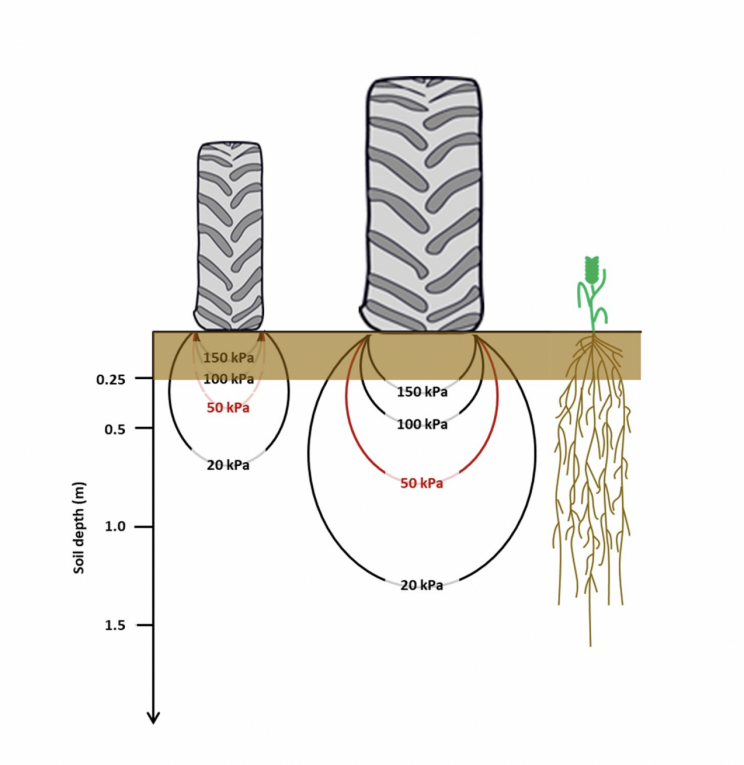
In a paper published Monday in the peer-reviewed journal PNAS, researchers show that farm equipment has grown so large that its heft can damage the soil that lies more than 20 inches (0.5 m) below the surface.
"Ironically, highly efficient tractors and harvesters may hamper progress toward increasing food production... due to the unintended risk of subsoil compaction," the authors write
Engineers who design agricultural machinery are well aware that soil is delicate. While dirt might seem simple and uninteresting, healthy soil is teeming with life and complexity.
"Soils are ecosystems containing fragile structures – pores and pathways which allow air to circulate and water to reach plant roots and other organisms," according to sustainability researcher Jess Davies and soil scientist John Quinton.
Engineers have mitigated this by putting progressively bigger tires on heavier farm vehicles. They've also used more flexible materials that make it possible to inflate the tires to lower pressure.
Those changes increase the amount of surface area contact between the vehicle and the ground. These measures have enabled engineers to build larger and larger vehicles without
increasing the amount of contact stress on the upper layers of soil.
Heavy equipment can compress the subsoil, causing problems in the future
It's not just the upper layers of soil that farmers need to worry about. In their analysis, the researchers found that "subsoil stresses under farm vehicles have affected progressively deeper soil layers over the past six decades."
In the 1940s, '50s, and '60s, farm vehicles weren't heavy enough to compress soil below the level that's tilled each year.
But that's no longer the case. Pressure from tractors, combines, and other pieces of equipment "has now penetrated deeper into the subsoil, thus potentially affecting untilled crop root zones," the authors write.
Challenger, IHCase, and John Deere all have rubber tracked tractors to mitigate this although it might be too little too late.
No more farming - eat dirt and bugs instead 🤪
Libtardism 101
Deep ripping fixes this.
Yeah, farmers are too stupid to take care of their own land.
Vehicles are inanimate objects, they do not threaten!
But you do.
We need hovertractors
Combines have much wider headers. So these tire tracks are much wider apart than previous .
And most combined now have rubber tracks, spreading the weight out more.
And we do much less tillage than before.
Just go fully tracked if ground pressure is an issue.
Waiting for self-righteous yuppies in NY and Washington DC to start carrying signs and wearing T-Shirts that say “No More Heavy Tractors!”
Feed the world Mr scientist.

Let me see it I understand correctly.
The new very large & very heavy farm equipment that is at least partially responsible for higher crop yields and more food for the masses is going to someday be responsible for killing us all.
OK.
Yes. Heavy combines with 40 foot heads don’t affect much of the soil they travel over. The article is written as if every bit of soil under that wide head is getting compacted.
I guess to paraphrase Milton Friedman our farmlands should be tilled with spoons.
This is a jackass article. In this video a farmer buries an egg 2” below the soil and runs over it with a four-track, 69 ton tractor and it does not break.
Starts at 7:28, https://www.youtube.com/watch?v=OZEy7tgnsg0
How many people are on this site talking about the farmers with their mouth full.
I live in an agricultural area. This moron writer has no clue of what farmers do with large equipment.
In the early spring the fields are ripped and tilled deep, then the crop is planted. Then the farmer stays off the crop until it’s ready for harvest. After harvest the field may be tilled again for a winter cover crop or left until the following spring.
Fertilizing, pesticides, and herbicides are administered through liquid fertigation, crop dusting, or with large, thin tired boom sprayers to minimize crop damage/loss.
It’s time we start plowing the big cities under. More acreage for food, and less devoted to growing idiots.
True enough. A lot of that “super heavy” new farm equipment has less ground pressure than older, smaller equipment, because it’s more spread out. A lot of spring work is done in rather damp conditions...it’s been known for a *very* long time what happens in mud if your ground pressure is too high.
Disclaimer: Opinions posted on Free Republic are those of the individual posters and do not necessarily represent the opinion of Free Republic or its management. All materials posted herein are protected by copyright law and the exemption for fair use of copyrighted works.