Posted on 01/20/2016 5:03:47 AM PST by Kaslin
Last July, Anthony Hervey, an outspoken black advocate for the Confederate flag, was killed in a car crash. Arlene Barnum, a surviving passenger in the vehicle, told authorities and the media that they had been forced off the road by a carload of "angry young black men" after Hervey, while wearing his Confederate kepi, stopped at a convenience store en route to his home in Oxford, Mississippi. His death was in no small part caused by the gross level of ignorance, organized deceit and anger about the War of 1861. Much of the ignorance stems from the fact that most Americans believe the war was initiated to free slaves, when in truth, freeing slaves was little more than an afterthought. I want to lay out a few quotations and ask what you make of them.
During the "Civil War," ex-slave Frederick Douglass observed, "There are at the present moment many colored men in the Confederate army doing duty not only as cooks, servants and laborers, but as real soldiers, having muskets on their shoulders, and bullets in their pockets, ready to shoot down loyal troops, and do all that soldiers may to destroy the Federal Government and build up that of the traitors and rebels" (Douglass' Monthly, September 1861).
"For more than two years, negroes had been extensively employed in belligerent operations by the Confederacy. They had been embodied and drilled as Rebel soldiers, and had paraded with White troops at a time when this would not have been tolerated in the armies of the Union." (Horace Greeley, in his book, "The American Conflict").
"Over 3,000 negroes must be included in this number (of Confederate troops). These were clad in all kinds of uniforms, not only in cast-off or captured United States uniforms, but in coats with Southern buttons, State buttons, etc. These were shabby, but not shabbier or seedier than those worn by white men in rebel ranks. Most of the negroes had arms, rifles, muskets, sabres, bowie-knives, dirks, etc. They were supplied, in many instances, with knapsacks, haversacks, canteens, etc., and were manifestly an integral portion of the Southern Confederacy Army. They were seen riding on horses and mules, driving wagons, riding on caissons, in ambulances, with the staff of Generals, and promiscuously mixed up with all the rebel horde" (report by Dr. Lewis H. Steiner, chief inspector of the U.S. Sanitary Commission).
In April 1861, a Petersburg, Virginia, newspaper proposed "three cheers for the patriotic free Negroes of Lynchburg" after 70 blacks offered "to act in whatever capacity" had been "assigned to them" in defense of Virginia.
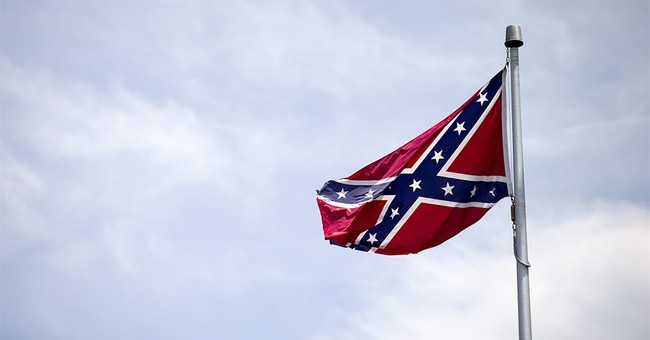
Those are but a few examples of the important role that blacks served as soldiers, freemen and slaves on the side of the Confederacy. The flap over the Confederate flag is not quite so simple as the nation's race "experts" make it. They want us to believe the flag is a symbol of racism. Yes, racists have used the Confederate flag as their symbol, but racists have also marched behind the U.S. flag and have used the Bible. Would anyone suggest banning the U.S. flag from state buildings and references to the Bible?
Black civil rights activists, their white liberal supporters and historically ignorant Americans who attack the Confederate flag have committed a deep, despicable dishonor to our patriotic Southern black ancestors who marched, fought and died not to protect slavery but to protect their homeland from Northern aggression. They don't deserve the dishonor. Dr. Leonard Haynes, a black professor at Southern University, stated, "When you eliminate the black Confederate soldier, you've eliminated the history of the South."
Stranger thngs have happened in war. Jews fought for Hitler.
It;s th same dude. rockrr calls him ‘’pokie’’.
I understand your confusion. When one has lived revisionism at the lofty levels that you have, reality no longer exist.
I think most here forget that the US Congress and Lincoln had stated that the war beginning was not about slavery, and as primary sources, do not in any way support the slavery argument.
That argument was used to inflame both before war and after.
It is important to take into consideration the people and words of the time.
3/18/1861 It took only a week for Northern newspapers to understand the meaning of the low Confederate Tariff announced the week earlier in Montgomery.
The Boston Transcript wrote,
"It does not require extraordinary sagacity to perceive that trade is perhaps the controlling motive operating to prevent the return of the seceding States to the Union.
"Alleged grievances in regard to slavery were originally the causes for the separation of the cotton States; but it is apparent that the people of the principal seceding states are now for commercial independence. They dream that the centers of traffic can be changed from Northern to Southern ports.
"The merchants of New Orleans, Charleston, and Savannah are possessed with the idea that New York, Boston, and Philadelphia may be shorn, in the future, of their mercantile greatness, by a revenue system verging upon free trade.
"If the Southern Confederation is allowed to carry out a policy by which only a nominal duty is laid upon imports, no doubt the business of the chief Northern cities will be seriously injured thereby."
And he calls you sweetheart.
Thanks
If you want to use the year 1860, your figure of import value of $362 million is the amount reported to Treasury as recorded at the ports, but only $268 million of those goods were dutible, or in other words subject to the duty prescribed by Federal Law.
So your comment: "Total imports for that year -- on which tariffs supported Federal revenues..." is incorrect by 25%.
That makes your conclusion: "So, we could reasonably suggest that cotton supported 53% of total imports, and therefore 53% Federal revenues." is totally and completely wrong.
Follow the money.
It would be folly to think that the Northern States did not recognize that abolition would have the same effect on cotton production as taking tractors from wheat farmers today would have on wheat production—which would adversely affect Treasury revenue as well. Without a crop, there would be nothing to tax.
Bro, I am not familiar with any telegraph between Lincoln and Pickens ever. Perhaps you can produce it for the record.
That failing, you must have some confusion.....on April 8, 1861 President Lincoln sent a dispatch by courier to South Carolina Governor Pickens advising that he would re-supply the fort.
It had been reported in Northern newspapers , that relief squadrons headed for the South consisted of eleven ships, carrying naval weapons guns, and one thousand, four hundred men in addition to the provisions to which the President had referred.
On this evening, Union Lieutenant Talbot, a frequent messenger to Ft. Sumter, accompanied a State Department clerk, Robert Chew who read a note that announced that the fort would be supplied with provisions at every hazard. This dispatch read, "I am directed by the President of the United States to notify you to expect an attempt will be made to supply Fort Sumter with provisions only, and that if such attempt be not resisted, no effort to throw in men, arms, or ammunition, will be made, without further notice, or in case of attack.
Lincoln's note was not signed, nor did the courier carry any orders for receiving a reply from the Governor.
Lincoln was not revealing the extent of his plans.
"Blockade Southern Ports. If not a series of customs houses will be required on the vast inland border from the Atlantic to West Texas. Worse still, with no protective tariff, European goods will under price Northern goods in Southern markets. Cotton for Northern mills will be charged an export tax. This will cripple the clothing industries, and make British mils prosper. Finally,, the great inland waterways, the Mississippi, the Missouri, and the Ohio Rivers will be subject to Southern tolls.
A newspaper that supported Lincoln said: ( Philadelphia Press on March 18, 1861)
"One of the most important benefits which the Federal Government has conferred upon the nation is unrestricted trade between many prosperous States with divers productions and industrial pursuits. But now, since the Montgomery Congress has passed a new tariff, and duties are extracted on Northern goods sent to ports in the Cotton States, the traffic between the two sections will be materially reduced)
"Another, and a more serious difficulty arises out of our foreign commerce, and the different rates of duty established by the two tariffs which will soon be in force".
"The General Government,to prevent the serious diminution of its revenues, will be compelled to blockade the Southern ports and prevent the importation of foreign goods into them, or to put another expensive guard upon the frontiers to prevent smuggling into the United States.
"The difference is so great between the tariff of the Union and that of the Confederated States, that the entire Northwest must find it to their advantage to purchase their imported goods at New Orleans rather than at New York. In addition to this, the manufacturing interest of the country will suffer from the increased importations resulting from low duties.
"The government would be false to its obligations if this state of things were not provided against.
" The New York Evening Post wrote,
"Allow railroad iron to be entered at Savannah with the low duty of ten per cent, which is all that the Southern Confederacy think of laying on imported goods, and not an ounce more would be imported at New York; the railways would be supplied from the Southern ports."
The Philadelphia Press said,
"Blockade Southern Ports. If not a series of customs houses will be required on the vast inland border from the Atlantic to West Texas. Worse still, with no protective tariff, European goods will under price Northern goods in Southern markets. Cotton for Northern mills will be charged an export tax. This will cripple the clothing industries, and make British mils prosper. Finally,, the great inland waterways, the Mississippi, the Missouri, and the Ohio Rivers will be subject to Southern tolls".
These commentaries were telling the truth of late March, 1861.
In fact, Governor Hicks perfectly reflected the politics of Maryland at the time, which was generally sympathetic to slavery, but also wanted to preserve and remain part of the Union.
The Maryland legislature voted more than two-to-one against secession, and Marylanders joined the Union Army by two-to-one over the Confederates.
Indeed, the great Battle of Antietam was fought because Davis & Lee just couldn’t believe more Marylanders were not eager to join the Confederate Army.
But it turned out Davis & Lee were wrong about that, because the vast majority of Marylanders were happier in the Union than out.
Today, of course, many like to pretend otherwise, but facts, as they say, are stubborn things.
And without a tax they couldn't run their precious federal government; disHonest Abe said so.
Go easy on ol' BrokebackJoe. When you've been in the revisionism business as long as the False Causers have been, things are apt to get a might muddled.
(I think ol' BrokebackJoe and his sewing circle get their War of Northern Aggression history from Harry Turtledove novels.)
I’m not confused pokie - I’m amused. Amused at your complete disconnect from reality. If I’m “living revisionism” as you suggest then so is 99.999% of the population who see reality as I do and as it is, not how the lost cause losers would have it be.
Like I said, if you exclude this or add that, you can make those numbers say whatever you wish.
However, you need to think very carefully about the claim made by pro-Confederates, then and now.
Their claim goes like this:
It's certainly not fair to say that cotton exports only paid for dutiable imports, when in fact, all exports helped pay for both dutiable and non-dutiable imports.
In 1860, no Northern state -- none -- called for abolition of slavery in the South.
What Northerners then wished was to prevent slavery's expansion into western territories and even into Northern states themselves.
So, I take it you agree that Lincoln sent, and Pickens received, the note which is reported in every discussion on this subject.
You wish to advise me this note was sent by courier, not by telegraph, and I'll accept that, though have not seen it reported elsewhere, "assumed" telegraph used, since transmission was quite rapid.
PeaRidge: "Lincoln was not revealing the extent of his plans."
But in fact, I've just demonstrated to you, from Lincoln's orders to his resupply leaders, that they received exactly the same instructions: resupply only, no military force to be used if no military resistance encountered.
So the choice to use Lincoln's mission as their excuse for launching war against the United States was strictly made by Jefferson Davis, doubtless with urging from Pickens and other Confederate leaders.
Hows bunking up with central va? Does he give the reach around?
Disclaimer: Opinions posted on Free Republic are those of the individual posters and do not necessarily represent the opinion of Free Republic or its management. All materials posted herein are protected by copyright law and the exemption for fair use of copyrighted works.