Posted on 10/14/2026 6:01:35 AM PDT by MtnClimber
We finally had our first hurricane this season in the North Atlantic region: Isaias. Isaias formed on October 7 as a tropical storm in the Gulf of America, and made landfall as a Category 1 hurricane on October 10 near Destin, Florida.
Paul Homewood of Not a Lot of People Know That collects the relevant data in a post from October 11.
Homewood notes that Isaias represents the latest ever first hurricane for the North Atlantic, at least since the satellite era (1966) has provided full data:
Isaiah was the first Atlantic hurricane of the season, the latest on record. The previous record was Sep 11th in both 2002 and 2013.
So Isaias broke the previous record for latest formation of the first hurricane by almost a full month.
And besides being late, Isaias was also rather unimpressive. Homewood has full data on Isaias’ wind speeds and Category designation:
Having briefly reached Cat 3 hours before landfall, the storm weakened considerably by the time it reached the coast. NWS claim sustained winds of 105 mph, but there is no evidence for this. Surface wind measurements put the highest wind gusts at 118 mph, but sustained winds are always much lower. Gusts at Santa Rosa, for instance, peaked at 116 mph, but NWS confirm sustained winds of 91 mph, which would mean it was only a Cat 1 hurricane at landfall.
Homewood provides a link to National Hurricane Center data on the hurricane, where NHS claims that their radar measured sustained winds at landfall of 105 mph. If correct, that would put Isaias into Category 2. However, Homewood observes that the highest sustained winds as measured at any ground station were 91 mph, well within the bounds of Category 1.
Meanwhile, the hurricane season continues to progress towards its conclusion. According to the NHC page today, there are no more hurricanes at this point in the Atlantic, and “tropical cyclone activity is not expected during the next 7 days.” With each passing day this late in the season, the likelihood of another hurricane declines rapidly.
To those who have accused me of cherry-picking the North Atlantic hurricane data, I say that I was not the one who suggested that metric to test the hypothesis of “more and more severe storms and hurricanes.” The metric was selected by advocates of the hypothesis when a few strong and widely publicized storms made it appear to be a useful metric to scare the public.
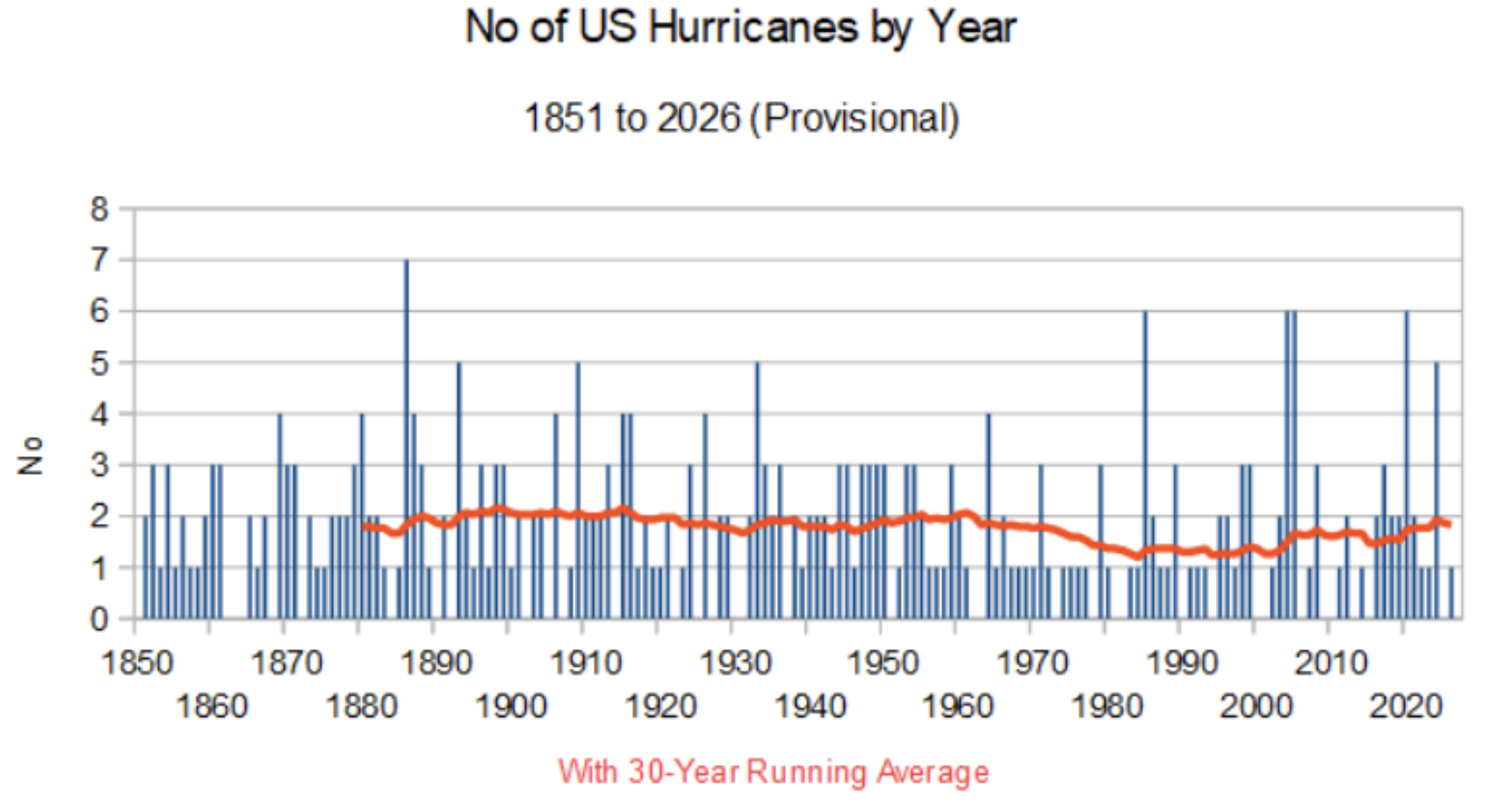
Now that the North Atlantic hurricanes are a bust, let them select a new metric for themselves, and see how it turns out. Homewood’s post contains two other charts. The first is from NOAA’s Atlantic Oceanographic & Meteorological Laboratory. It shows simply the number of hurricanes making landfall by year in the U.S., going all the way back to 1851. Homewood has added a red line showing a 30-year running mean:
No noticeable trend there. The record year was 1886.
Another possible metric is global hurricane frequency. For that one, Homewood provides one of Ryan Mate’s charts with global data going back to 1980:
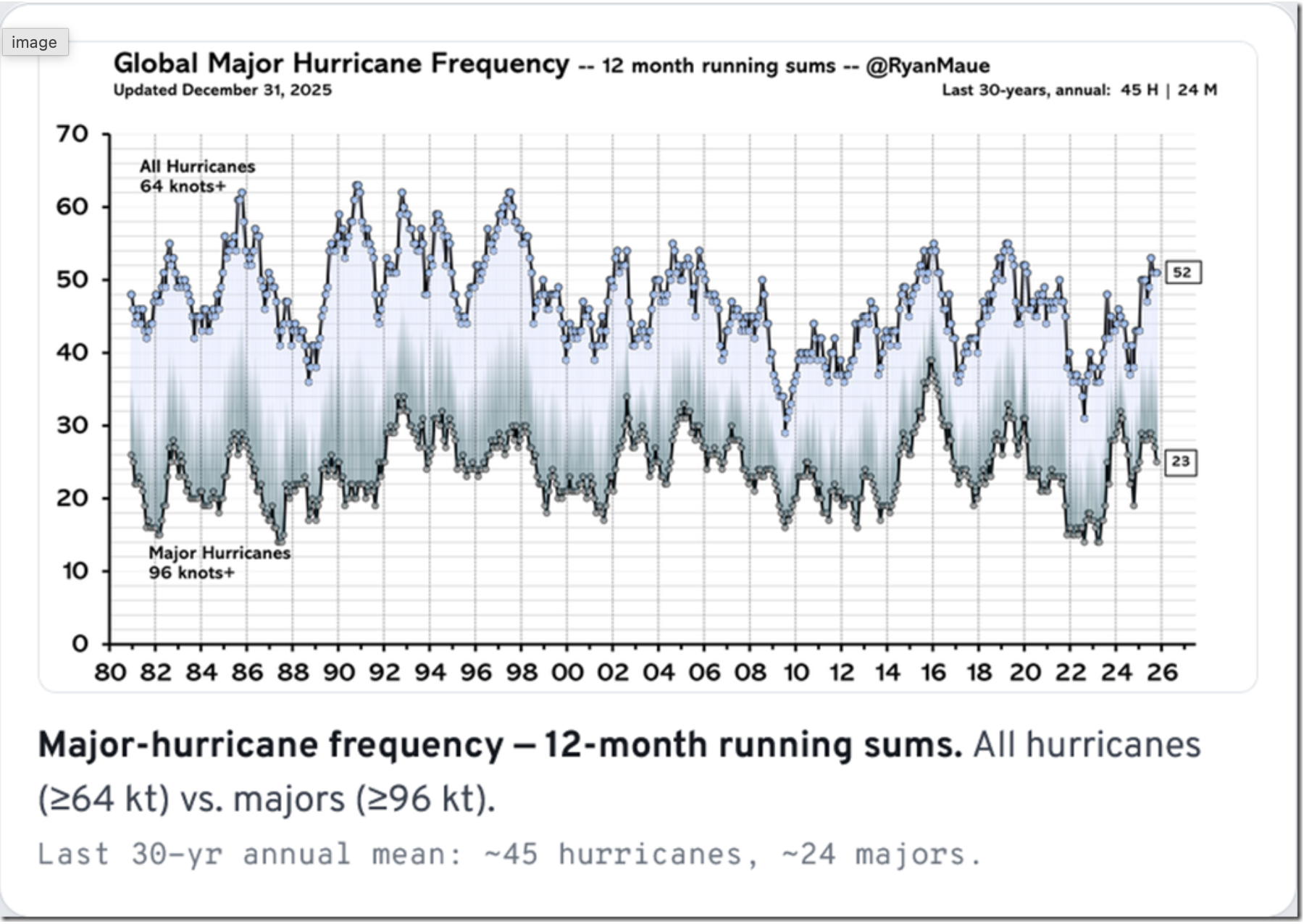
No noticeable upward trend in that one either. And then there’s the Accumulated Cyclone Energy metric, for which I provided a chart of global data in my October 4 post. That makes four proposed metrics so far, and the “more and more severe storms and hurricanes” hypothesis has failed all four of them.
But maybe advocates of the “more and more severe storms” proposition have yet another metric they would prefer. If so, name it! They won’t, because once they name their metric, they must agree that the hypothesis is falsified when the metric fails to perform as predicted.
I think that we are well past the point where the “more and more severe storms and hurricanes” hypothesis has been falsified.

|
Click here: to donate by Credit Card Or here: to donate by PayPal Or by mail to: Free Republic, LLC - PO Box 9771 - Fresno, CA 93794 Thank you very much and God bless you. |
Manhattan Contrarian ping
Two facts that the media never explain.
1) In the past, before satellites, many hurricanes just went undetected.
Unless they made some damage, they would just fizzle somewhere in North Atlantic, or even bring some heavy rain somewhere, and nobody would notice.
2) The increasing costs of hurricane damages is just because there is a lot more to damage.
In 1900, there were only half a million Floridians, the state was practically empty, so no hurricane, even category 5 can not make too much damage!
Now, there is so many people and all kind of stuff over there, no wonder any hurricane would cause a lot more damage than in the past.
It would seem to me that the way hurricanes are reported or forecast might change to affect prices or other things in certain areas. Not sure that it does, but I am just wondering.
Thanks!
Based on these numbers, I think Trump should propose a new national holiday — Triumph Over Global Warming Day.
Lay out all the terror-inducing “warnings,” then these numbers, and make the DemocRats prove otherwise in Congress.
Hey, I’m OK if part of the resolution praises US efforts 20 years ago that stopped Global Warming before it could start. Praising Al Gore by name might be a bit too far, but...it would be fun if he denied having anything to do with it.
Jim Cantore and the Weather Channel is so happy! They finally got a hurricane to hype!
When I got to the issue of satellite data and no conclusive uptick in hurricane activity you'd thought I'd been stealing money.
It went completely against the narrative they'd been hearing from the weather channel and lamestream media.
The problem is people didn’t build on places that were prone to hurricane or cyclical fire damage.
The building along the beach is only due to National Flood Insurance. The US taxpayers rebuilding multi million beach houses over and over in the same spot. At least on the Outer Banks they are no longer rebuilding houses on shifting sandbars. Once they fall into the Atlantic, they are not rebuilt along that shore.
The California Native Americans and the Spanish settlers knew that the Santa Anna winds caused brush fires to sweep down the hills and burn EVERYTHING down to the Pacific Ocean. Yet, now we rebuild houses in those same spots over and over again expecting it NEVER to happen again.
Federally subsidized so-called “flood insurance” has encouraged development in ridiculous areas: estuaries, barrier islands, and other places no uninsured person would ever put their own money into.
“””Homewood notes that Isaias represents the latest ever first hurricane for the North Atlantic,”””
The Gulf of America is not in the North Atlantic.
Another point-—
1. Hurricane Milton 2024 was born in the Gulf of Mexico (now Gulf of America).
2. Hurricane Isaias 2026 was born in the Gulf of Mexico.
I did some research to find other hurricanes that had their beginning in the Gulf of Mexico/America. I found no conclusive data.
“The Data Are In”
Glad to see the correct usage of the word “data” - which is plural so “are” is the correct verb.
Singular: Datum
Plural: Data
And yes, I am a Grammar Nazi.
In the early 1970s I drove from Melbourne (central Florida) all the way to Miami on US Route A1A. Other than short distances, A1A followed the coast line of the Atlantic. For long distances there was nothing but sand dunes. The road was 2 lanes flat and straight and I could look ahead as far as I could see and not see another car. It was mostly empty until you got to Palm Beach.
Now, it is all built up. Lines of Condos and apartment buildings on the beach side. Billions of dollars worth of property.
There’s been several hurricanes that have formed in the Gulf, notably Hurricane Audrey in 1957, Hurricane Humberto in 2007, etc.
“Hurricane Isaias: The Data Are In”
Grammarian note — I appreciate any headline that correctly uses “data” as a plural.
>>And yes, I am a Grammar Nazi.
I became a Spelling Nazi because these Gen-Z “loosers” are “rediculous” and make me “nauseous”!
As an engineer, I was thinking the same thing.
Somewhat like my memory of Phoenix and most of Arizona when I drove through it in ‘71.
Sedona was maybe 3,000, Much of New Mexico the same.
“ We finally had our first hurricane this season in the North Atlantic region: Isaias.”
Why did the MSM insist on pronouncing “Isais” as “Ee-SAH-Ee”? It looks like it should be pronounced “Eye-SAY-Us”.
So sick of libs and their virtue signaling.
“ We finally had our first hurricane this season in the North Atlantic region: Isaias.”
Why did the MSM insist on pronouncing “Isais” as “Ee-SAH-Ee”? It looks like it should be pronounced “Eye-SAY-Us”.
So sick of libs and their virtue signaling.
Disclaimer: Opinions posted on Free Republic are those of the individual posters and do not necessarily represent the opinion of Free Republic or its management. All materials posted herein are protected by copyright law and the exemption for fair use of copyrighted works.