They do. But the winner is (and he isn’t done yet)
Posted on 10/02/2026 9:19:02 AM PDT by wafflehouse
President Donald Trump said “certain levels of inflation” can reduce the burden of the national debt “very rapidly,” putting a long-running bond-market concern into unusually direct language.
The remarks came in a TIME interview conducted Monday and published Thursday, and were reported by the Wall Street Journal’s Nick Timiraos. Trump also said Federal Reserve interest-rate policy is hurting the economy more than inflation and blamed high rates for making it harder to reduce federal deficits.
“Certain levels of inflation will also pay off that debt very rapidly. Very rapidly.”
Pressed on how Washington could bring down the debt burden, Trump added:
“I don’t want to tell you what those means are, but you can pay off the debt through other means.”
For bondholders, the issue is straightforward. Higher inflation reduces the real value of fixed-rate debt if yields do not rise enough to compensate, effectively shifting part of the burden away from the borrower and onto holders of long-duration government bonds.
Trump also criticized the Fed’s rate-setting committee after its unanimous decision last month to raise rates to fight persistent inflation. He called the board “very hostile” while largely sparing Chairman Kevin Warsh, whom he said was constrained by other members of the committee.
It was lean for a while with me. Then I heard Biden making speeches during his campaign that he was going to get rid of oil if elected, make them pay, etc. I perked up. After his selection I loaded up on oil, to the gills. I went with Brazilian oil to take advantage of expected dollar depreciation -an arbitrage. Bolsonaro delivered!
I knew Biden’s anti oil actions would ensure a nice profit. And they did.
When the market inherits a bias that’s the time to profit.
I’ve been pretty heavily invested in domestic E&P. Riding the whole “I’m gonna obliterate Iran” to T.A.C.O. cycle has been profitable. I can’t believe the market still keeps reacting to this nonsense. It is as if the war is being prosecuted predicated upon the price of oil.
IMO it is and both sides are doing it.
They do. But the winner is (and he isn’t done yet)
Inflation will shrink your savings and make it hard to find money to eat.
But it will shrink your debt, and the national debt
but hey, just stay home and let the Democrats win and you can have a twofer: Inflation plus increased spending making the national debt higher leading to economic collapse.
“What’s to be said about domestic bond holders. Is our debt to ourselves harmless?”
Kind of bites - I have a decent chunk of change, so not so good for me (but still better than being a debtor). But I am talking overall, and so lots of foreigners still hold lots of bonds.
This is AOC/DSA level of stupidity.
I’m fine writing this off as DJT having a diarrhea of the mouth level tendency to just string words together that make negative logical sense.
But in ZERO rational, logical, realistic way does this make even slightest bit of sense.
It’s so painfully wrong it makes my head hurt.
Really? You’ll stay home. let communists win.
Smart. You really think that will help you afford hamburger? Or help you see with anything in your life?
Grow up.
Alan Greenspan pegged it 60 years ago:
But the opposition to the gold standard in any form-from a growing number of welfare-state advocates-was prompted by a much subtler insight: the realization that the gold standard is incompatible with chronic deficit spending (the hallmark of the welfare state). Stripped of its academic jargon, the welfare state is nothing more than a mechanism by which governments confiscate the wealth of the productive members of a society to support a wide variety of welfare schemes. A substantial part of the confiscation is effected by taxation. But the welfare statists were quick to recognize that if they wished to retain political power, the amount of taxation had to be limited and they had to resort to programs of massive deficit spending, i.e., they had to borrow money, by issuing government bonds, to finance welfare expenditures on a large scale.
Under a gold standard, the amount of credit that an economy can support is determined by the economy’s tangible assets, since every credit instrument is ultimately a claim on some tangible asset. But government bonds are not backed by tangible wealth, only by the government’s promise to pay out of future tax revenues, and cannot easily be absorbed by the financial markets. A large volume of new government bonds can be sold to the public only at progressively higher interest rates. Thus, government deficit spending under a gold standard is severely limited. The abandonment of the gold standard made it possible for the welfare statists to use the banking system as a means to an unlimited expansion of credit. They have created paper reserves in the form of government bonds which-through a complex series of steps-the banks accept in place of tangible assets and treat as if they were an actual deposit, i.e., as the equivalent of what was formerly a deposit of gold. The holder of a government bond or of a bank deposit created by paper reserves believes that he has a valid claim on a real asset. But the fact is that there are now more claims outstanding than real assets. The law of supply and demand is not to be conned. As the supply of money (of claims) increases relative to the supply of tangible assets in the economy, prices must eventually rise. Thus the earnings saved by the productive members of the society lose value in terms of goods. When the economy’s books are finally balanced, one finds that this loss in value represents the goods purchased by the government for welfare or other purposes with the money proceeds of the government bonds financed by bank credit expansion.
In the absence of the gold standard, there is no way to protect savings from confiscation through inflation. There is no safe store of value. If there were, the government would have to make its holding illegal, as was done in the case of gold. If everyone decided, for example, to convert all his bank deposits to silver or copper or any other good, and thereafter declined to accept checks as payment for goods, bank deposits would lose their purchasing power and government-created bank credit would be worthless as a claim on goods. The financial policy of the welfare state requires that there be no way for the owners of wealth to protect themselves.
This is the shabby secret of the welfare statists’ tirades against gold. Deficit spending is simply a scheme for the confiscation of wealth. Gold stands in the way of this insidious process. It stands as a protector of property rights. If one grasps this, one has no difficulty in understanding the statists’ antagonism toward the gold standard. - Alan Greenspan, Gold and Economic Freedom, 1966
"I don't believe we should ever have good money again before we take the thing out of the hands of government..." - Frederick Hayek, 1984
The mechanism they're trying to invoke with that measure is for banks to borrow from them for near zero and buy Treasuries, increasing demand for Treasuries and bringing down rates.
Failing that, they print and buy it themselves.
The Fed started growing it's balance sheet again last December. I don't see how growing the Fed's balance sheet can result in anything but inflation. It's a playbook that Bernanke laid out in 2002 and I've referenced many times since:
"The conclusion that deflation is always reversible under a fiat money system follows from basic economic reasoning. A little parable may prove useful: Today an ounce of gold sells for $300, more or less. Now suppose that a modern alchemist solves his subject's oldest problem by finding a way to produce unlimited amounts of new gold at essentially no cost. Moreover, his invention is widely publicized and scientifically verified, and he announces his intention to begin massive production of gold within days. What would happen to the price of gold? Presumably, the potentially unlimited supply of cheap gold would cause the market price of gold to plummet. Indeed, if the market for gold is to any degree efficient, the price of gold would collapse immediately after the announcement of the invention, before the alchemist had produced and marketed a single ounce of yellow metal.
What has this got to do with monetary policy? Like gold, U.S. dollars have value only to the extent that they are strictly limited in supply. But the U.S. government has a technology, called a printing press (or, today, its electronic equivalent), that allows it to produce as many U.S. dollars as it wishes at essentially no cost. By increasing the number of U.S. dollars in circulation, or even by credibly threatening to do so, the U.S. government can also reduce the value of a dollar in terms of goods and services, which is equivalent to raising the prices in dollars of those goods and services. We conclude that, under a paper-money system, a determined government can always generate higher spending and hence positive inflation.
Of course, the U.S. government is not going to print money and distribute it willy-nilly (although as we will see later, there are practical policies that approximate this behavior). [Ed note: I'd say post-COVID we're well into the 'willy-nilly' territory he could scarcely imagine then] Normally, money is injected into the economy through asset purchases by the Federal Reserve. To stimulate aggregate spending when short-term interest rates have reached zero, the Fed must expand the scale of its asset purchases or, possibly, expand the menu of assets that it buys. Alternatively, the Fed could find other ways of injecting money into the system--for example, by making low-interest-rate loans to banks or cooperating with the fiscal authorities. Each method of adding money to the economy has advantages and drawbacks, both technical and economic. One important concern in practice is that calibrating the economic effects of nonstandard means of injecting money may be difficult, given our relative lack of experience with such policies. Thus, as I have stressed already, prevention of deflation remains preferable to having to cure it. If we do fall into deflation, however, we can take comfort that the logic of the printing press example must assert itself, and sufficient injections of money will ultimately always reverse a deflation." - Remarks by Governor Ben S. Bernanke Before the National Economists Club, Washington, D.C. November 21, 2002
I dare say after the Federal Reserve's 'alchemy' the last quarter century it's hard to argue he didn't succeed in reducing the value of the dollar and proving the 'logic of the printing press'.
This is why bitcoin was created - a currency the authorities cannot counterfeit and inflate.
The Orange Idiot speaks and gets it wrong, yet again.
“i VoTEd fOR tHiS!” - MAGA turds, everywhere.
“Just buy chicken.” - some stupid tone deaf bitch on Fox News.
Do the math.
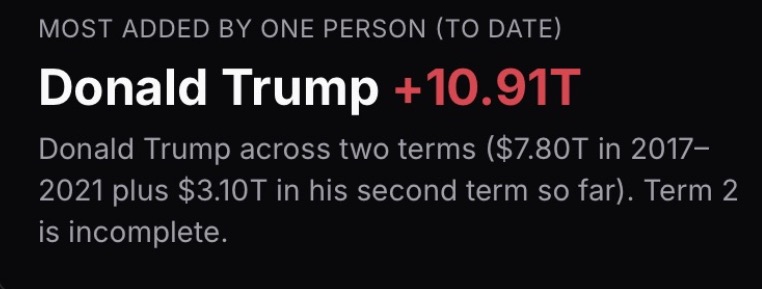
You’re comparing 1-term debt to 1.5 term debt.
MSNBC much?
GIGO

No, I am not comparing a 1-term debt to a 1.5-term debt. What I posted was a very simple and self-explanatory graphic—except, of course, to those like yourself who are mentally challenged. Here’s another opportunity. Best of luck.
I don ‘t know of any.
We’ve been living with planned inflation since the Fed was created, the question is, how many more notches can you kick it up? This solution is only acceptable if we immediately suspend deficit spending, but given how much of our economy is tied to that type of spending, I believe we would immediately go into a deep recession.
I see no good way out, inflation let’s them kick the can down the r0oad a little further.
Boy, that sounds like a GREAT plan, wafflehead... ya moron
show me someone to vote for that doesnt want to steal from me
show me someone to vote for that doesnt want to steal from me. until then you can shut the hell up
Disclaimer: Opinions posted on Free Republic are those of the individual posters and do not necessarily represent the opinion of Free Republic or its management. All materials posted herein are protected by copyright law and the exemption for fair use of copyrighted works.