Skip to comments.
AI has taken my job: No arts career is safe from the bots
The Spectator ^
| 07/21/26
| Geoff Bagwell
Posted on 07/21/2026 3:12:44 PM PDT by SeekAndFind
This week I was replaced by AI. I saw it coming, but it didn’t make the news any easier to deal with. To be honest, it terrifies me for the future of our species. If that sounds a bit over the top, hear me out.
I am a writer. Not only that, I am a commercially successful one. Although you probably haven’t heard of me, I’ve published more than 300 short stories in women’s magazines over the past 15 years. From ghost stories in Woman’s Weekly to tales of romance in Take a Break Fiction Feast, I write them all. Sorry – wrote.
Dear Geoff,’ the email said. ‘Going forward, our in-house team will be using AI tools to compile future editions, but we thank you for your many contributions to the magazine over the years. Kind regards, Rebecca.’ Or to put it more bluntly: ‘We’ve replaced you with a robot.’
I enjoyed writing all my stories. Sure, they were not exactly high art. I never expected a call from the Pulitzer panel or an invitation from Radio 4 to discuss how I manage to express the human condition. But coming up with characters, throwing them into difficult situations and seeing how they coped, writing dialogue that felt real, inventing satisfying-yet-believable twists, was all fun to write and, I hope, fun to read.
So I began typing my reply to Rebecca. I hadn’t even finished the first sentence when the truth occurred to me: Rebecca doesn’t exist. If a women’s magazine no longer needs writers, why does it need an ‘in-house team’? A vision rose in my mind of someone arriving at an office in the morning, switching on a computer, then going home again while the computer produced a magazine.
But the end of my career didn’t surprise me, because three things told me this was coming. The first was when my dad died two years ago. There was no funeral – he didn’t want one – but some close family had a small get-together where we planted a tree in my mum’s garden. ‘Has anyone thought of any words we could say?’ my mum asked. No one had. So I thought it would be amusing to give ChatGPT a few prompts to write a poem. My dad would have appreciated that. Within a few seconds I was reading out ‘A West Ham Fan’, a poem filled with humour and pathos. It was good.
The second thing that happened was a song appearing in my YouTube feed. ‘Pocket of his Raincoat’ was sung by Paul McCartney with a simple acoustic guitar backing, a Beatles ballad with wonderfully esoteric lyrics and a haunting melody. I love the Beatles and here was a song up there with ‘Yesterday’ and ‘For No One’. Why had I never heard it before? Then I noticed the performer: the AI Beatles. I had discovered a new favourite Beatles track neither written nor performed by the Beatles themselves. I was listening to a machine.
And the third thing. A few months ago, as an experiment, I prompted ChatGPT to write me a story I could sell to a women’s magazine: ‘Make it 700 words long, a love story, humorous, with an unexpected and emotionally satisfying ending.’ As soon as I hit return on my computer the story immediately began scrolling out on my screen. That story – funny and as good as any I have ever written or read – has sat on my computer ever since, an unsubmitted harbinger of the end of human story-telling. The unavoidable consequence of ever-improving AI is nothing less than the end of all human creativity.
There is no way to stop it. What Beatles fan is going to resist listening to a new album from the Fab Four because it was written and recorded by an AI app? Who wouldn’t be curious about a new Shakespeare play or a tenth symphony by Beethoven? And if you think it won’t happen, a quick search online will show you it already is.
YouTube is full of new songs from dead artists, movie scenes from actors who have never worked together, speeches and jokes from deceased politicians they never made. There are even concerts where Elvis Presley and the Beatles perform together in packed stadiums, concerts that never happened in real life. You might say all this machine imagination simply isn’t as good as the real thing. I say, give it time.
Some artists and creative industry organisations have fought back against AI. What is interesting about this fight, however, is that mostly it’s been about compensation for artists whose work is being used to train AI programs. In other words, if you want to teach AI to write a song in the style of Ed Sheeran or produce a novel in the ‘voice’ of JK Rowling, the argument is not about if it should be done, but whether these artists and writers should be compensated and if so how much. What this fightback misses is the new talent, the undiscovered storytellers and songwriters who will never be published or recorded. And it misses something else, something more fundamental.
AI doesn’t just mean short story writers and wannabe popstars are losing their careers. The unavoidable consequence of ever-improving AI is nothing less than the end of all human creativity. Why? Because whether it’s a novel or a rock song, a portrait or a poem, who is going to spend the years of study and practice required to produce something that can be churned out by a computer in seconds?
Even if an artist doesn’t use AI, who is going to believe them? If an unknown author writes the next One Hundred Years of Solitude, how will we know AI didn’t help? A young singer-songwriter is hailed as the new Bob Dylan? Maybe he just selected the ‘Dylan’ option on the songwriting app. In a world where music, art and literature can be made by machine, everyone will assume it was made by machine.
There is a story about Chicago in the 1880s. Back then, experts predicted cities would be buried under horse manure because of the growing number of horse-drawn vehicles. The arrival of the car and other motorised transport made those predictions obsolete. This story comes to mind because a couple of years ago TV personality Monty Don wrote an article suggesting prized jobs in broadcasting and the arts should no longer be given to privately educated straight white men like him, and instead previously under-represented minorities should be prioritised.
I was angry and wrote to Monty Don to tell him why. My son is white and from a working class background. But he worked hard, put in thousands of hours of practice, and won a fully-paid music scholarship to a private school. ‘Why should my son be overlooked just because he is white?’ I asked Monty Don.
Monty Don never replied and now I realise it doesn’t matter. Just like Chicago in the 1880s, technology has provided an answer no one expected. Black or white, male or female, straight or gay, there will be no jobs left in the arts for anyone.
TOPICS: Arts/Photography; Computers/Internet; Society
KEYWORDS: ai; arts; writing
Navigation: use the links below to view more comments.
first previous 1-20, 21-40, 41-60, 61-80, 81-100 next last
To: Celerity
My clients aren’t even interested in AI. They have confidence in my abilities.If you’re losing work to AI, it’s not AIs fault. No one really likes your work.
Actually AI likes your work. AI likes it so much in fact that it has copied your product or service. And improved it.
And if I'm your client, I will use the new and improved abilities over your old ones. And pay far less for them as well.
61
posted on
07/21/2026 5:18:08 PM PDT
by
Responsibility2nd
(It's not what the media reports; it's what they don't report that's important)
To: Fungi
How about a counter argument?,,, OK. AI will free up time for those put out of work to adapt to a life of crime. Opportunities abound - misappropriation, narcotics, pimping, corruption and anything else that can be encountered in politics.
62
posted on
07/21/2026 5:18:28 PM PDT
by
shaggy eel
(A long way south of the border.)
To: SeekAndFind
On that train all graphite and glitter
Undersea by rail
Ninety minutes from New York to Paris
(more leisure for artists everywhere)
A just machine to make big decisions
Programmed by fellows with compassion and vision
We’ll be clean when their work is done
We’ll be eternally free yes and eternally young
What a beautiful world this will be
What a glorious time to be free
-Donald Fagen
63
posted on
07/21/2026 5:34:37 PM PDT
by
dfwgator
("I am Charlie Kirk!")
To: SeekAndFind
Humanity is entering its darkest hours.
64
posted on
07/21/2026 5:37:53 PM PDT
by
Revel
To: Responsibility2nd
I don’t know how it could be enforced, but every story written by AI should be clearly identified. Any ppic retouched by AI should be labelled.
In uae of AI should be explicitly disclosed to viewers. There are some uses for which most people, including me, probably wouldn’t object. If a movie is going to be dubbed into 157 different languages, maybe use AI for that. If it is used to generate scenic background, fine, but disclose it. And I’m ok with using AI for the sandworms and death stars. But if it is used to alter the images and voice of actors, disclose it.
There have akways been animated movies. That, and children’s programming, will probably be the first genres that are completely taken over. But viewers should know what they are watching.
I wonder how many of the commercials I see are all AI. I suspect a lot. It’s also all over the place in YouTube channels, and that has really taken off in the last couple of years.
65
posted on
07/21/2026 5:41:08 PM PDT
by
sphinx
To: Leaning Right
Very soon a football fan will be watching an AI football game, and not realize it’s AI. The big question: will he care if the game is fun to watch? The 100K fans in the big college football stadiums will know it's real.
66
posted on
07/21/2026 5:41:09 PM PDT
by
Tell It Right
(1 Thessalonians 5:21 -- Put everything to the test, hold fast to that which is true.)
To: Tell It Right
> The 100K fans in the big college football stadiums will know it’s real. <
Yes, indeed. But what about the average Joe watching AI football at home? If he can’t be fooled now, he can be fooled soon.
To: jerod
Good luck making a living in the trades competing against the massive number of tradesman that will flood the market from other jobs. The trades are only behind in the AI disruption they aren’t exempt.
68
posted on
07/21/2026 5:51:35 PM PDT
by
Ajnin
(Don't be a pansy, embrace the fireball.)
To: E. Pluribus Unum
Hopefully she doesn’t get an ai generated “your fired” email
69
posted on
07/21/2026 5:51:39 PM PDT
by
cableguymn
(Can't cancel all of us)
To: maddog55
70
posted on
07/21/2026 6:03:54 PM PDT
by
Joann37
(This )
To: SeekAndFind
The “history” stories on YouTube really PMO.
To: SeekAndFind
I will be 70 on my birthday and am pretty much retired except for a part-time gig I have teaching at a community college. I don’t have to worry about a career anymore. I spend much of my time every day reading: Bible and theology in the morning, natural science and history in the afternoon, literature in the evenings and at bedtime. I Watch TV and movies, listen to music, and enjoy looking at photos and paintings. In short, I am a beneficiary of the arts, as we all are. Besides appreciating the products, I also appreciate that there are human beings with the talent, skills, knowledge, life experience and creativity to produce a work of art. Art is the quintessential human product, one of the ways humans interact. Art doesn’t come from a computer program and, no matter how “good” it might be, I will never willing subject myself to AI “art.” Humans are made to be creative in various ways. AI taking over the arts is an attack on that.
To: sphinx
Thoughtful post. I’ll re-read it and absorb what I can as it “melts in my mind” as someone once said when I was a college student.
73
posted on
07/21/2026 6:08:04 PM PDT
by
frank ballenger
(There's a battle outside and it's raging. It'll soon shake your windows and rattle your walls. )
To: E. Pluribus Unum
Our daughter-in-law with a BA art degree makes a very decent living as a commercial graphics artist with her own company. Drawing a general conclusion from a single example is formally known as a hasty generalization. It is a logical fallacy where someone takes an isolated incident or unrepresentative sample and incorrectly assumes it applies to an entire group, situation, or rule.
Field of degree: Fine and performing arts 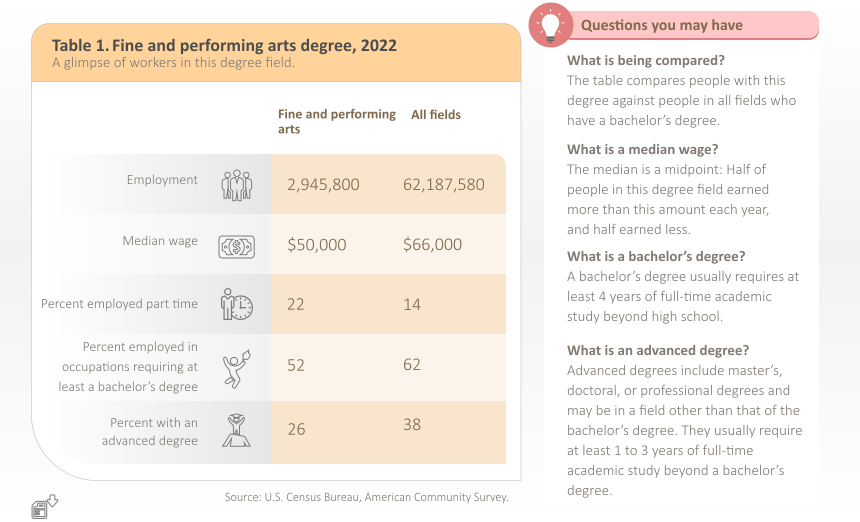
74
posted on
07/21/2026 6:08:57 PM PDT
by
af_vet_1981
( The bus came by and I got on, That's when it all began.)
To: SeekAndFind
My son in law is an artist. A really successful one. My daughter is an artist. Not as successful but never out of work, never out of money. They have been working at it for 15 years or so.
AI is not taking their jobs. Not when the art is physical. Mid level writers? Yeah, probably.
To: maddog55
“I’m immune...I’m retired.”
LOL, you’ll be talking to your chatgpt doctor like everyone else. Fool.
To: Labyrinthos
There will be humans initiating and watching over the process to weed out problems. Will they be editors and publishers going to AI to produce scores of indifferent, more or less the same stories, or will they be “authors” or “post-authors” who work with AI to carefully craft serious work?
77
posted on
07/21/2026 6:28:44 PM PDT
by
x
To: Leaning Right
“Everyone will have lots of free time to do as he wishes.”
I doubt if God approves. He knows more than we do.
To: sphinx
Hadn’t thought about games. The results may depend on the betting amounts.
I was thinking about sports reporting. If you plug in the play by play, AIO could give you a good summary of the action and determine the key plays in the results. Player Interviews responses are heavily coached now so why not just have AI generate the responses.
To: desertsolitaire
AI could develop a vaccine that addresses the underfunded SS and Medicare.
Navigation: use the links below to view more comments.
first previous 1-20, 21-40, 41-60, 61-80, 81-100 next last
Disclaimer:
Opinions posted on Free Republic are those of the individual
posters and do not necessarily represent the opinion of Free Republic or its
management. All materials posted herein are protected by copyright law and the
exemption for fair use of copyrighted works.
FreeRepublic.com is powered by software copyright 2000-2008 John Robinson