Skip to comments.
The Victory Garden Thread - May, 2026
May 1, 2026
| Diana in WI/Greeneyes in Memoriam
Posted on 05/01/2026 6:24:57 AM PDT by Diana in Wisconsin
The MONTHLY Victory Garden Thread is a gathering of folks that love soil, seeds and plants of all kinds. From complete newbies that are looking to start that first potted plant, to gardeners with some acreage, to Master Gardener level and beyond, we would love to hear from you.
If you have specific question about a plant/problem you are having, please remember to state the Growing Zone where you are located.
This thread is a non-political respite. No matter what, you won’t be flamed, and the only dumb question is the one that isn’t asked.
It is impossible to hijack the Victory Garden Thread. Planting, Harvest to Table Recipes, Preserving, Good Living - there is no telling where it will go - and that is part of the fun and interest. Jump in and join us! Send a Private Message to Diana in Wisconsin if you'd like to be added to/removed from our New & Improved Ping List.
NOTE: This is a once a MONTH Ping List, but we DO post to the thread all throughout the month. Links to related articles and discussions which might be of interest to Gardeners are welcomed any time.
TOPICS: Agriculture; Food; Gardening; Hobbies
KEYWORDS: cowgirlcandy; deerproof; food; fritatta; garden; gardening; howard; selfsufficiency; selfsufficient; victory; vidaliaonionsauce; vitaminc; wasps
Navigation: use the links below to view more comments.
first previous 1-20 ... 61-80, 81-100, 101-120 ... 741-742 next last
To: Diana in Wisconsin
And they don’t need light, do they?
Or do they to a certain extent?
81
posted on
05/03/2026 8:56:05 AM PDT
by
metmom
(He who testifies to these things says, “Surely I am coming soon." Amen. Come, Lord Jesus….)
To: Paul R.
We had a raccoon (”Ricky”) getting into our trash. The cans were large, plastic with wheels & the tops fit over the cans by a couple of inches. I don’t know how he was getting those tops off!
I came up with “Ricky Wraps”. I took rope, similar to clothes line variety & put it around the can vertically. I had a loop in both ends. The ends did not meet - I connected them with a heavy duty black rubber bungi cord stretched pretty tight. We had 3 trash cans & all 3 had Ricky wraps. I loved it when I saw Ricky footprints all over the cans & the tops were still securely on! :-)
82
posted on
05/03/2026 10:56:19 AM PDT
by
Qiviut
(A Mighty Fortress: “...the body they may kill. God’s truth abideth still. His kingdom is forever")
To: Qiviut
Yes, I figured I can use a bungee cord over the metal trash can lid, from handle to handle. Or I can bend the metal a bit and make it a tighter fit.
83
posted on
05/03/2026 12:45:58 PM PDT
by
Paul R.
(Old Viking saying: "Never be more than 3 steps away from your weapon ... or a Uriah Heep song!" ;-))
To: Paul R.
Whups, that was supposed to say something like "~ 4' x 8' and nearly 6’ tall". (It actually has a roughly 2.something:12 roof a bit over 6' high at the highest.)
84
posted on
05/03/2026 12:54:38 PM PDT
by
Paul R.
(Old Viking saying: "Never be more than 3 steps away from your weapon ... or a Uriah Heep song!" ;-))
To: Diana in Wisconsin
Well, he sure acts pretty excited... ;-)
85
posted on
05/03/2026 12:56:26 PM PDT
by
Paul R.
(Old Viking saying: "Never be more than 3 steps away from your weapon ... or a Uriah Heep song!" ;-))
To: Paul R.; All
Here's a little different question:
I suppose almost everyone knows of the "trick" to use a little saliva (or a drop of water) to hold together loose ends of a cotton string or thread. However, I bought some 70 lb. braided Kevlar heavy thread (or call it darn small string), and despite being braided, the ends still fray somewhat easily, making it hard to pass through, say, a small eyelet. Saliva or water doesn't help much -- the Kevlar is a synthetic fiber that doesn't react "favorably" in this instance with water.
I wonder if soft clay rolled into the string would help?
Beyond that, I asked Brave Search for ideas on what would work best, and here is what it came up with:
https://search.brave.com/ask?q=What+adhesives+effectively+seal+Kevlar+fraying%3F&conversation=090a6c3d3a66a2a666589da83e2974a89651
86
posted on
05/03/2026 1:18:26 PM PDT
by
Paul R.
(Old Viking saying: "Never be more than 3 steps away from your weapon ... or a Uriah Heep song!" ;-))
To: Paul R.
"the ends still fray somewhat easily, making it hard to pass through, say, a small eyelet. Saliva or water doesn't help much -"
********
If I understand your issue properly i.e. getting a frayed, split end through something narrow, I deal with this all the time, trying to thread a fuzzy yarn end through the eye of a small needle. This is what I do:
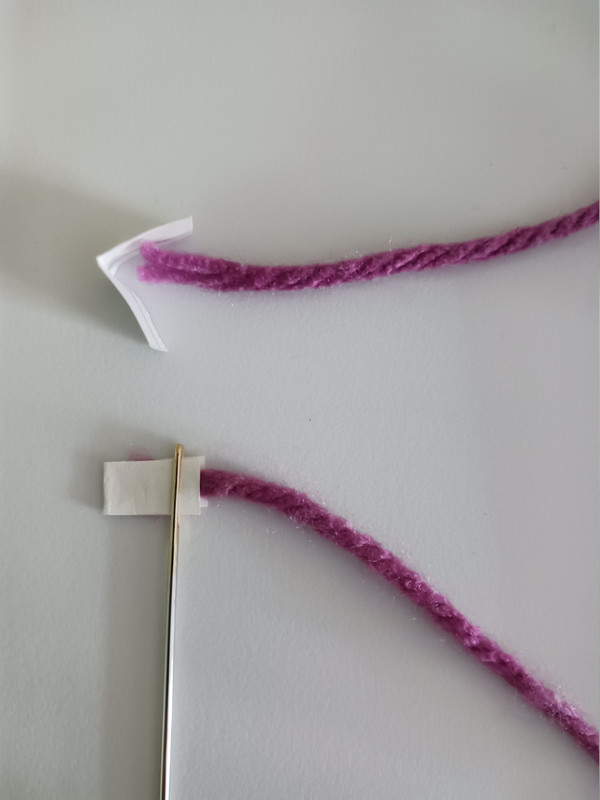
I use an index card for my paper 'guide' - stiffer than regular paper, but not too thick.
87
posted on
05/03/2026 3:39:40 PM PDT
by
Qiviut
(A Mighty Fortress: “...the body they may kill. God’s truth abideth still. His kingdom is forever")
To: metmom
Amazingly, they need no light to grow. Cool, dark and damp for mushrooms.
There’s an old saying about working for a living and how they ‘keep you in the dark and feed you horse manure...’
What are we? Mushrooms? LOL!
88
posted on
05/03/2026 5:00:28 PM PDT
by
Diana in Wisconsin
(I don't have, 'Hobbies.' I'm developing a robust Post-Apocalyptic skill set.)
To: Paul R.
Hot Glue Gun. Fixes pretty much everything!
89
posted on
05/03/2026 5:02:50 PM PDT
by
Diana in Wisconsin
(I don't have, 'Hobbies.' I'm developing a robust Post-Apocalyptic skill set.)
To: Paul R.
When I have synthetic cord that shows signs of unraveling, I snip off a bit to make a new end and then melt just the tip of it in a candle flame.
90
posted on
05/03/2026 5:10:10 PM PDT
by
metmom
(He who testifies to these things says, “Surely I am coming soon." Amen. Come, Lord Jesus….)
To: Qiviut
Unfortunately, I am dealing with a round eyelet that is only about 0.040” diameter, and the thread (if I don’t squash it trying to measure it) appears to be ~0.020” diameter — before the end frays when cut, that is.
However, your post is quite useful should I need to do some sewing (more likely with a more common material than Kevlar thread!), and it also gave me the idea to more accurately measure these and other small eyelets’ diameters — by finding pins or needles that just barely pass through them. ;-)
Thanks!
91
posted on
05/03/2026 7:34:46 PM PDT
by
Paul R.
(Old Viking saying: "Never be more than 3 steps away from your weapon ... or a Uriah Heep song!" ;-))
To: Qiviut
92
posted on
05/03/2026 7:35:24 PM PDT
by
Paul R.
(Old Viking saying: "Never be more than 3 steps away from your weapon ... or a Uriah Heep song!" ;-))
To: metmom
Kevlar doesn’t melt - it just chars if you get it hot enough to alter it. :-(
Also, since I am trying to get an approx. 0.020” thread (before fraying) through a roughly 0.040” round eyelet, the little “ball” of melted material that forms on the end of, say, a nylon string, using the candle flame method, would be problematic.
I briefly considered using braided fishing line, as it has almost as much strength as Kevlar thread / string for a given diameter, and I already have some in a 50 lb. break strength rating, but the Kevlar is much more abrasion and cut resistant, in addition to its higher temperature performance. Those characteristics may come in handy for some automotive uses, later on, too. :-)
This Kevlar “heavy thread” can actually be used to cut through soft wood, though that’s not the app I need it for at present.
93
posted on
05/03/2026 8:05:54 PM PDT
by
Paul R.
(Old Viking saying: "Never be more than 3 steps away from your weapon ... or a Uriah Heep song!" ;-))
To: Paul R.
What about nail polish? Dipping the end of the thread in some?
94
posted on
05/03/2026 8:55:56 PM PDT
by
metmom
(He who testifies to these things says, “Surely I am coming soon." Amen. Come, Lord Jesus….)
To: metmom
Yes, that (nail polish) might work — in advance.
I don’t think one could roll an already frayed end back into a thin thread held together by the nail polish. The adhesion of the nail polish to latex or vinyl gloves would likely be as great or greater than the nail polish’ adhesion to the Kevlar fibers.
However, let’s say one needs a 2 ft. section of thread with no fraying at either end. If the fraying at the loose end is under 3/4”, one could thinly “paint” on nail polish from 3/4” to 1-1/4”, and again from 24-3/4” to 25-1/4”. Let dry, then cut at 1” and 25”.
Some sources seem to indicate similar, with shellac or even white glue may work.
I have not yet seen any method that will “fix” an already frayed end, however, the way moisture will work with cotton string.
95
posted on
05/03/2026 10:31:23 PM PDT
by
Paul R.
(Old Viking saying: "Never be more than 3 steps away from your weapon ... or a Uriah Heep song!" ;-))
96
posted on
05/04/2026 2:18:50 AM PDT
by
MomwithHope
(Forever grateful to all our patriots, past, present and future.)
To: All

Osso Bucco Milanese
Veal shanks braised in white wine and tomato sauce
served w/ gremolata: chp garlic, parsley, lemon zest.
ING 1/4 c oil 4 lb veal shank, in 2" thick pieces 1 lge diced onion 2 diced celery stalks, 2 diced carrots,
1 minced clove garlic, 1 lge can tomatoes Chopped parsley 1/2 c white wine 1/2 tsp basil S/p, Bay leaf
METHOD Brown veal few pieces at a time in oil, then remove to plate. In veal drippings, cook onion, celery, carrots, garlic. Return veal to pan, add tomatoes and next five ing after the boil. Reduce heat, cover/simmer fork tender 1 1/2-2 hrs. Serve over rice, or orzo (an Italian pasta), topped with gremolata.
97
posted on
05/04/2026 3:44:47 AM PDT
by
Liz
(Jonathan Swift: Govrnment without the consent of the governed is the very definition of slavery .)
To: Diana in Wisconsin
98
posted on
05/04/2026 6:13:39 AM PDT
by
MomwithHope
(Forever grateful to all our patriots, past, present and future.)
To: MomwithHope
Soon!

99
posted on
05/04/2026 6:40:28 AM PDT
by
Diana in Wisconsin
(I don't have, 'Hobbies.' I'm developing a robust Post-Apocalyptic skill set.)
To: Diana in Wisconsin
I just checked on my pawpaws. Last year I had 202 fruit. I am thinking over 300 this year, two younger trees are blossomed out. Mason bees busy too just hung up a new tube. Before I could walk away two went inside.
100
posted on
05/04/2026 8:50:59 AM PDT
by
MomwithHope
(Forever grateful to all our patriots, past, present and future.)
Navigation: use the links below to view more comments.
first previous 1-20 ... 61-80, 81-100, 101-120 ... 741-742 next last
Disclaimer:
Opinions posted on Free Republic are those of the individual
posters and do not necessarily represent the opinion of Free Republic or its
management. All materials posted herein are protected by copyright law and the
exemption for fair use of copyrighted works.
FreeRepublic.com is powered by software copyright 2000-2008 John Robinson