Some kind of AI sez:
“The statement is false. The original air-cooled Volkswagen Type 2 (Microbus) has a drag coefficient ($C_d$) of approximately 0.44, while Formula One cars have drag coefficients ranging from 0.7 to 1.1 depending on the aerodynamic setup.
Although F1 cars generate significant downforce, their high drag coefficients mean they are far less aerodynamically efficient in terms of pure air resistance than the Microbus. The Microbus’s $C_d$ of 0.44 is actually lower than that of the original Beetle ($0.48$) and comparable to many modern SUVs, but it remains significantly lower than the values associated with open-wheel race cars. “
0.4 hasn’t been all that great for a hundirt years.
The drag coefficient (Cd) of the first-generation Ford Taurus (introduced for the 1986 model year) was 0.32! This made it one of the most aerodynamic mass-market American cars of its time, a significant improvement over the typical ~0.45 Cd of many 1980s U.S. vehicles. The sleek "jellybean" design, flush headlights/grille, and other aero features (like the smooth profile and optimized body shape) contributed to this figure.
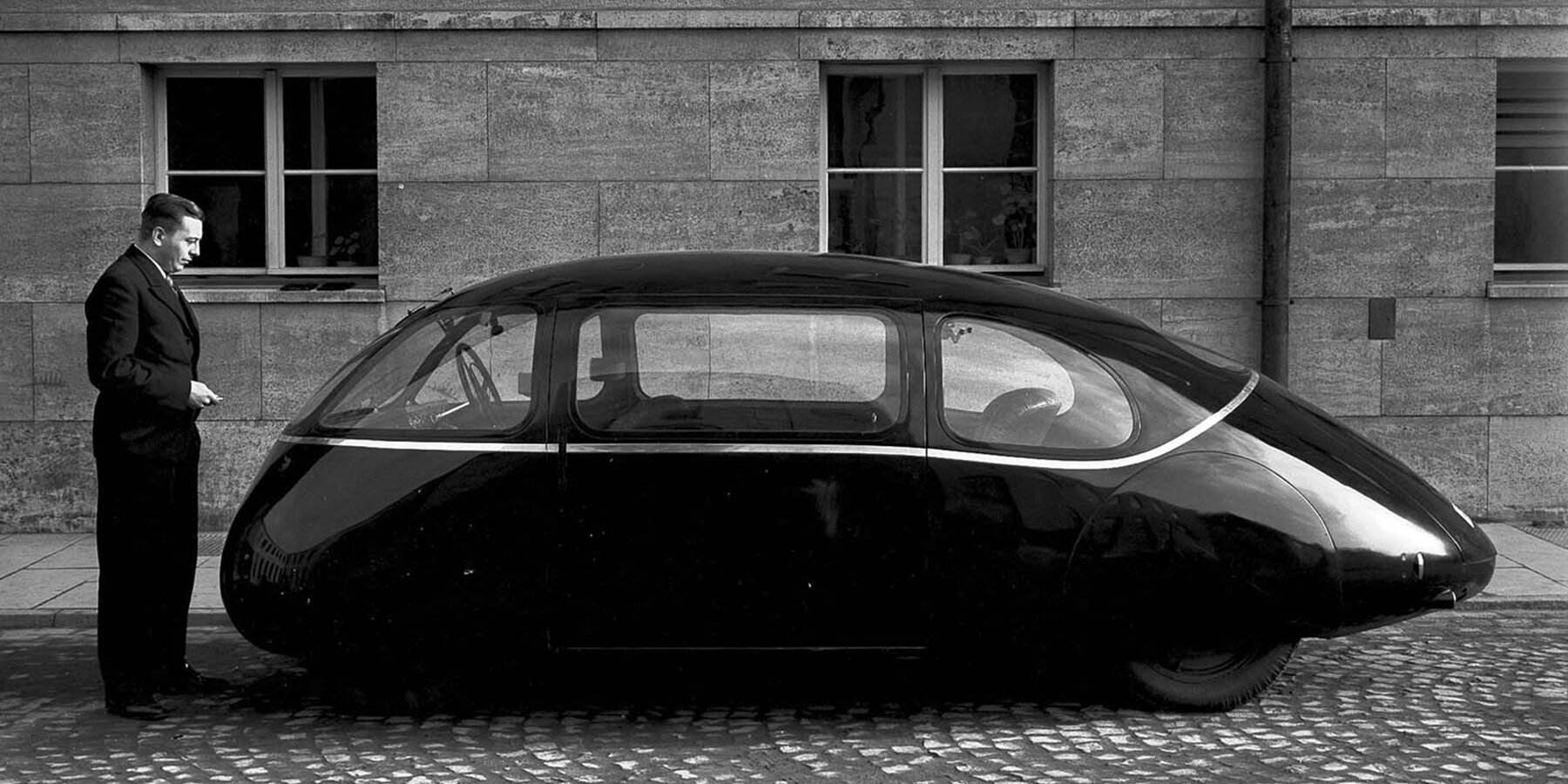
Then there was the 1930s (yes, 1930s) German Schlörwagen (also known as the "Pillbug" or "wing on wheels"). A 1939 German prototype had the lowest drag coefficient of any car from the 1930s at approximately 0.186 (full-size motorized version; scale models tested as low as 0.113–0.15).
The teardrop-shaped, highly streamlined design—built on a Mercedes-Benz 170H chassis with an aluminum body—represented the pinnacle of 1930s aerodynamic research. It was developed by engineer Karl Schlör at the Aerodynamische Versuchsanstalt (AVA) in Göttingen, drawing heavily from aircraft and airship principles. It could seat up to seven people yet achieved efficiency comparable to (or better than) many modern production cars like the Volkswagen XL1.