I see -- South-Central Tennessee, where about 30% of families in 1860 owned slaves meaning: if your ancestors there did not, then some of their relatives and neighbors did.None of the families who lived there at the time that I am descended from owned so much as a single slave. This was the norm throughout the Southern states at the time.
30% of slaveholding families is well within the range of regions which voted for secession and supported the Confederate cause.
1. I would need to see where you are getting that 30% figure and 2. 87% of Tennesseans voted to secede.
Contrast your pro-secession Central and Westen Tennessee with Eastern Tennessee, which had very few slaves and only about 5% of families owned slaves. Eastern Tennesseans: Voted against secession by a margin of 2 to 1, even after Fort Sumter. Tried to secede from Tennessee and form their own Union state, like West Virginia. Burned railroad bridges to disrupt Confederate communications. Suffered under Confederate army imposed martial law, revocation of habeas corpus, expulsions, deportations, drumhead trial hangings, and massacre ordered by Confederate commander to "take no prisoners". Supplied more white troops to the Union army (31,000) than to Confederates (~20,000). Bottom line: your Tennessee family was embedded in the the 30% slaveholder culture of Middle & Western Tennessee, not the 5% slaveholder anti-slavery pro-Union culture of East Tennessee.
Considering 87% of Tennesseans voted for secession, that tells you how small the population of East Tennessee was. I am actually descended from 3 different families from that area at that time (as well as others from different areas obviously) and NONE of the 3 families owned so much as a single slave. They all supported the Confederacy. That was their culture. It was the norm throughout the Southern states. Most of the White population did not own slaves and most supported the CSA.
No, there were no such areas, not any! Your ancestors' area of central Tennessee was deeply embedded in the Southern slave culture, with ~30% of slaveholding families.
See above. Where are you getting this 30% claim from? The rate of slave ownership in the Upper South was lower than in the Deep South AND the percentage of families in the entire CSA which owned slaves was 19.9%. So it seems rather farfetched to say it was 30% in central Tennessee at the time. Anyway, not owning any slaves and supporting the CSA was the NORM throughout the South. After all.....only 5.63% of individuals and 19.9% of White families owned slaves and yet the populations of those states overwhelmingly voted for secession and the overwhelming majority fought in the Confederate Army.
All that is 100% pure nonsense because: Per capita suppression of dissent in the Confederacy was at least as vigorous as in the Union, arguably considerably more so.
Yes but....no. That's pure BS.
Neely identified 14,401 Union military arrests of Union civilians, all but a handful of those being in Border States and conflict regions for: Trading with the enemy Blockade runners Guerillas & spies Draft evaders & assisting deserters Contractors cheating and supplying defective goods Small numbers of copperheads, agitators, newspaper editors and anti-war politicians Neely identified 4,108 civilian Confederates arrested by Confederate authorities for: Unionism Harboring or sheltering Union sympathizers Anti-conscription agitation, draft resistors and civilians aiding deserters Religious conscientious objectors Being labeled "disloyal", “disaffected,” “dangerous,” or “unreliable” by CSA authorities Claiming the CW was a “rich man’s war, poor man’s fight” Writing letters to relatives in Union states Domestic violence against Confederate authorities Hiding goods from CSA impressment officials Trading with Union smugglers or forces
Neely's estimate of 14,400 in the union is at the extreme low end of estimates. Most historians and others who have looked into the matter place the number far higher. Secondly, your claim that most were for cause is also pure BS. If they were arrested and held for cause they were usually actually charged with same. No, these were people arrested and held without charge.....ie they were arrested for simply disagreeing with Lincoln's war. There were far more people arbitrarily arrested and held in the Union than in the Confederacy then there are the matters of the torture they inflicted, the Newspapers shut down all telegraph traffic censored, confiscation acts, etc etc.
What a truckload of cr*p that is! Here's the truth of it: The US Congress did investigate Fort Pillow immediately after the events in April 1864, while war was still ongoing. Congress found: There was a massacre ("slaughter", "butchery", "murder", "atrocity" in newspaper reports) of Union troops after surrender at Fort Pillow African American soldiers were deliberately & disproportionately targeted Confederate claims of a “false surrender” causing the deaths, do not align with casualty patterns or eyewitness testimony. Confederate law refused to recognize Black Union soldiers as lawful combatants. Confederate law required that captured Black soldiers be treated as enslaved insurrectionists rather than prisoners of war -- meaning they could be killed on sight -- a policy known to Confederate troops in the field. Regarding Forrest, Congress found in May 1864 (paraphrasing): The massacre was committed by troops under Forrest’s command, after control was secured, and Forrest as commanding officer bore responsibility whether by action or failure to prevent it. Forrest did not testify to Congress (or anyone else) in 1864, since he was still in the field fighting the war! When Forrest did finally testify to Congress, in June 1871, it was about his alleged role in the KKK (he denied it) and no question about Fort Pillow was ever raised or answered.
As usual you are completely full of chit.
Firstly, the accusation made without evidence in 1864...ie during the war....when the Union Congress could not examine the evidence from both sides and were motivated by war fever are a complete joke. Even they could not substantiate any guilt on Forrest's part because they even recognized they lacked evidence. "Moreover, as the transcript will reveal, the Congress was unable to establish Forrest's guilt. Nevertheless, a careful review of the Fort Pillow investigation transcript reveals many inconsistencies, leaving room to question whether this investigation can be relied upon to inform Forrest's reputation." pg 35
"Despite Jordan and Pryor, among numerous biographers, going to great lengths to demonstrate that most, if not all, of the charges made against Forrest were unfounded...."
https://www.amazon.com/Campaigns-General-Bedford-Forrest-Forrests/dp/030680719X
...."Four, the Northern Congress did not include any testimony from Forrest or Southern sources. Fifth, numerous Union witnesses have later been determined to not have been on the battlefield the day of the conflict..."
That was the 1864 "investigation" by Congress. Testimony by union sources who weren't even there and no testimony by Southern Sources....in other words it was a complete joke exactly as one would expect during a war.
https://digitalcommons.memphis.edu/cgi/viewcontent.cgi?article=1351&context=etd
By the way, as is uncontested by anyone, Forrest's horse was shot out from under him early in the battle and rolled over him leaving his ribs pretty seriously bruised. As a result he was not even at the front that day like he usually was. Why do you suspect even the Union government never even saw fit to charge him with any crime for the Battle of Fort Pillow if they had proof of him being guilty of anything?
Neely's research shows that the Confederate per capita rate of civilian arrests was equal to or greater than the Union rate. Further, that these arrests occurred within the Confederacy itself, predominately in regions which had voted against secession, not as was the Union, in Border States with large numbers of slaveholding pro-Confederates.
Neely is the about the only one who even farcically claims the Confederates arrested anywhere near as many as the Union even on a per capita basis and the claim that the Union arrested mostly people in the Border States is a lie. They arrested tons of people throughout the Union. Hell, the most famous one was Senator Clement Vallandingham of Ohio. As usual, you're just spouting crap.
FLT-bird:
"None of the families who lived there at the time that I am descended from owned so much as a single slave.
This was the norm throughout the Southern states at the time." And yet, the 1860 census didn't lie.
It shows Giles & Marshall County (South-central TN) slave populations around 35% of the total and cotton as the major cash crop.
This puts those counties well within the Deep South's King Cotton slavery culture and locked Giles & Marshall loyalties into the CSA.
Giles & Marshall contrast sharply with Eastern Tennessee, where slaves & slaveholders made up less than 10% of the population, and also contrast with nine other notable anti-CSA regions of the Confederacy, all with few to no slaves, including: 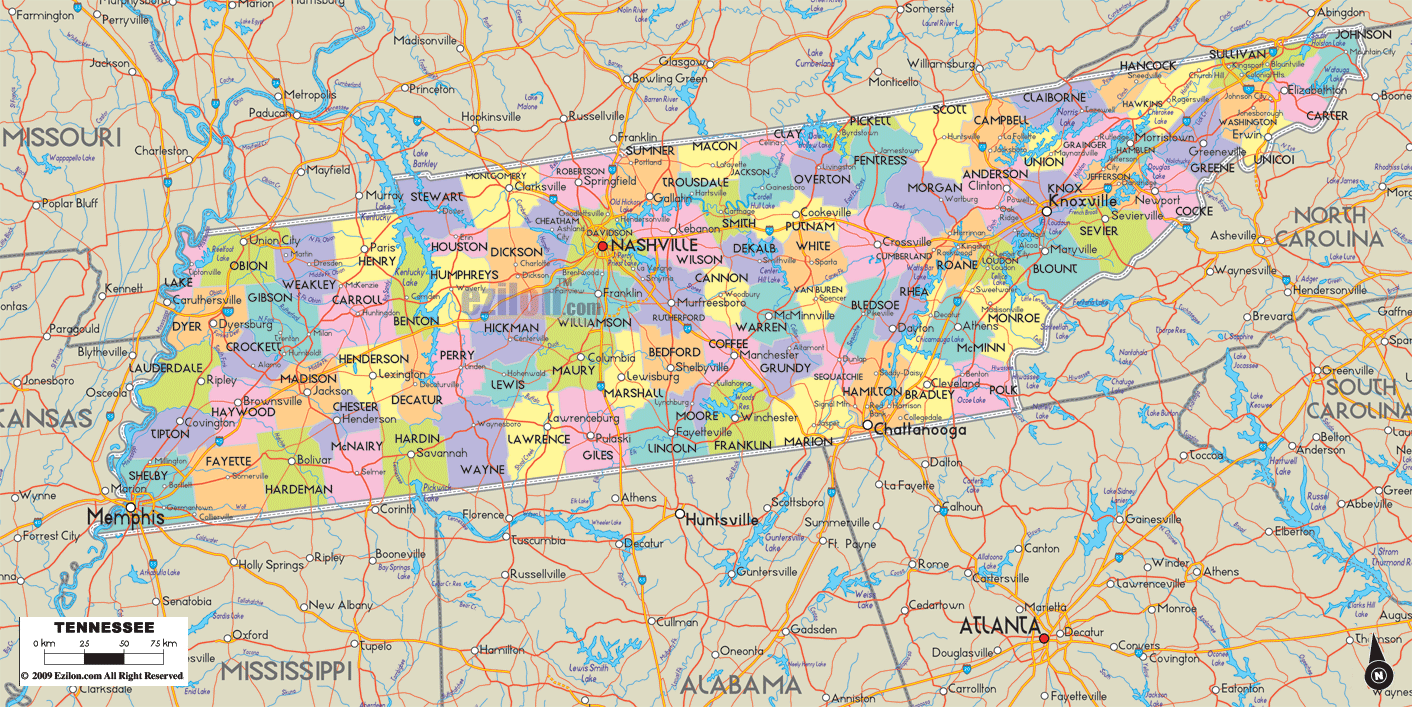
- Western Virginia
- Eastern Tennessee
- Western North Carolina
- Northern Georgia
- Northern Alabama
- Mississippi Free State of Jones, Piney Woods
- Arkansas Ozarks
- Southern Louisiana, including Cajun country
- Northern Texas and Texas Hill Country
FLT-bird:
"1. I would need to see where you are getting that 30% figure and
2. 87% of Tennesseans voted to secede." Two questions, two answers:
- This link shows the percentages of slave populations in Eastern (9%), Central (29%) and Western (34%) Tennessee, 1860.
It also shows overall Tennessee slave population as 25%.
Numerous studies support slaveholding family numbers, including: - Mooney (foundational)
- Tennessee Encyclopedia synthesis
- Edwards (explicit “families” language)
- Cimprich (East TN rarity & small scale)
- Owsley structural analysis
- Census Office spatial evidence
Any of these you can find with online inquiries, and are the basis for my % families owning slaves: 5%-8% East TN, 22%-28% Middle TN, 35%-45% West TN.
Bottom line: here are the numbers I found for Tennessee based on the 1860 census and secondary studies:
1860 Tennessee Population and Slaves by Region:
| Area | Free population
(approx.) | Estimated free
families | Enslaved
population | % enslaved of
total pop. | % of free families
owning slaves |
|---|
| East Tennessee | 245,000 | 47,000 | 28,000 | ~10% | ~5–8% |
| Middle Tennessee | 435,000 | 84,000 | 155,000 | ~26% | ~22–28% |
| West Tennessee | 195,000 | 37,500 | 92,000 | ~32% | ~35–45% |
| Tennessee (total) | 875,000 | 168,000 | 275,719 | 24.9% | ~25% |
| |
| Giles County (Middle TN) | 15,800 | 3,000 | 9,200 | ~37% | ~40–45% |
| Marshall County (Middle TN) | 11,400 | 2,200 | 6,100 | ~35% | ~38–43% |
As you can see, Giles & Marshall counties were in the heart of Tennessee's Cotton Belt and so achieved slave populations equal to or greater than those in even West Tennessee plantation counties.
- 87% of Tennesseans did not vote for secession on June 8, 1861.
The actual number was ~70%, and counties like Giles and Marshall did not change much -- they voted for a secession convention on February 9 by 75% and for secession on June 8 by over 90%.
That's because Giles & Marshall were solidly in the South-Central Tennessee Cotton-Belt slavery culture, so they voted with their Deep South Neighbors. Also, East Tennessee counties like Scott, Sevier and Carter remained at ~95% against secession, while West TN counties like Shelby (Memphis) remained solidly (over 97%) for secession.
So the Feb.-June flip from anti-secession to pro-secession came most dramatically in Northern Middle TN counties -- those counties north of Giles & Marshall -- counties like Sumner, Wilson, Davidson (Nashville) & Rutherford.
Those were less tied to the Deep South's Cotton economy than were Giles & Marshall.
FLT-bird:
"That was their culture.
It was the norm throughout the Southern states.
Most of the White population did not own slaves and most supported the CSA." Again, Giles & Marshall (South-central TN) counties were deeply embedded in the Deep South's Cotton & slave culture, with slave populations over 35% of the total and slaveholding families around 40%.
This means, if your ancestors did not themselves own slaves, then their neighbors, cousins and other relations certainly did.
That's why, unlike East TN (i.e., Knoxville) and North-central TN (i.e., Nashville), which voted against secession in February, Giles & Marshall voted overwhelmingly for secession in both February and June, 1861.
Giles and Marshall did not need the Battle of Fort Sumter to motivate them to join the Deep South's Confederacy because they were already part of it, economically and culturally.
FLT-bird: "Neely's estimate of 14,400 in the union is at the extreme low end of estimates. "
No, those 14,401 are identified and named individuals, not estimates.
From those you can extrapolate, calculate or estimate until the cows come home, but Neely's are names, not estimates.
The same is true of Neely's 4,108 Confederate civilians arrested by CSA authorities -- a number that is relatively equal to the Union arrests per capita but is based on far less systematic records available.
IOW, just as you can extrapolate, calculate & estimate Union numbers based on Neely's 14,401 named Union individuals, so you also extrapolate, calculate or estimate based on his 4,108 named Confederates.