To: BroJoeK; Rockingham; Ditto; ClearCase_guy
The 1860 census numbers are well known and not disputed. But how those numbers get interpreted can often reveal a person's biases and loyalties. Here are the actual 1860 census numbers by region showing household sizes and % of slave ownerships: Average % of Households Holding Slaves, by Region -- 1860 Census Region Free population Enslaved population Freedmen (free Blacks) Free Households Free people per household % households owning slaves Avg. enslaved per slaveholding household Free States / Territories 18,810,000 0 226,000 3,610,000 5.21 0.0% — Border States 2,710,000 430,000 129,000 490,000 5.56 15.9% 5.55 Upper South 2,930,000 1,210,000 96,000 530,000 5.50 25.3% 8.95 Deep (Lower) South 2,660,000 2,310,000 36,000 490,000 5.37 36.7% 12.74 TOTAL (U.S.) 27,110,000 3,950,000 487,000 5,120,000 ≈ 5.3 ≈26% of Southern households ≈10 The first thing to point out here is that regional averages hide the extremes:Here we go. Where did you get that % of households owning slaves? You definitely did not get that from the 1860 US Census. Statistical tables for each State and Territory include from the 1860 US Census include
Population by age, sex, and color according to counties;
Population by color and condition (free, colored, and slave) by counties;
Population by color and sex of cities and towns and other subdivisions;
Free population, native and foreign, by counties;
Nativities of the free population;
Occupations.
Nowhere in that Census will you find the # or percentage of households owning slaves in each state. That percentage is something you're just making up without evidence.
So, no single number can encompass the entire slaveholding South. Likewise, it's entirely fair to say that overall ~75% of Southern households did not own slaves, but that number ranged from 97% in Delaware to only ~50% in Mississippi.
You have no evidence for your claims about the % of households in each state that owned slaves. Obviously there were differences between states usually depending on the suitability of the land in that state for growing the 2 more labor intensive cash crops - Cotton and Tobacco.
Methodologically: The 1860 census counted households, not nuclear families. Households did not include slaves but did include anyone living there, related or not. In the South, households were typically all related, while in the North, households could include borders or hired hands. Yes, the claim that some households included multiple slaveholders is true, but it's just as true that some slaveholders owned slaves in multiple households. But both cases were rare, and so the overall averages remain valid.
I'm sure some cases of slave owners not owning any slaves in the household they lived in but still owning slaves in other households existed, but I would suspect it far more rare than cases in which there was more than a single slaveowner in one household. Women could and did inherit slaves from their families (like Julia Grant and Mary Anne Custus Lee) so it was not at all a safe assumption to believe only the husband owned slaves. Similarly, in households that owned a lot of slaves, it was not at all unusual for children to be gifted slaves as birthday or wedding gifts (eg a maid who was a childhood best friend, etc). There is simply no way of proving what percentage of households owned slaves based on the 1860 US Census - which was significantly more detailed than earlier Censuses.
Finally, especially in Deep Cotton South states, it's utterly disingenuous to suggest that slavery was not intimately woven into the fabric of the "Southern way of life" in 1860.
It certainly was for some. It wasn't for the majority who did not own any slaves.
So virtually everyone who joined the Confederate army or participated in Confederate government was embedded in the South's "Peculiar Institution".
False. The overwhelming majority of White Southerners did not own any slaves. Laughable to claim somebody was "embedded in" slavery when that person did not own any slaves.
To: FLT-bird
1860 census included the following…
Schedule 2 - Slave Inhabitants
Name of slave owner
Number of slaves
Age
Sex
Seems to me with the name os the slave holder and the number of slaves he owned, it would be easy to calculate the percent of slave owning families.
435 posted on
03/30/2026 12:25:56 PM PDT by
Ditto
To: FLT-bird
Permit me to direct our exchange back to the importance of slavery to the South. Based on the US statistical abstract, here are the state by state percentages of the population that was slaves:
1860
Slaves as per cent
of population
Alabama 45.12
Arkansas 25.52
Delaware 1.60
Florida 43.97
Georgia 43.72
Kentucky 19.51
Louisiana 46.85
Maryland 12.69
Mississippi 55.18
Missouri 9.72
North Carolina 33.35
South Carolina 57.18
Tennessee 24.84
Texas 30.22
Virginia 30.75
Overall 32.27
So which do you think would be a stronger influence on public opinion in the South before the Civil War? The speculative promise of marginally cheaper manufactured goods due to lower tariffs under a Confederate government?
Or that with the liberation of the slaves, a third of the South’s population, would become hungry, homeless, without work, and free to roam and settle where they liked and do as they liked? And, as in Haiti, many of the freed slaves could be expected to be angry and vengeful toward their former owners and whites in general.
Under emancipation, the former slaves would also get the right to vote and their numbers would determine the officials, laws, and policies in a great many Southern states and communities. That would be the end of white rule in those areas.
For many Southerners, the continuation of slavery was essential to a safe and civilized public order. Even for non-slaveholders, emancipation carried the certainty of not just major social and economic upheaval but also a risk of violence and chaos at the hands of newly free former slaves.
As it was, the South after the Civil War experienced many such ills. The result was the formation of the Klan and the creation of Jim Crow and disenfranchisement to keep blacks separate and under control.
Due to such calculations, most Southern whites who did not own slaves nevertheless wanted slavery to continue. That accounts for their support for secession, not tariffs.
To: FLT-bird; Ditto; Rockingham; x; ClearCase_guy
FLT-bird:
"Here we go.
Where did you get that % of households owning slaves?
You definitely did not get that from the 1860 US Census."FLT-bird: "Nowhere in that Census will you find the # or percentage of households owning slaves in each state.
That percentage is something you're just making up without evidence."
Ditto #435: "Seems to me with the name of the slave holder and the number of slaves he owned, it would be easy to calculate the percent of slave owning families."
FLT-bird #439: "By this guy's calculation 20% of families in the slaveholding states owned slaves."
So, the first key point to understand is that the 1860 census was taken by household, meaning not just the nuclear family, but everyone who lived there including borders and hired hands, but not slaves.
Slave schedules were kept separately and identified by owner.
This makes identifying slaveholding households relatively simple & straightforward.
Several studies have digitized and analyzed the original 1860 data to account for both:
- Multiple slaveholders per household and
- One slaveholder owning slaves in multiple households
These studies include:
In every case the data was analyzed and classified to combine multiple owners in each household and to derive the overall percentages of households owning slaves.
FLT-bird: "I'm sure some cases of slave owners not owning any slaves in the household they lived in but still owning slaves in other households existed, but I would suspect it far more rare than cases in which there was more than a single slaveowner in one household."
Both conditions are recognized and adjusted for in the historical scholarship to insure that each slaveholding household is counted only once, not once for each slaveholder.
FLT-bird: "The overwhelming majority of White Southerners did not own any slaves.
Laughable to claim somebody was "embedded in" slavery when that person did not own any slaves."
1862 Nueces Massacre, Texas Hill Country:
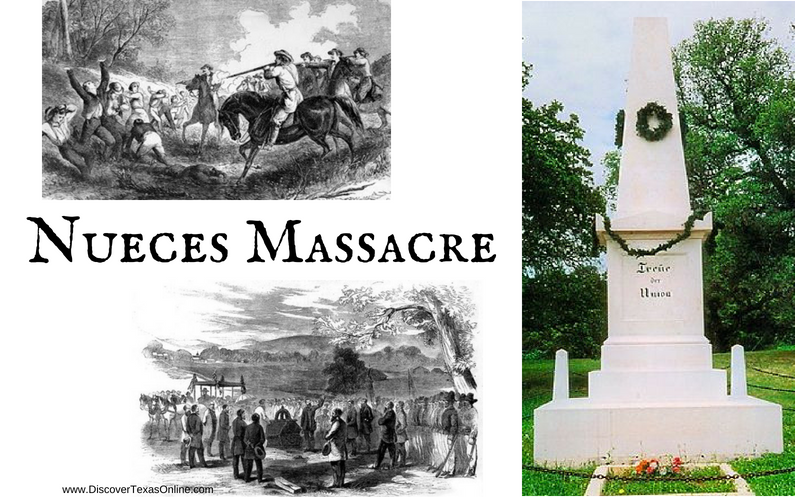 Sure, laugh all you want, ~97% of Delaware households did not own slaves, ~50% of Mississippi households did not own slaves.
So a typical young man from the Deep South in the Confederate army owned no slaves, however:
- his parents owned slaves
- his uncles owned slaves
- his older brothers owned slaves
- his sweetheart's family owned slaves
- his neighbors' families owned slaves
So, yes, that young Confederate soldier who owned no slaves was still deeply embedded in the "Southern way of life" and its "peculiar institution".
By contrast, Southerners who seriously did not own slaves opposed secession and Confederacy, refused to serve in the CSA army and were often mistreated or massacred, including the 1862 Nueces Massacre, Texas Hill Country:
- ~1/3 of Confederate voters voted against secession
- ~10% of Confederates actively resisted Confederate service in places like western VA, eastern TN, western NC, northern AL, Ozarks of AR, Texas Hill Country.
- ~5% of Confederate white men served in the Union Army -- 100,000 overall.
Those were the non-slaveholding, anti-slavery Confederates.
448 posted on
03/31/2026 6:22:04 AM PDT by
BroJoeK
(future DDG 134 -- we remember)
FreeRepublic.com is powered by software copyright 2000-2008 John Robinson