Free Republic
Browse · Search
General/Chat
Topics · Post Article

To: FLT-bird; Ditto; Rockingham; x; ClearCase_guy
FLT-bird: "Here we go.
Where did you get that % of households owning slaves?
You definitely did not get that from the 1860 US Census."

FLT-bird: "Nowhere in that Census will you find the # or percentage of households owning slaves in each state.
That percentage is something you're just making up without evidence."

Ditto #435: "Seems to me with the name of the slave holder and the number of slaves he owned, it would be easy to calculate the percent of slave owning families."

FLT-bird #439: "By this guy's calculation 20% of families in the slaveholding states owned slaves."

So, the first key point to understand is that the 1860 census was taken by household, meaning not just the nuclear family, but everyone who lived there including borders and hired hands, but not slaves.
Slave schedules were kept separately and identified by owner.

This makes identifying slaveholding households relatively simple & straightforward.
Several studies have digitized and analyzed the original 1860 data to account for both:

  1. Multiple slaveholders per household and
  2. One slaveholder owning slaves in multiple households
These studies include: In every case the data was analyzed and classified to combine multiple owners in each household and to derive the overall percentages of households owning slaves.

FLT-bird: "I'm sure some cases of slave owners not owning any slaves in the household they lived in but still owning slaves in other households existed, but I would suspect it far more rare than cases in which there was more than a single slaveowner in one household."

Both conditions are recognized and adjusted for in the historical scholarship to insure that each slaveholding household is counted only once, not once for each slaveholder.

FLT-bird: "The overwhelming majority of White Southerners did not own any slaves.
Laughable to claim somebody was "embedded in" slavery when that person did not own any slaves."

1862 Nueces Massacre, Texas Hill Country:
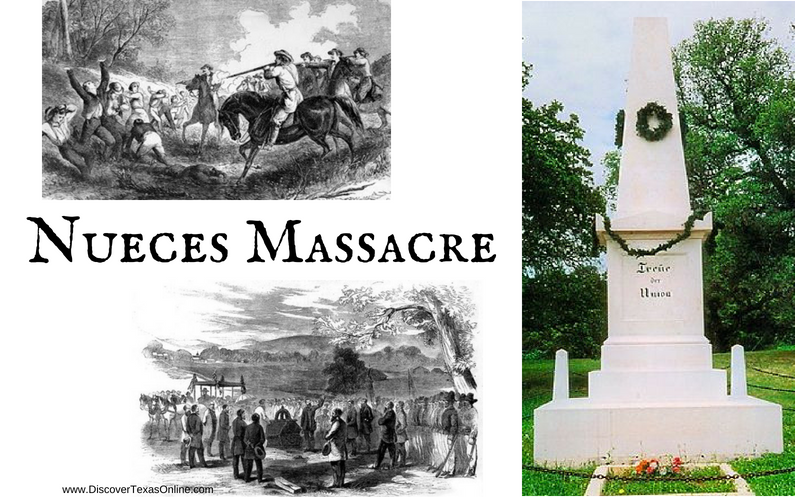
Sure, laugh all you want, ~97% of Delaware households did not own slaves, ~50% of Mississippi households did not own slaves.
So a typical young man from the Deep South in the Confederate army owned no slaves, however:

  1. his parents owned slaves
  2. his uncles owned slaves
  3. his older brothers owned slaves
  4. his sweetheart's family owned slaves
  5. his neighbors' families owned slaves
So, yes, that young Confederate soldier who owned no slaves was still deeply embedded in the "Southern way of life" and its "peculiar institution".

By contrast, Southerners who seriously did not own slaves opposed secession and Confederacy, refused to serve in the CSA army and were often mistreated or massacred, including the 1862 Nueces Massacre, Texas Hill Country:

  1. ~1/3 of Confederate voters voted against secession

  2. ~10% of Confederates actively resisted Confederate service in places like western VA, eastern TN, western NC, northern AL, Ozarks of AR, Texas Hill Country.

  3. ~5% of Confederate white men served in the Union Army -- 100,000 overall.
Those were the non-slaveholding, anti-slavery Confederates.
448 posted on 03/31/2026 6:22:04 AM PDT by BroJoeK (future DDG 134 -- we remember)
[ Post Reply | Private Reply | To 434 | View Replies ]


To: BroJoeK; Ditto; Rockingham; ClearCase_guy
So, the first key point to understand is that the 1860 census was taken by household, meaning not just the nuclear family, but everyone who lived there including borders and hired hands, but not slaves. Slave schedules were kept separately and identified by owner.

Actually the 1860 US Census recorded BOTH families AND households.

This makes identifying slaveholding households relatively simple & straightforward. Several studies have digitized and analyzed the original 1860 data to account for both:

And families.

1862 Nueces Massacre, Texas Hill Country:

relevance?

Sure, laugh all you want, ~97% of Delaware households did not own slaves, ~50% of Mississippi households did not own slaves. So a typical young man from the Deep South in the Confederate army owned no slaves, however: his parents owned slaves his uncles owned slaves his older brothers owned slaves his sweetheart's family owned slaves his neighbors' families owned slaves So, yes, that young Confederate soldier who owned no slaves was still deeply embedded in the "Southern way of life" and its "peculiar institution".

In one of the densest Cotton producing areas HALF of White Southern families owned slaves - not all as you have portrayed it. And of course, that was only a small portion of the CSA. You frequently accuse me of "cherrypicking". This is the biggest example of cherrypicking there could be.

By contrast, Southerners who seriously did not own slaves opposed secession and Confederacy, refused to serve in the CSA army and were often mistreated or massacred, including the 1862 Nueces Massacre, Texas Hill Country:

No they didn't. The large majority of White Southern families did not own slaves....ie more than 80% according to the studies you yourself cited. They made up the large majority of the Confederate army. The 3 families of my ancestors who lived in Tennessee at the time provided 10 Confederate soldiers. The 3 families between them owned a grand total of 0 slaves. This was not unusual.

~1/3 of Confederate voters voted against secession

That depends on when and where you're talking about. Tennessee for example voted 54% against secession UNTIL Lincoln chose to start a war. Then it voted 88% for secession. Texas voted 76% for secession in the first instance. Virginia voted 78% in favor after Lincoln chose to start a war.

~10% of Confederates actively resisted Confederate service in places like western VA, eastern TN, western NC, northern AL, Ozarks of AR, Texas Hill Country. ~5% of Confederate white men served in the Union Army -- 100,000 overall. Those were the non-slaveholding, anti-slavery Confederates.

Both sides experienced draft dodging and desertion became a major problem on both sides. To say that those Southerners who served in the Union army or refused to serve in the Confederate army were non slave owning is wrong. To say they were therefore anti slavery is likewise wrong. People had plenty of different motivations for the choices they made. There are plenty of examples though of slaveholding unionists and there was precious little support for abolition anywhere in the country prior to 1863.

456 posted on 03/31/2026 7:20:37 AM PDT by FLT-bird
[ Post Reply | Private Reply | To 448 | View Replies ]

Free Republic
Browse · Search
General/Chat
Topics · Post Article


FreeRepublic, LLC, PO BOX 9771, FRESNO, CA 93794
FreeRepublic.com is powered by software copyright 2000-2008 John Robinson