Total Chinese monopoly.
95+% of neodymium magnets come from them.
Can the US make its own? Yes.
After 10-15 years of process development.
Is 15 yrs required to produce a single neodymium magnet? No.
You can do that in a few months.
But how long to produce domestically the amount imported from China in 2024?
That’s the 10-15 yrs."
I think your information is outdated.
What's true is that: 
- The US produced our own Neodymium Magnets for around 25 years, ending circa 2011, when production was moved to China.
So, we know how to do it, and we did it for decades. - In recent years, the US has returned to Neodymium Magnet production, currently at the rate of circa 3,000 tons per year, which is a drop in the bucket compared to US total consumption of some 80,000 tons per year, 90% of that in consumer electronics and other imported equipment.
- The US current 3,000 tons is barely enough to cover critical national security needs and is being expanded to 12,000 tons by the end of 2028.
12,000 tons of Neodymium Magnets is enough to cover all US manufactured products' requirements, but not enough to replace magnets in imported consumer goods. - A US "green field" project to add another 10,000 tons capacity will cost ~$6 billion and take 5 years (under Trump) to 10 years (under anyone else).
But "brown field" projects to expand existing infrastructure cost only half as much and take only half the time -- as little as 2-3 years.
Owen: "I have also noticed that after this first awareness of the situation, he stopped using (and shipping to Ukraine) precision weapons.
The inventory is all we have, and will have for 10-15 yrs. "
Domestic Neodymium Magnet manufacturing will increase from 3,000 tons today to 12,000 tons by the end of 2028.
That will supply all of our national security needs, though none for imported consumer electronics & other general applications.
Owen: "It must not be widely spoken of for fear of encouraging enemies, but this is a horrible constraint on foreign policy.
Those weapons must be conserved for something important, which Iran and Ukraine are not."
Since at least the Obama presidency, US national defense documents have identified China as the US major "geostrategic threat".
There is a long list of CCP Chinese threats to Western Civilization, beginning with military threats against Taiwan, the South China Sea and others, and including such things as intellectual property thefts, cultural corruptions, etc.
Owen: "As for oil timelines, as noted before shale wells die vertically.
Talking about Reserves is always somewhat weak. You mentioned KSA.
If you hit the Global Reserves wiki you can find things country by country.
For KSA in particular, pumping about 7 billion barrels/year, they quote a number of about 260Billion barrels in some year 20-30 yrs ago.
hen each year after that the reserves hold at that number.
Year after Year.
Same number."
Sure, I understand all that, which is why the numbers I've used here are not "proven reserves" (which are fictitious) but rather the larger estimates of "oil in place", or "oil in the ground".
Yes, you can argue against those too, however, they do represent the total potential of oil now known to be available, given necessary oil prices and extraction technology.
What "oil in place" numbers tell us is that there are huge reserves of energy remaining to be extracted as current "proven" resources are consumed.
Owen: "As for what most defines a timeline, well, of course it is war.
China consumes 17 million bpd and domestic production is 4.5 mbpd.
So they import. A lot.
It only takes the slightest interference in those imports for them to be forced . . . note that, forced . . . to grab the flow to Japan, which has zero domestic production."
- Japan maintains huge Strategic Oil Reserves, approaching nearly a year's supply at peacetime usage rates.
- China produces roughly 1/3 of its own peacetime oil requirements and maintains Strategic Oil Reserves to cover those imports for 121 days.
- The USA's Strategic Oil Reserve, when full will cover about 90 days of US imports -- though the US is a net exporter of oil, imports are still necessary to keep some refineries busy.
Neither country will suffer in the least from minor disruptions.
But a major war which, God forbid, lasts for months or years, is a very different situation.
And this could only happen under conditions we have not seen since 1945 -- a CCP Chinese invasion of Taiwan and closure of the South China Sea would roil the planet like nothing we've seen in my lifetime.
Every US ally from Japan, South Korea, Taiwan, Philippines, Australia & Thailand to Canada, UK & France would be forced into whatever major adjustments are necessary to deal with lunatic Chi-Com leadership.
Of course, nobody wants that to happen, but please keep in mind, if it ever did, then a few redirected oil tankers would be the least of the world's problems.
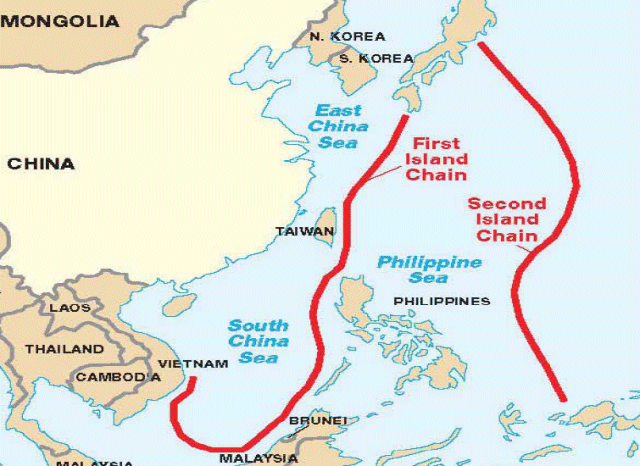 Owen: "The US responds? With what?
Escorting middle east tankers along that huge Chinese coastline north to Japan?
The first actual action will require use of precision weapons. Reluctance.
Ship oil from the US to Japan?
We don’t have enough excess for that, certainly not with the Permian peaking.
Japan is a big consumer of oil."
- Japan consumes ~3 million barrels of oil per day.
- China consumes ~16 million barrels of oil per day.
- The USA consumes ~20 million barrels of oil per day.
- Japan's oil reserves can last nearly a year.
- Middle Eastern resupply tankers will reach Japan along the Second Island Chain, not via China's coastline.
- US Gulf Coast refineries can process up to 2 million barrels per day of Venezuelan crude oil for export to Japan via the Panama Canal and north-Pacific ocean.
Bottom line: WWIII or an asteroid strike will end civilization as we know it today, but anything short of that will not destroy life on earth and, indeed, the world can adapt and respond to a lot, if we have to.