Posted on 01/13/2026 8:39:16 AM PST by Miami Rebel
President Trump told reporters Sunday night that he was “inclined” to deny ExxonMobil any role in rebuilding Venezuela’s moribund oil industry after its CEO told him point-blank Friday that the South American country was “uninvestable” despite the recent capture of President Nicolas Maduro.
“I didn’t like Exxon’s response,” Trump said to reporters on Air Force One as he departed West Palm Beach, Florida. “They’re playing too cute.”
ExxonMobil CEO Darren Woods made the blunt assessment during a White House meeting of petroleum executives whom Trump was trying to persuade to restart production in Venezuela after more than 25 years of left-wing authoritarian rule.
“If we look at the commercial constructs and frameworks in place today in Venezuela, today it’s uninvestable,” said Woods, who has led the world’s largest oil company since January 2017.
(Excerpt) Read more at nypost.com ...
Yes, and as soon as someone (Exxon Mobil CEO) disagreed, and said that Venezuela was not an “investible” location, not only did Trump disagree, but he said that Exxon Mobil would be “shut out” of any future opportunities. That they were “too cute”.
Thats how you cultivate “yes men”. When not only does the President disagree, but punishes you for doing so.
Then why do they have a market cap of over $500 billion dollars? Because they sell gas above market rate and people are dumb enough to buy it?
Gas is a commodity. Its all the same. You buy whatever is cheapest or most convenient.
Telling businesses to invest where they’d lose money is what Democrats do.
Bingo
ExxonMobil aims for a corporate breakeven oil price of $30 per barrel by 2030 to ensure sustained profitability. The company’s current portfolio-weighted breakeven is estimated to be around $40-$42 per barrel.
Current and Projected Breakeven Costs
ExxonMobil does not rely on a single oil price for profit across all operations, as breakeven points vary by project and region. The company has focused heavily on reducing costs to be profitable even in a low-price environment.
Current (approx. 2025): The estimated portfolio-weighted breakeven point is in the range of $40-$42 per barrel. Operations in high-margin areas like Guyana remain profitable at oil prices as low as $30 per barrel.
Near-term Target (by 2027): The company has stated it plans to lower its breakeven costs to $35 per barrel.
Long-term Target (by 2030): ExxonMobil’s goal for its global operations is a breakeven cost of approximately $30 per barrel.
This focus on lowering the breakeven point, primarily by investing in advantaged assets (like the Permian Basin and offshore Guyana) and achieving structural cost savings, is designed to make the company resilient to volatile commodity prices and profitable even when oil prices are below $60 per barrel.
Why Exxon Mobil Stock Just Hit a New 52-Week High While ...
Dec 29, 2025 — Quick Read * Exxon Mobil (XOM) reached a new 52-week high despite WTI crude falling nearly 20% in 2025. The stock recovered fully ...
Trump offers US oil companies a poisoned chalice in Venezuela
Jan 5, 2026 — Exxon’s breakeven target for its global oil production by 2030 is $30 a barrel, driven by low-cost fields in Guyana and the U.S. P...
Reuters
Oil Executives Brace For Another Tough Year Ahead | OilPrice ...
Dec 17, 2025 — There’s a method to the madness, though. Exxon reported an additional $2.2 billion in structural cost savings in the third quarter...
Oil Price
·
Alex Kimani
Perfect example. Yes men only need apply. Everything i said was valid, and instead of giving YOUR point of view, you launch a personal attack.
Sadly little man, you have continually itched, whined and moaned, over and against president Trump. Your pretense of superiority can only come from some 'religious' defect. Honesty IS not your long suit ... and I am willing to guess a high IQ is literally wanting ... YOU hurl and accuse just like the devil.
Ahh, and the personal attacks escalate. I’m imagining the church lady yelling at me. “so, you feel the need to criticize President Trump. isn’t that special. What could be the cause of that? Could it be ….. SATAN!?!?”
The Trump yes men truly are a special breed
Just like the devil twisting what I typed... snuggled in like a parasite pretending to be MAGA, time and again, upchuck comes out of your twisted mouth. Obviously, you would better fit on a ungodly site .. but no you need to spew your ignorance and HATE of all things Trump ... just like your mommy Nanny the Red Pelouise ...
And once again Bre’r Rabbit outsmarts ol’ Bre’r Fox.
Easy.
He’s negotiating with the master deal maker.
Shrewd, but he’s off to a bad start going public.
Modifying his position will undercut his leadership and he will eventually bow out rather than explain why he denied ExxonMobil investors a slice of Venezuela.
Preach!!
https://cdn.statcdn.com/Infographic/images/normal/16830.jpeg
Not Exxon but others in Syria: https://www.reuters.com/sustainability/boards-policy-regulation/us-firms-develop-syria-energy-masterplan-after-trump-lifts-sanctions-2025-07-18/
Venezuela is a gold mine.
Easily accessed oil.
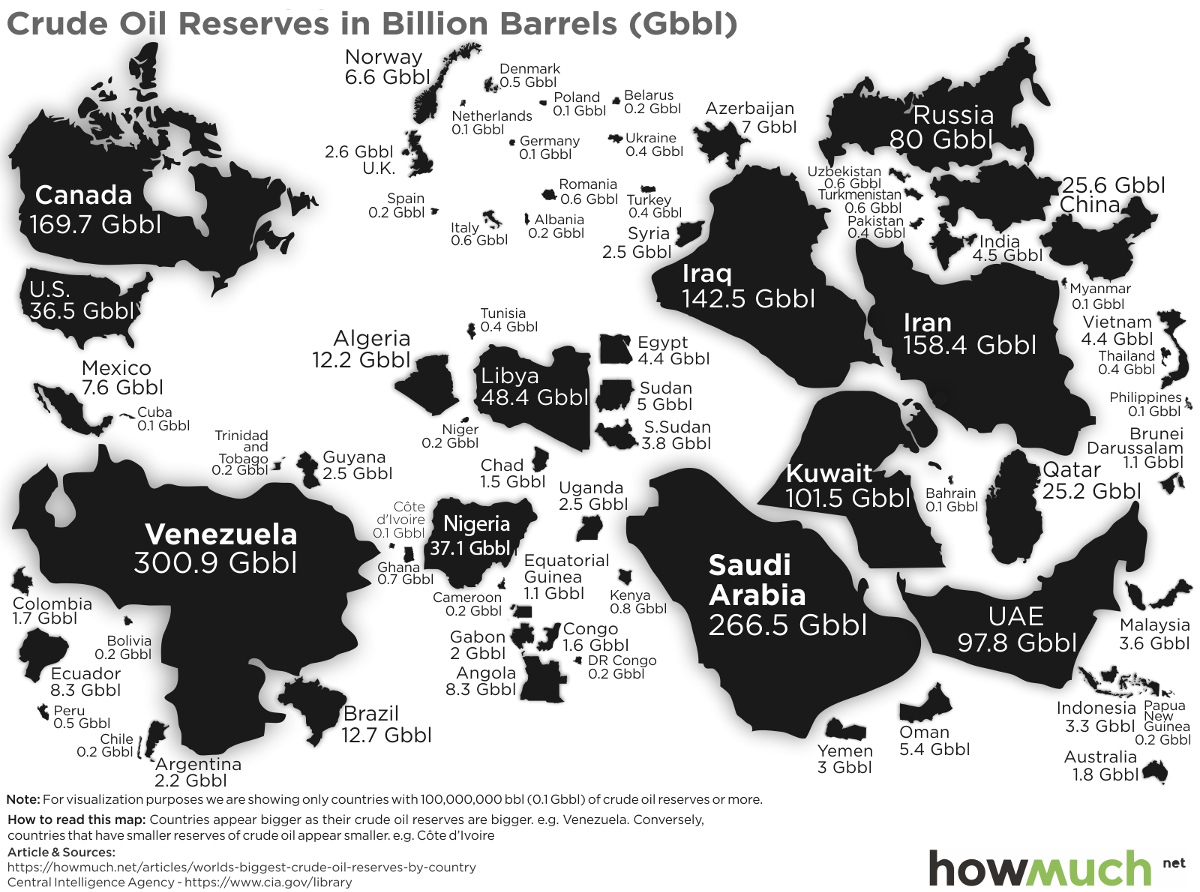
Some of the largest proven oil reserves on the planet.
Albeit lower quality: heavy and sour
Exxon and others are in places like Libya!!!
Exxon probably wants something. This is about making deals, and Exxon if I had to guess wants the US government to give them assurances that they will step in if their investments are threatened. Hard to tell what is talked about in these deals, but it’s for sure NOT because Venezuela is such a basket case. We’re in places far more dangerous and unstable pumping oil.
As I’ve posted before, the reserve numbers for Venezuela are the stuff of fantasy. They were unaudited, self-promotional estimates produced when oil briefly exploded to $150 WTI in 2008.
Syria is chump change and has no bearing. Iraq has political risk but easily accessible high-quality oil. Exxon has made no investment thus far: there’s a non-binding preliminary agreement.
Whether 100 mm bbls. or 300, Venezuela sour is costly to extract and to process. The mechanisms for doing so are kaput and will cost many billions to replace.
If you were running a major integrated energy company, why would you invest billions in a project with a very long payoff period and an uncertain political backdrop?
Meanwhile, if you ARE successful, is it really in your shareholders’ interest to produce more volumes to drive down prices? President Trump and Interior Secretary Burgum have both within the past 24 hours expressed the desire to drive WTI down to $50.
At that price it’d be nuts to boost capex in exploration and production: the better use would be share buybacks (which happen to have zero risk.)
When I was 12, I got two shares of stock from my grandfather: one of American Tobacco and one of Standard Oil of New Jersey, predecessor of ExxonMobil. That was almost 60 years ago. The former became American Brands, then Fortune Brands, and then got bought by Suntory. My share of Standard Oil of New Jersey has had a compound rate of return of over 8.5% over half a century. That was not accomplished by throwing money at projects to please our government or any other. Political expediency would be only reason to invest in Venezuela today.
If Darren Woods wanted to BS President Trump, he could’ve said, “We’re analyzing it and giving it serious consideration.” But he’s a stand-up guy.
Syria was a player before the war. A major civil war and each side trying to deny the other access to that revenue by destroying pipelines, platforms, and blowing up storage facilities takes its toll.
Venezuela: let’s assume you’re right and they over inflated their numbers, then they would still be number #2: https://2b1stconsulting.com/proven-reserves/ (2012 data)
With us taking over Iraq, Syria, Libya, and Venezuela, you have seen our control over the global “traded” oil increase from about 2/3rds (1991) to 4/5ths (current).
https://ourworldindata.org/grapher/oil-production-by-country
If this were a monopoly game. We won.
1.) We have the political reigns in our hands or a high degree of influence in Saudi Arabia, Kuwait, UAE, Qatar, Iraq, Venezuela, Syria, Libya, Nigeria, Canada, Egypt and Mexico. We are of course ourselves a huge energy producer.
2.) Most of the oil and gas is traded in the USD and we can play games with that too.
3.) The systems managing the trading (the payment networks for example), belong to us.
4.) We have declared ourselves the world’s policeman a long time ago, we make the rules and selectively apply them. So for example, our naval blockade of Venezuela and seizing their tankers is acceptable, but Iran doing that to a neighbor, or Libya doing that to their Gulf, or China closing the South China Sea would escalate to our military involvement and we would talk about rule of law, international conventions, bla bla bla. We own the water ways (Panama and Suez) and keep them open to “us” but can deny their use to those we don’t like. It’s good to be the king.
You can do things like this when you’re the king: https://m.economictimes.com/news/international/world-news/us-blew-up-nord-stream-pipeline-in-covert-operation-says-top-investigative-journalist/articleshow/97812841.cms
And no one will look to hard either. LOL
Most the world runs on energy we control.
I invite you to revisit some of your statements.
“With us taking over Iraq, Syria, Libya, and Venezuela...” Who is “us”? Multinational energy companies don’t necessarily align with US policy interests. Up until last year, US-based majors have shied away from Iraq. (That changed last year, but active production has predominantly been in the hands of Royal Dutch Shell, ENI, Total, BP, and other European companies.)
We have no more and no less influence over the Arabs than we have had for the past half century. The Saudis are our closest sometimes-allies, but they have not been reluctant to manipulate the market in order to weaken US competition. They drove prices down by flooding the market and thereby blew up US domestic small and mid-sized producers. The Saudis have the power and patience to endure short-term pain in order to cripple US production, as they did most spectacularly in 2020. I question what real long-term influence we have on any foreign country’s production levels. If we want cheaper oil, will Nigeria or Canada or Mexico bend the knee? I doubt it. (By the way, of all the countries you list, Canada was probably the most likely to align our interests with theirs, but that changed last year.)
When you say Syria was at one time a player, it’s now ranked #58 in the world as a producer at 60,000 barrels a day. If it were to return to its 2011 peak of 305,000 barrels a day, it would still be only #32, between Australia and Turkmenistan.
Being king, or hegemon, or whatever you want to call it, gives us strategic muscle to shut down or limit exports from strategic adversaries, but it doesn’t create new production to meet our needs.
One last point, and a completely apolitical one: to the extent that governmental policies result in cheaper energy for the American consumer, the less the incentive for US producers to Drill, Baby, Drill. There is the conundrum of affordability today constraining availability in the future.
Saudi Arabia has their own economic interests which they pursue.
But in the bigger picture, they are under our thumb.
For example, their national guard is basically a praetorian guard for their royal family. We built that organization, trained them, organized them, equipped them. In fact, one of the master minds in putting that together for the Saudis was General Dempsey (his job before Iraq): https://www.britannica.com/biography/Martin-Dempsey
If you look at Saudi Arabia and their equipment, the military hardware, it’s mostly ours, and most of their key military leaders are trained in US defense institutions.
You have US and Saudi Arabia cooperating on security matters (sharing information) and US bases there (low key).
When we pressure them to take out some of the folks financing Suni based terror groups (first Trump term) in Saudi Arabia (key folks in Saudi Arabia) the Saudi’s do as told, even at great internal risk to their own regime.
When the US pressures Saudi Arabia to take greater military action in Yemen, they do so.
That is because at the top level, we have a huge influence on Saudi Arabia and no one can really fill the void. It’s not like Saudi Arabia can turn to someone else for help. If we cut them off, they would be in horrible trouble in a very short time.
Firms like Agrip, Fina, Total, BP, Shell might be Euro firms, but they ultimately pump much of their oil out of the ground where (((we))) in the background have the political reigns. In fact, that was a MAJOR concern the French had regards Iraq 2003 since they went against the war and were worried we would not honor the previous agreements they had made in Iraq in the Saddam era.
Furthermore, we have through our military might and presence in key areas control over most of the key navigation routes and canals. Not the Russians, not the Chinese, we do.
Most of the world’s trade in oil is conducted in the USD.
Most the mechanisms for financial transfers are controlled by us.
We are single handedly the biggest in terms of building some of the infrastructure in the oil industry with firms like Bechtel, Flour, Halliburton or smaller but important specialized firms in niche areas (blow outs, fires, etc) leading the way.
Times have changed. This isn’t ancient Rome where you need a Prefect and legionaries standing on every corner to own a place.
Disclaimer: Opinions posted on Free Republic are those of the individual posters and do not necessarily represent the opinion of Free Republic or its management. All materials posted herein are protected by copyright law and the exemption for fair use of copyrighted works.