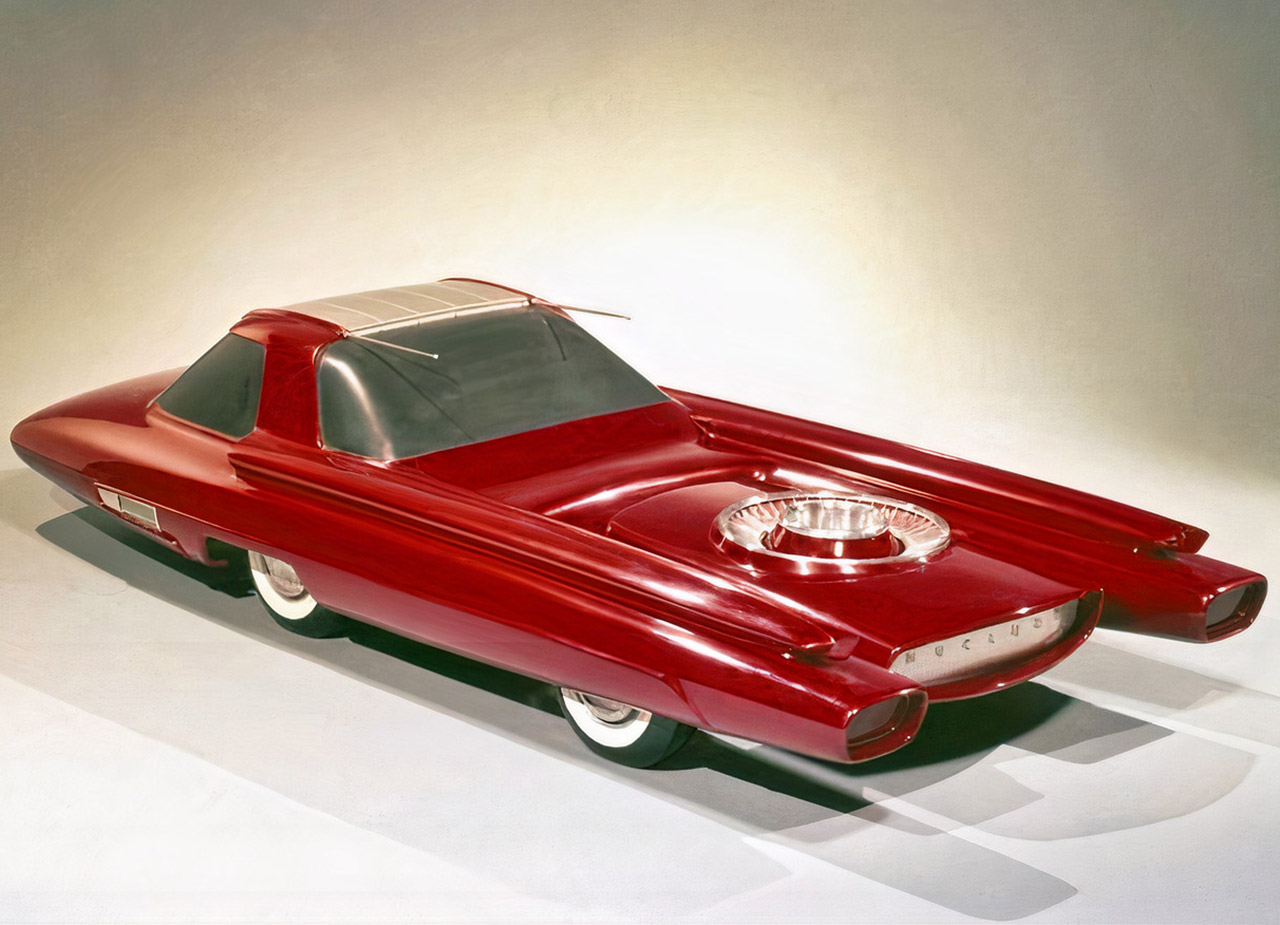
While is was fission not fusion - the Ford 'Nucleon' concept car from 1958.
It sounds great until Achmed decides he wants to blow up an entire city with it.
Posted on 12/20/2025 6:02:42 AM PST by MtnClimber
It was less than three years ago — early 2023 — that I was writing about the then-universal government and industry line that electric vehicles (EVs) would soon be taking over the American car market. In April 2022 the Biden Administration had adopted aggressive vehicle mileage standards intended to be achievable only through rapid transition to EVs. Our “climate leader” states, California and New York, had then adopted regulations in August and September 2022, respectively, mandating a phase-out of sales of combustion vehicles, to culminate in 2035, after which only EVs would be allowed. In a post in January 2023, I linked to the websites of Ford and GM, where they both touted their grand plans for rapid conversion of their companies to the manufacture of mostly or entirely EVs. At that time, Ford was claiming that it would “lead America’s shift to EVs,” and would achieve 50% of its sales in that category by 2030. GM bragged about its “path to an all-electric future” by 2035.
In a post on February 23, 2023, I expressed skepticism.
It seems like all the smart people have made up their minds that the future of automobiles belongs to electric vehicles. . . . So, are electric vehicles about to sweep the country and become the dominant form of transportation? I bet against it.
Here was my reasoning:
This is just a specific instance of the general principle that it is always wise to bet against central planning of the economy. EVs may be a successful niche product for a small number of wealthy consumers, but the idea that they will fully replace gasoline powered cars in short order is the dream of central planners, who think they can implement their dream by coercion. Central planning never works, and won’t work this time either.
The past few weeks have brought a lot of news on the EV front. The short version is that even I would not have predicted how quickly and completely the EV fantasy has collapsed.
The background, of course, is that the second Trump administration took prompt steps on re-entering office to end the huge federal support that had been propping up EV sales. The large tax credit for EV purchases was ended by the One Big Beautiful Bill Act, signed on July 4 and effective after September 30, 2025. On December 3, the administration announced the roll-back of the vehicle mileage standards known as “CAFE,” to levels at which combustion vehicles can comply.
The collapse of EV sales began immediately with the end of the tax credit. On October 31, trade publication Inside EVs reported on the first month’s results after the end of the credit:
Both J.D. Power and S&P Global Mobility estimate that October's EV market share plummeted to around 5% in the U.S., from a record high of over 12% in September. The battery-powered share of sales also dropped significantly on a year-over-year basis, from over 8% in October 2024. The last time EVs made up 5% of U.S. vehicle sales was in early 2022. According to S&P Global Mobility, some 64,000 new electric vehicles were sold in October. That's an epic drop from September, when Americans bought or leased nearly 150,000 EVs as they scrambled to cash in on the expiring $7,500 incentive.
The big automakers were quick to realize that they had to do a pivot. On December 15 the Wall Street Journal reported that Ford would take a massive charge of $19.5 billion to write down its EV investments:
Ford Motor said Monday it expected to take about $19.5 billion in charges, mainly tied to its electric-vehicle business, a massive hit as the automaker retrenches in the face of sinking EV demand. The sum is among the largest impairments taken by a company and marks the U.S. auto industry’s biggest reckoning to date that it can’t realize its electric-vehicle ambitions anytime soon.
The $19.5 billion is in addition to some $13 billion of operating losses that Ford has incurred over the past 3 years trying to compete in the EV business, even with the huge government subsidies:
Ford . . . has lost $13 billion on its EV business since 2023. . . .
Over at GM, the write-down is smaller, but the change of direction is no less stark. From NBC News, October 16:
On Tuesday, General Motors reported it was taking losses totaling $1.6 billion related to planned changes to its EV rollout. The company attributed some of the change to President Donald Trump’s elimination of the $7,500 in EV purchasing incentives enacted by President Joe Biden.
Nor is the collapse of EV sales limited to Ford and GM. From the NBC piece, as to Tesla:
Plunging sales at Tesla — still the U.S. leader in EV sales — are also contributing to the weakening outlook. Its second-quarter sales dropped almost 13%, and CEO Elon Musk has warned of some “rough quarters” ahead for the company.
And a comparable phenomenon is occurring in other countries, although under differing regulatory and policy regimes. From the Wall Street Journal, October 14:
The Rest of the World Is Following America’s Retreat on EVs. Canada, U.K. and European Union back off electric-vehicle targets as economic reality sets in and even China shows cracks. . . . Carmakers argue the EV business model is an unprofitable proposition given still-high battery costs, spotty car-charging networks and dwindling government subsidies. Incentive programs have ended or have been pared back across Europe and in the U.S. and Canada.
Let’s face it, this was always ill-conceived central planning, and it was never going to work. I went back to the links that I had included to the Ford and GM websites in my January 2022 post. Both links remain active, but the excited talk about leading the way to an all-EV future has been scrubbed from both. Instead, if you go there, you will find, in the case of GM, further links to follow if you want to buy yourself an EV; and in the case of Ford, general news about the company. Reality has returned.
Not sure you understood what I said but right now there is a massive discrepancy in day and night time electrical demand. EVs don’t displace any electrical demand.... they add to it because what they are displacing is hydrocarbon fuels.
If the concept of ICE being replaced by EVs is accepted as a reality, wouldn’t it make sense to structure things so that all charging is done essentially at night? If done during the day, the only way to do that is build out far more electrical generation and you still have the discrepancy between demand during the day and night.....
There were people right on this site who were peddling these electrical appliance cars. Now these people are losing billions on this fiasco. 🙂
I agree. Better to think of Tesla as an AI and robotics company with a car division.
Your daughter doesn't get "free" charging at her employers.
The cost of that charging is coming from a markup to customers, reduction in salaries for her and her coworkers, and taxpayers via subsidies. It is NOT free.
Unfortunately true. The aggravation, limited range, lack of public charging, etc. ARE NOT BUGS. THEY ARE FEATURES that the Democrats are counting on to limit our freedom of movement.
Where can I get an atomic transmission? Sounds awesome.
Now that was a great post. Informative and intelligent.
You shouldn't be on the road then. You're willing to risk others lives for your convenience.
EV base of support was high but not wide.
While is was fission not fusion - the Ford 'Nucleon' concept car from 1958.
It sounds great until Achmed decides he wants to blow up an entire city with it.
If our 2006 Buick Lucerne with V-8 were still made and available at the cost then plus inflation I would go out and buy one today without hesitation. It has more than I need on a car, things I still don’t use and I sure don’t need apps or a big screen or a navigation system to drive, I have done fine without any of that for nearly 60 years.
I do not need a refrigerator that entertains me, a coffee pot that can be turned on from my phone, an oven that can be operated by remote controls. None of that and it all contributes to unreliability and cost.
Gimmicks, who needs them? I sure don’t.
Too bad others that love gimmicks and don’t reason well are in the driver’s seat now.
If they insist in veering away from the IC the hybrid is the way to go.
Many farmers are seeking out 40 year-old tractors because they are reliable and you can work on them yourself. The new ones leave you stranded at critical times, which is when you use them. My older tractors are reliable, my new front end loader and excavator are packed with electronics and computer, I fear them.
https://www.electricchoice.com/electricity-prices-by-state/
are you sure you have your facts right on KWH cost?
My point is to not discredit you but your facts don't apply to every situation. If works for you I am fine with that if your facts are right. You analysis just looks a few datapoints. Throw in depreciation of your outdated technology and what is the cost?
And the rules and prices will be changing.
Appropriated technology is just that, appropriate for certain situations and people. Freedom to choose and responsibility with those freedoms. I'd like to see you pay your road tax.
My repeated issue is the one size fits all mandated by a centralized govt.
A point of reference, and I keep meticulous records of all cash costs, not including depreciation. MY 97 suburban is my cheapest operating vehicle at $.25 per mile. The dodge minivan is $.28. When I had a motorcycle years back, it cost me $.60 per mile (but more smiles per mile).
We were stopped at a gas station/restaurant in the middle of California - that has a very large parking lot with many spaces to charge EVs.
My son noticed that each and every chargers was broken - the nozzles were broken apart. Apparently there is something in there, like copper, that the thieves want.
My cousin, who has an EV, complains bitterly about broken chargers - or not enough and the wait can be hours.
EREV’s are the near term trend.
Long term, pure EV’s are inevitable but the batteries still have a way to go for 100% adoption, as-in decades.
“ My son noticed that each and every chargers was broken - the nozzles were broken apart.”
Any competent engineer should have known to put the charging cable ON the car. A receptacle at the charging station.
Theft problem eliminated.
Ford Oakville assembly has mothballed their EV production plans
They are going to assemble Ford F superduty
Kentucky and Avon Lake cannot keep up with demand
I understand Ford Essex engine will ramp up assemby of big beautiful V8 for all of those Superduties
I hope it is better than the 1972 Mazda RX-2, rotary engine that I had. The engine blew up at 44,000 miles.
One of my vehicles is a Ford F150 with the 5.0L V8 Coyote engine.
I’m sure they have dropped some. I wonder what the average drop has been?
“Plunging sales at Tesla.”
Left-wing jerks on X said that Trump was Elon’s puppet. Guess not.
I look forward to similar articles on wind turbines and solar panels.
Hybrid cars (regenerative breaking) makes some sense to me. I’ll leave that to the market, primarily buyers, to decide.
Disclaimer: Opinions posted on Free Republic are those of the individual posters and do not necessarily represent the opinion of Free Republic or its management. All materials posted herein are protected by copyright law and the exemption for fair use of copyrighted works.