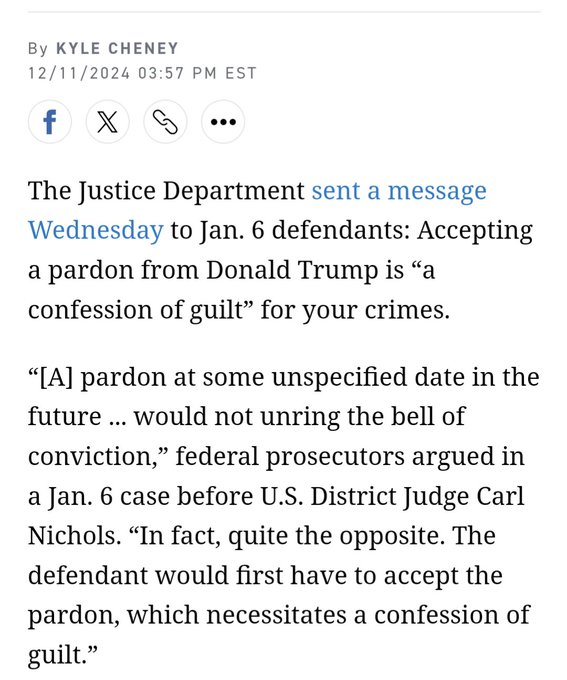
Posted on 01/20/2025 6:20:10 AM PST by Raycpa
The power of a presidential pardon would be nullified if they could not be in effect before convictions or even indictments. All the government prosecutor would need to do is pocket the charges or prosecution until after the presidents term.
Nixon got a preemptive pardon, end of story.
We've granted a President the power of pardons, never the ability to take a pardon away.
Preemptive presidential pardons have yet to be tested in court.
In view of Biden’s cognitive decline, Speaker Johnson’s statements, all circumstances around the pardons should be examined and possibly challenged.
I want to see the Hur tape.
Well the Brookings Insitute came out with a huge report that stated in late 1st term of Trump saying “preemptive pardons” are not legal and could be challenged and overturned. This report was written by a number of legal minds including several living SCOTUS retired justices and others.
They can crow about that, but the Nixon preemptive pardon has been the standard for over 40 years. R’s and D’s love presidential powers.
By taking away the Jury Box there will be only one “Box” left for redress of grievances.
I may be wrong here but wasn’t Nixon’s pardon related to the indictment inherent in the House vote to impeach, and/or Nixon having been named as an unindicted co-conspirator in the Watergate cases?
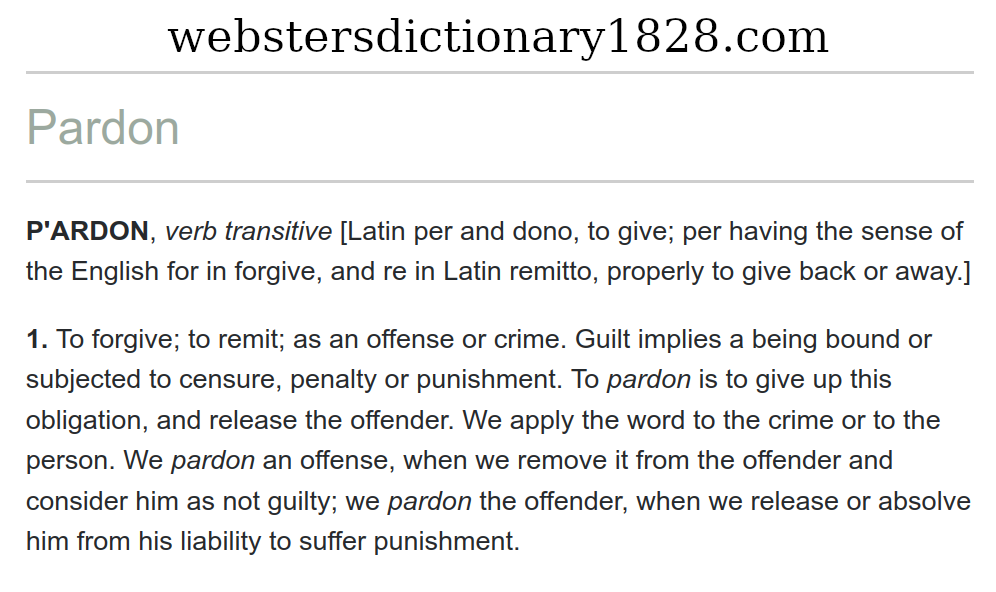
Welp, I sure messed up that formatting!
I beg your pardon, Friends.
Interesting. Kaylee McEnany just stated on Fox that the Trump administration legal team had studied it and deemed it to be legitimate.
Pardons are generally thought of as bomb proof.
That's probably wise, IMHO.
The power of a presidential pardon would be nullified if they could not be in effect before convictions or even indictments. All the government prosecutor would need to do is pocket the charges or prosecution until after the presidents term.
*********
The power to pardon is not nullified just because a different president would be deciding who to pardon, any more than the power to legislate is nullified if a fillibuster delays legislation until a new Congress takes over. The same limit to pardons would apply to both presdents.
The entire language in the Constitution pertaining to pardons is “he shall have Power to grant Reprieves and Pardons for Offences against the United States, except in Cases of Impeachment”.
So a President can issue pardons only for “Offences against the United States”, yet the Biden pardon states “The issuance of these pardons should not be mistaken as an acknowledgment that any individual engaged in any wrongdoing, nor should acceptance be misconstrued as an admission of guilt for any offense.”
So, in the absence of any offense (according to Biden) there are no “Offences against the United States” for which pardons can be granted.
In the US, no one has committed a crime (”Offence”) unless he or she has been convicted in court, or pleads guilty. So, the President has no authority under the Constitution to grant pardons when no “Offence” has been committed.
Section 8 and Amendment 5 of the Constitution both imply that the meanings of “offence” and “crime” are the same. The Fifth Amendment discusses “crimes” and “offenses” in its provision related to double jeopardy.
And yes, if the SCOTUS were to rule that no such pardon power exists, it would render the pardon of Richard Nixon illegal and invalid. But since Nixon and Gerald Ford are both dead, the issues is moot.
Agree. If our right as citizens to speak freely or bear arms can be limited, then so can the president’s pardon authority. Otherwise he may as well be King Joe.
Waiting for the legal scholars to weigh in on this.
Note the second paragraph.
Article II, Section 2, Clause 1:
The President shall be Commander in Chief of the Army and Navy of the United States, and of the Militia of the several States, when called into the actual Service of the United States; he may require the Opinion, in writing, of the principal Officer in each of the executive Departments, upon any Subject relating to the Duties of their respective Offices, and he shall have Power to grant Reprieves and Pardons for Offences against the United States, except in Cases of Impeachment.
The Constitution establishes the President’s authority to grant clemency, encompassing not only pardons of individuals but several other forms of relief from criminal punishment as well.1 The power, which has historical roots in early English law,2 has been recognized by the Supreme Court as quite broad. In the 1886 case Ex parte Garland, the Court referred to the President’s authority to pardon as unlimited except in cases of impeachment, extending to every offence known to the law and able to be exercised either before legal proceedings are taken, or during their pendency, or after conviction and judgment.3 Much later, the Court wrote that the broad power conferred in the Constitution gives the President plenary authority to ‘forgive’ [a] convicted person in part or entirely, to reduce a penalty in terms of a specified number of years, or to alter it with certain conditions.4
Despite the breadth of the President’s authority under the Pardon Clause, the Constitution’s text provides for at least two limits on the power: first, clemency may only be granted for Offenses against the United States,5 meaning that state criminal offenses and federal or state civil claims are not covered.6 Second, the President’s clemency authority cannot be used in Cases of impeachment.7
Beyond textual limits, certain external constitutional and legal considerations may act as constraints on the power. For instance, the Court has indicated that the power may be exercised at any time after [an offense’s] commission,8 reflecting that the President may not preemptively immunize future criminal conduct. In Schick v. Reed, the Court recognized that an exercise of clemency may include any condition which does not otherwise offend the Constitution,9 suggesting that the President may not make clemency subject to a condition that is prohibited by another constitutional provision.10 Other apparent limitations include not affecting vested rights of third parties, such as where forfeited property is sold,11 or proceeds paid into the treasury, which can only be secured to the former owner . . . through an act of [C]ongress.12 The Court in The Laura also alluded to an exception for fines . . . imposed by a co-ordinate department of the government for contempt of its authority,13 though a later case recognized that the President may pardon one who is subject to criminal punishment for contempt of court.14
Assuming the recognized limitations are not transgressed, a full pardon granted by the President and accepted by its subject15 prevents or removes any of the penalties and disabilities consequent upon conviction . . . .16 In several nineteenth-century cases, the Supreme Court suggested that a pardon broadly obviates all legal guilt of the offender, effectively erasing the crime from existence.17 Subsequent cases appear to have backed away from this understanding,18 suggesting instead that, although a full pardon precludes punishment for the offense in question, a prior and pardoned offense may still be considered in subsequent proceedings.19
Congress generally cannot substantively constrain the President’s pardon authority through legislation, as the Court has held that the power of the President is not subject to legislative control. Congress can neither limit the effect of his pardon, nor exclude from its exercise any class of offenders. The benign prerogative of mercy reposed in him cannot be fettered by any legislative restrictions.20 Nevertheless, there is historical precedent for legislation facilitating the exercise of the pardon power through funding of Executive Branch positions to review clemency petitions.21 Congress also has other constitutional tools that it may use in relation to the President’s pardon authority, provided the legal conditions associated with those tools are met, such as oversight,22 impeachment,23 and constitutional amendment.24
Constitution.congress.gov
former President Biden should be made to publicly confirm he made the pardons on an individual basis. at least 8,000 names should be on the “list” and if he can’t pick out his “lucky 4,000” then the whole list should be bogus and thrown out.
Those pardoned can invoke 5th amendment and refuse on that basis but if subsequently given transactional immunity they are compelled to testify. If they refuse to testify to Congress, it will expose them to contempt. If they lie during testimony, they can be charged with perjury.
Even if these criminals have immunity, we need to get to the truth and hopefully others will be exposed.
It’s the price you pay to get the truth from these government crooks.
Since a pardon can’t negate an impeachment action, the complete process toward an impeachment (for someone subject thereto) is legitimate, even for a pardoned person.
How can an incompetent person sign a legally binding document like a pardon?
Disclaimer: Opinions posted on Free Republic are those of the individual posters and do not necessarily represent the opinion of Free Republic or its management. All materials posted herein are protected by copyright law and the exemption for fair use of copyrighted works.